
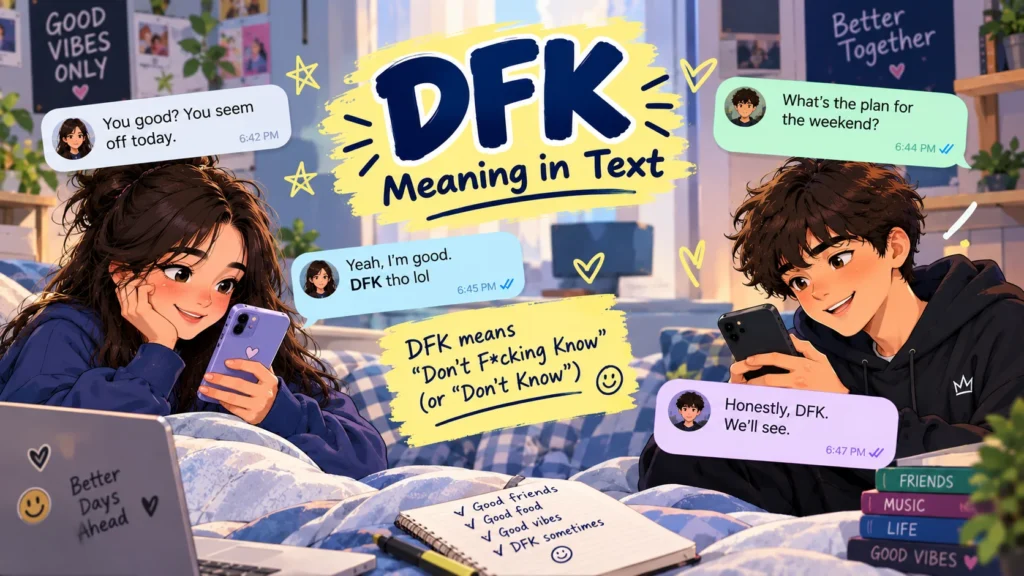
DFK in text messages usually means “Don’t Freaking Know” or, in some conversations, “Don’t F*ing Know.”** It is a casual way to say “I don’t know” while adding frustration, emphasis, or a slightly blunt tone.
The exact meaning depends heavily on the conversation. Someone might use DFK because they genuinely do not have an answer, while another person may use it to sound annoyed or impatient.
For example:
- “DFK what happened 😂” = “I don’t know what happened.”
- “DFK, ask Sarah.” = “I don’t know, ask Sarah.”
- “DFK why he left.” = “I have no idea why he left.”
Because the phrase can contain profanity when interpreted as “Don’t F***ing Know,” it is generally more appropriate for casual conversations than formal communication.
DFK Meaning – Quick Meaning
What Does DFK Stand For?
The most common interpretation is “Don’t Freaking Know.” The word “freaking” acts as a softened substitute for profanity.
Another interpretation is “Don’t F*ing Know,”** particularly among friends who regularly use stronger language.
In both cases, the basic message is:
“I don’t know.”
The difference is mainly tone. DFK can make a simple “I don’t know” sound more frustrated, dramatic, humorous, or dismissive.
Simple Examples
“DFK where my phone is.”
The person has no idea where their phone is.
“DFK 😂 maybe check the car.”
The speaker does not know but is responding casually.
“DFK, stop asking me.”
The expression sounds irritated and should not automatically be interpreted as friendly.
Origin & Background
DFK belongs to the broader world of internet abbreviations where people shorten phrases to type faster.
Unlike older abbreviations such as “LOL” or “BRB,” DFK is less universally standardized. Its meaning can change according to the community, conversation, and individual typing habits.
Why People Use DFK
The abbreviation is useful when someone wants to communicate uncertainty quickly without typing a complete sentence.
Instead of writing:
“I honestly have no idea what happened.”
Someone might simply type:
“DFK what happened.”
This makes the message shorter while also giving it more attitude.
Social Media Influence
Texting, Discord, Instagram, TikTok comments, gaming chats, and group conversations have helped informal abbreviations spread quickly.
People often combine abbreviations with emojis, lowercase typing, repeated punctuation, or slang to communicate emotion.
For example:
“dfk 😭”
can feel much more casual than:
“I don’t know.”
The meaning stays similar, but the emotional presentation changes.
Read More : ARD Meaning in Text: What Does ARD Mean?
Real-Life Conversations
WhatsApp Conversation
Person A:
“Do you know where Mike went?”
Person B:
“DFK 😭 he just left.”
and,
Person A:
“Did he say anything?”
Person B:
“Nope.”
Here, DFK simply means the person does not know.
Instagram DM
Person A:
“Why did she unfollow me?”
Person B:
“DFK honestly.”
and,
Person A:
“Maybe I said something?”
Person B:
“Could be, but I wouldn’t overthink it.”
In this example, DFK makes the response sound casual and conversational.
TikTok Comments
Person A:
“DFK why this video has me crying 😂”
Person B:
“Same 😭”
Here, the abbreviation is playful rather than angry.
Text Message
Person A:
“What time are we leaving?”
and,
Person B:
“DFK, ask Jake.”
moreover,
Person A:
“Okay lol.”
This use is straightforward and slightly dismissive.
Emotional & Psychological Meaning
DFK does more than communicate uncertainty. It can also reveal how the speaker feels about not knowing.
A plain “I don’t know” can sound neutral. DFK may suggest frustration, confusion, impatience, humor, or emotional exhaustion.
DFK Can Show Frustration
Consider:
“DFK why he keeps doing that.”
The person is not necessarily angry at the person receiving the message. They may simply be frustrated with the situation.
DFK Can Sound Playful
Friends may use DFK jokingly:
“DFK bro 😂 you tell me.”
The emoji and surrounding language soften the abbreviation.
A Small Real-Life Scenario
Imagine a friend asking you why your mutual friend suddenly changed plans. You genuinely have no idea, so you reply, “DFK 😭 he didn’t tell me anything.”
The abbreviation makes your uncertainty feel more natural than a formal “I do not know.”
Usage in Different Contexts
Social Media
DFK can appear in comments, DMs, captions, and private messages.
It works particularly well when the conversation is informal and the people already understand each other’s communication style.
Friends and Relationships
Among close friends, DFK may communicate uncertainty without sounding overly serious.
For example:
“DFK babe, maybe ask him.”
However, tone matters. If the other person is discussing something emotional, DFK may sound dismissive.
Work and Professional Settings
DFK is generally not recommended for professional emails, business messages, academic communication, or formal customer conversations.
Instead of:
“DFK when the report is due.”
Use:
“I’m not sure when the report is due.”
The second version is clearer and more professional.
Casual vs. Serious Tone
| Context | DFK Appropriate? |
|---|---|
| Close friends | Usually |
| Group chats | Usually |
| Gaming chat | Often |
| Instagram DMs | Often |
| TikTok comments | Sometimes |
| Professional email | No |
| Academic writing | No |
| Customer support | No |
When NOT to Use DFK
Formal Conversations
Avoid DFK when speaking with a manager, teacher, client, interviewer, or unfamiliar professional contact.
The abbreviation may appear careless or overly informal.
Sensitive Conversations
If someone is talking about a breakup, family problem, grief, or another serious issue, DFK can sound cold.
For example:
“Why is my dad in the hospital?”
Responding:
“DFK.”
could come across as uncaring, even if you genuinely do not know.
A more considerate response would be:
“I honestly don’t know, but I’ll try to find out.”
When the Meaning Could Be Confusing
Because DFK is not one of the most universally recognized abbreviations, some people may not know what it means.
When communicating with someone unfamiliar with texting slang, writing “I don’t know” is safer.
Common Misunderstandings
DFK Does Not Always Mean Anger
Some people assume DFK automatically means the sender is angry.
That is not necessarily true.
A message such as:
“dfk 😂”
may simply be humorous.
It Can Contain Profanity
Depending on the sender, DFK may represent “Don’t F*ing Know.”**
The softened interpretation, “Don’t Freaking Know,” is also common.
Therefore, the surrounding conversation is important.
Capitalization Does Not Change the Core Meaning
You may see:
- DFK
- dfk
- Dfk
These generally communicate the same basic idea.
Lowercase typing often feels more relaxed, while uppercase can sometimes add emphasis.
DFK Compared With Similar Expressions
| Expression | Meaning | Typical Tone |
|---|---|---|
| DFK | Don’t Freaking/F***ing Know | Casual, emphatic |
| IDK | I Don’t Know | Neutral, casual |
| IDC | I Don’t Care | Dismissive |
| IMO | In My Opinion | Conversational |
| NGL | Not Gonna Lie | Honest/casual |
| WTF | What The F*** | Shock or frustration |
| Dunno | Don’t Know | Very casual |
| No idea | I have no idea | Casual, clear |
Key Insight
DFK and IDK both communicate uncertainty, but DFK usually carries more attitude. If you only want to say that you don’t know something, IDK or “I don’t know” is usually more neutral.
Variations and Types of DFK
1. DFK
The basic abbreviation.
It can mean “Don’t Freaking Know” or “Don’t F***ing Know.”
2. dfk
The lowercase version feels relaxed and informal.
It is especially common in casual texting.
3. DFK?
Adding a question mark can express confusion or disbelief.
For example:
“DFK? Why are you asking me?”
4. DFK lol
Adding “lol” makes the expression sound lighter.
“DFK lol, you were there too.”
5. DFK 😂
An emoji can make the phrase playful rather than irritated.
6. DFK tbh
“TBH” means “to be honest.”
Together, the phrase emphasizes genuine uncertainty.
7. DFK honestly
This combination reinforces that the person truly does not have an answer.
8. DFK bro
Adding “bro” gives the message a strongly conversational feel.
9. DFK rn
“RN” means “right now.”
The phrase suggests the person doesn’t know at the moment.
10. DFK man
This can sound frustrated or resigned, depending on the conversation.
How to Respond When Someone Uses DFK
Casual Replies
You can simply answer:
“Fair 😂”
or:
“Same lol.”
These work well with friends.
Funny Replies
Try something playful:
“Bro has officially entered mystery mode 😂”
or:
“Guess we’re both clueless 😭”
Mature Replies
If the topic is important:
“No worries. I’ll check and find out.”
This keeps the conversation constructive.
Respectful Replies
If someone seems frustrated:
“That’s okay. Let me know if you find out.”
A calm response can prevent a casual abbreviation from turning into unnecessary tension.
Regional & Cultural Usage
DFK is primarily an English-language internet abbreviation, so its meaning is most consistent among people familiar with English texting slang.
Western Culture
In the United States, Canada, the United Kingdom, Australia, and similar English-speaking online communities, DFK may be understood as a casual version of “I don’t know.”
The profanity-based interpretation depends on the speaker.
Asian Culture
English internet slang is widely used across many Asian social media communities.
However, not everyone will interpret DFK in exactly the same way. Some users may recognize IDK but not DFK.
Middle Eastern Culture
English abbreviations are also common in online conversations, especially among users who communicate across languages.
Still, the abbreviation may be unfamiliar to people who mainly use English for formal rather than casual communication.
Global Internet Usage
Internet slang crosses national boundaries quickly.
Gaming communities, social media platforms, fandoms, and messaging apps can introduce users to abbreviations they would not normally encounter in everyday speech.
Generational Differences
Gen Z users may be more comfortable experimenting with abbreviations, emojis, and compressed expressions.
Millennials also use texting slang, although individual preferences vary greatly.
The important point is that age alone does not determine whether someone will understand DFK. Online community and personal texting habits matter too.
Is DFK Safe for Kids?
DFK is not inherently dangerous, but children and younger users should understand its context.
The main consideration is that DFK can represent a profane expression, depending on how the sender interprets the abbreviation.
For younger users, it can be useful to explain that online abbreviations can have multiple meanings and that slang appropriate for friends may not be appropriate at school or in formal communication.
Parents and educators can focus on context, tone, and audience rather than treating every abbreviation as having one fixed meaning.
FAQs
What does DFK mean in text?
DFK commonly means “Don’t Freaking Know” or “Don’t F*ing Know.”** It is a casual way to say “I don’t know” with extra emphasis.
Is DFK a bad word?
DFK itself is an abbreviation, but it can represent a phrase containing profanity. The intended meaning depends on the sender and conversation.
What does DFK mean from a girl?
If a girl texts “DFK,” it generally means she doesn’t know something. The abbreviation alone does not indicate a particular romantic or emotional meaning.
What does DFK mean from a guy?
From a guy, DFK usually has the same basic meaning: “I don’t know.” His tone may be casual, frustrated, humorous, or dismissive depending on the context.
Is DFK the same as IDK?
They are similar because both communicate uncertainty. However, DFK often sounds more emphatic or frustrated, while IDK is more neutral.
Can I use DFK at work?
It is better to avoid DFK in formal workplace communication. Use “I’m not sure,” “I don’t know,” or “I don’t have that information” instead.
Why do people use DFK instead of saying “I don’t know”?
People use DFK because it is short, informal, and can communicate extra emotion. It can also fit naturally into fast-paced texting and social media conversations.
Conclusion
DFK meaning in text is generally connected to “Don’t Freaking Know” or “Don’t F*ing Know.”** At its simplest, it means “I don’t know,” but the abbreviation can add frustration, humor, emphasis, or casual attitude.
The most important clue is the surrounding conversation.
A message like “dfk 😂” may be playful, while “DFK, stop asking” may sound irritated. The same abbreviation can therefore feel very different depending on punctuation, emojis, relationship, and topic.
If you’re chatting with close friends, DFK can fit naturally into an informal conversation. For professional, academic, or sensitive situations, a clearer phrase such as “I’m not sure” is usually more appropriate.
Understanding slang is not just about memorizing abbreviations. It is about recognizing the tone and relationship behind the words.



1 thought on “DFK Meaning in Text: What Does DFK Mean?”