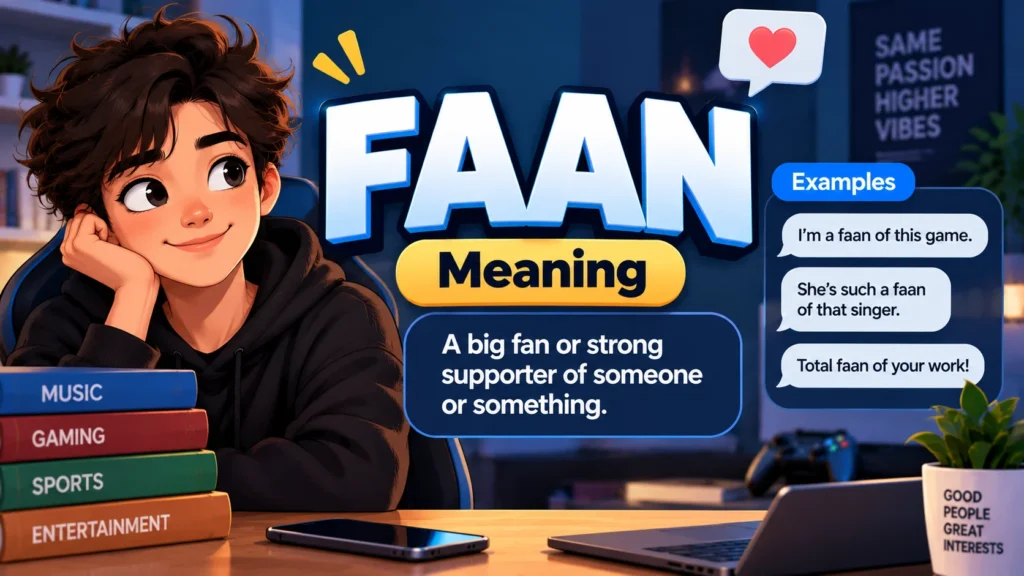
If you recently came across the word “faan,” you may have assumed it was simply a misspelling of fan. Surprisingly, it has a real history of its own.
In older science-fiction fandom, faan means a “fan of fandom”—someone who is especially interested in fan culture, fan communities, fanzines, conventions, personalities, and the activities surrounding a fandom, sometimes even more than the original books, films, or stories themselves. The term is considered dated and has sometimes carried a teasing or negative tone.
The situation becomes more confusing when the word appears in capital letters. FAAN can be an acronym with completely unrelated meanings, including the Federal Airports Authority of Nigeria and professional fellowship titles.
So, does faan mean fan? Is it modern slang? Is FAAN an airport organization?
The answer depends entirely on context.
This guide explains the real faan meaning, its fascinating fandom history, modern uses, emotional tone, related words, and the major FAAN acronym meanings you may encounter online.
Faan Meaning – Quick Meaning
The traditional slang meaning of faan is:
A fan who is especially interested in fandom itself.
In other words, a regular fan may love a science-fiction story, while a faan may be fascinated by the community built around it—the conventions, fanzines, fan debates, history, friendships, jokes, and personalities.
Fanlore describes the older term as meaning “fan of fandom.” Wiktionary similarly identifies it as dated fandom slang for a person more interested in fandom than its original subject.
A few quick examples make the difference clearer:
“He knows more about old conventions than the novels. Total faan.”
Here, the speaker means someone deeply involved in fandom culture.
“The faans spent the evening discussing fanzine history.”
Again, the focus is the community rather than the fictional universe itself.
“FAAN announced changes at the airport.”
This is completely different. Capitalized FAAN here most likely refers to an organization, not fandom slang.
That capitalization clue can save you a lot of confusion.
Origin and Background of Faan
A Word Born Inside Science-Fiction Fandom
Faan belongs to a rich collection of vocabulary created by early science-fiction fans.
Long before TikTok fandoms, Discord servers, or Reddit communities existed, science-fiction enthusiasts communicated through conventions, clubs, letters, and amateur publications known as fanzines.
These communities gradually developed their own language.
One of those expressions was faan.
Historical fandom references explain it as someone intensely interested in fan culture itself—a person who follows what fans are writing, doing, debating, publishing, and organizing.
Was Faan Originally an Insult?
Sometimes.
Older descriptions could be teasing or mildly derogatory. A faan might be portrayed as someone so obsessed with fandom politics and gossip that the original science fiction had almost become secondary.
File 770 notes that the word was originally capable of functioning as a put-down, implying an exaggerated level of “fannishness.”
Over time, however, communities can reclaim playful labels.
What sounds insulting from an outsider may become an inside joke or even a badge of identity among the people using it.
Social Media Didn’t Create Faan
This is important for modern readers.
Unlike terms such as “rizz,” “delulu,” or “FR,” faan is not new Gen Z slang.
Its roots lie in much older science-fiction fandom.
Social media can introduce younger users to the term today, particularly through discussions of fandom history, but the word existed long before modern social platforms.
Real-Life Conversations Using Faan
Because faan is niche, realistic examples help show when it actually makes sense.
WhatsApp Conversation
Person A: Have you finished the new sci-fi novel yet?
Person B: Not even halfway 😭
and,
Person A: But you’ve already read three articles about the convention drama?
Person B: Okay, maybe I’m more of a faan than a fan 😂
Here, the speaker jokingly admits being more interested in fandom culture than the original story.
Instagram DM
Person A: Why do you collect all those old fanzines?
Person B: I love seeing how fandom worked before social media.
and,
Person A: You’re basically a fandom historian.
Person B: Certified faan behavior 😂
The word is being used affectionately and self-consciously rather than as an insult.
TikTok Comments
User A: Imagine caring more about 1980s convention gossip than the actual movie franchise.
and,
User B: Old-school fandom literally had a word for that: faan.
moreoever,
User C: Wait, that’s actually interesting.
In this example, the term is being introduced as a piece of fandom history.
Text Message
Person A: FAAN is trending because of an airport announcement.
Person B: Faan as in fandom?
and,
Person A: Nope. Federal Airports Authority of Nigeria.
Person B: Completely different then 😭
This conversation demonstrates why capitalization and surrounding words matter.
Emotional and Psychological Meaning of Faan
At first glance, faan seems like a simple label. Psychologically, however, it represents something important about communities: sometimes people become attached not only to an interest, but to the social world surrounding that interest.
Think about modern fandom.
Someone may begin by loving a television series. Eventually, their closest friendships come from the fan community. They attend conventions, make memes, follow creators, discuss fandom history, participate in group chats, and remember famous community controversies.
At that point, belonging may become as important as the show itself.
That is essentially the emotional idea behind faan.
Why People Become Fans of Fandom
Communities provide:
- Belonging
- Shared identity
- Friendship
- Inside jokes
- Recognition
- Creative expression
- Shared history
A person may therefore stay active in a fandom even after their interest in the original subject becomes weaker.
Imagine attending a convention because you love a particular author. Years later, the author is no longer your main reason for attending.
You return because your friends are there.
The relationships have become the real attraction.
That is the kind of experience the old word faan captures surprisingly well.
Faan Usage in Different Contexts
Social Media
Lowercase faan is uncommon in ordinary modern social-media conversation.
When it appears, it is often connected with fandom history, science-fiction communities, fanzines, or someone deliberately using old-school fan vocabulary.
Do not automatically treat it as a trendy TikTok abbreviation.
Friends and Fandom Communities
Among people who know the history, faan can be playful.
Calling someone a faan might mean:
“You’re obsessed with fandom culture itself.”
Whether that sounds affectionate or critical depends on the relationship.
Professional and Aviation Contexts
Uppercase FAAN frequently has nothing to do with slang.
In Nigeria, FAAN officially stands for the Federal Airports Authority of Nigeria, the public organization responsible for managing commercial airports and related airport services.
If a news headline mentions:
“FAAN airport operations”
the meaning is institutional, not conversational.
Academic and Healthcare Contexts
FAAN can also appear after a person’s name as a professional fellowship designation.
Acronym references list both Fellow of the American Academy of Nursing and Fellow of the American Academy of Neurology among established expansions.
The person’s profession normally tells you which meaning applies.
Casual vs. Serious Tone
Lowercase faan usually carries historical, playful, or niche fandom energy.
Uppercase FAAN should be treated more carefully because it may represent an official institution or professional credential.
When NOT to Use Faan
Avoid using faan as though everyone knows what it means.
Most modern English speakers are much more familiar with fan than faan.
If you write:
“She is a faan.”
many readers will simply assume you made a spelling mistake.
When writing for a general audience, introduce the term first:
“In older science-fiction fandom, a ‘faan’ was a fan particularly interested in fandom itself.”
After that, you can use it naturally.
You should also avoid using the old negative sense toward someone unless the context is friendly. Calling a person overly obsessed with fandom politics could sound dismissive.
Finally, never change an official FAAN acronym into lowercase faan when discussing an organization or professional title. Capitalization helps readers distinguish between meanings.
Common Misunderstandings About Faan
“Faan Is Just a Misspelling of Fan”
Not always.
People certainly can mistype fan as faan, but faan also has a documented history as science-fiction fandom slang.
“Faan Is New Internet Slang”
No.
It predates contemporary social-media slang by decades.
Its presence online today does not make it newly invented.
“Faan Means a Superfan”
That explanation is close, but incomplete.
A superfan usually means someone extremely enthusiastic about a particular celebrity, team, franchise, or subject.
A faan is more specifically interested in fandom itself—the people, culture, publications, history, and community surrounding the interest.
“FAAN Always Means the Same Thing”
Definitely not.
Capitalized FAAN has several institutional and professional expansions.
Context is essential.
“Faan Is Always Insulting”
Not necessarily.
Historically, it could be derogatory or teasing, but fan communities have also used the concept humorously and positively.
Tone determines whether it feels like criticism or affectionate self-description.
Faan Compared With Similar Words and Acronyms
| Term | Meaning | Typical Context | Tone |
|---|---|---|---|
| Faan | Fan of fandom | Science-fiction fandom | Historical / playful |
| Fan | Enthusiastic supporter | General culture | Neutral |
| Superfan | Extremely devoted fan | Sports / entertainment | Positive |
| Fandom | Community of fans | Internet / pop culture | Neutral |
| Fannish | Related to fan culture | Fandom | Playful / descriptive |
| Sercon | Serious and constructive | Older fandom | Analytical |
| Neofan | New fan | Older fandom | Descriptive |
| Fanzine | Fan-created publication | Fandom history | Neutral |
| FAAN | Federal Airports Authority of Nigeria | Aviation | Formal |
| FAAN | Professional fellowship abbreviation | Healthcare | Formal |
Key Insight
A fan focuses primarily on the subject they love. A faan, in its historical sense, is fascinated by the social culture of being a fan. That small distinction is what makes the old term unique.
10 Faan Variations, Types, and Related Meanings
1. Faan
Meaning: A fan of fandom.
The classic fandom term describes someone especially interested in fan culture, history, people, publications, and activities.
2. Faaan
Meaning: An exaggerated spelling of faan.
Older fandom sources record forms with additional “a” letters, often emphasizing excessive fannishness or adding comic effect.
3. Faanish
Meaning: Strongly associated with playful fandom culture.
It can describe behavior, writing, humor, or activities centered on fandom itself.
4. Faanish Fandom
Meaning: A fandom community particularly interested in its own fan culture.
Fancyclopedia describes this as fandom focused on fan activity itself rather than solely studying or promoting science fiction.
5. Faan Fiction
Meaning: Fiction involving fans or fandom culture.
Historically, it refers to fan-created stories centered on real or imagined members of fandom rather than fictional characters from mainstream works.
6. FAAn Awards
Meaning: Fan(zine) Activity Achievement Awards.
These awards recognize achievements connected with science-fiction fanzines and fan activity. The awards were introduced in the 1970s and later revived in association with Corflu.
7. Fan
Meaning: Someone enthusiastic about a person, subject, team, work, or hobby.
This is the ordinary modern word and should not automatically be replaced with faan.
8. Neofan
Meaning: A newcomer to fandom.
This older fandom term contrasts an inexperienced newcomer with people deeply embedded in fan culture.
9. FAAN – Federal Airports Authority of Nigeria
Meaning: Nigeria’s federal airport authority.
The organization states that it manages commercial airports and supports safe and efficient movement of passengers and goods.
10. FAAN – Professional Fellowship
Meaning: A post-nominal professional designation.
Depending on the person’s field, FAAN may identify fellowship in a major nursing or neurology academy. This meaning is entirely unrelated to fandom slang.
How to Respond When Someone Uses Faan
Your response depends on the context.
Casual Replies
If someone jokingly calls themselves a faan:
- “You really do know all the fandom history 😂”
- “Okay, certified faan.”
- “You’re here for the community more than the story.”
- “That actually describes you perfectly.”
Funny Replies
With close friends:
- “Fan of the fans? That’s next-level 😂”
- “You’ve unlocked fandom inside fandom.”
- “You study the fandom like it’s history class.”
- “The lore isn’t enough—you need fandom lore too.”
Mature Replies
If you genuinely do not know what they mean:
- “Do you mean ‘faan’ as the old fandom term?”
- “Are you talking about fandom or the FAAN organization?”
- “What does FAAN stand for in this context?”
Respectful Replies
When professional titles or institutions are involved, clarification is better than guessing:
“Could you clarify which FAAN you mean?”
That simple question prevents you from confusing a fandom term with an airport authority or professional credential.
Regional and Cultural Usage of Faan
Western Culture
The historical faan meaning developed within English-speaking science-fiction fandom and is most recognizable among people interested in older fan history, fanzines, and conventions.
It remains niche rather than mainstream everyday slang.
Asian Culture
The English fandom term can certainly appear in Asian fan communities, especially among people studying global fandom history.
However, modern Asian fandoms have their own rich vocabularies, and there is no reason to assume faan has the same familiarity everywhere.
Middle Eastern Culture
Likewise, faan is not a standard everyday English slang term across Middle Eastern digital culture.
Someone encountering it without science-fiction context may reasonably think it is a typo for fan.
Nigerian Context
Uppercase FAAN is particularly recognizable in Nigeria because it refers to the Federal Airports Authority of Nigeria.
The organization says its modern name dates from the 1995 restructuring of the former Nigeria Airports Authority.
Global Internet Usage
Online communities make old vocabulary searchable again.
A forgotten fandom term can suddenly appear in a Reddit discussion, archived fanzine, wiki, TikTok history video, or fandom essay and reach an entirely new generation.
Gen Z vs. Millennials
Neither Gen Z nor Millennials invented faan.
Younger users encountering it today are more likely to meet it as historical fandom vocabulary, while people active in long-running science-fiction communities may recognize its older cultural associations.
Is Faan Safe for Kids?
Yes. Faan itself is completely harmless.
Its traditional meaning relates to fandom and fan culture. There is no inherent profanity, sexual meaning, or offensive content attached to the word.
A child interested in science fiction, conventions, or fandom history could encounter the term without concern.
The only caution is ordinary online safety.
Fan communities can contain people of many ages and backgrounds, so children should still follow sensible rules about privacy, direct messages, personal information, and interactions with strangers.
The word is safe; the surrounding online environment should always be considered separately.
FAQs About Faan Meaning
What does faan mean in slang?
Faan is an older science-fiction fandom term meaning a “fan of fandom”—someone strongly interested in fan culture, community, history, fanzines, and fan activity itself.
Is faan the same as fan?
No. A fan primarily follows a subject, person, team, franchise, or work. Historically, a faan is specifically interested in the culture and activities of fandom itself.
Is faan modern TikTok slang?
No. Faan is much older than TikTok and modern social media. It comes from earlier science-fiction fandom culture.
What does FAAN stand for in Nigeria?
FAAN stands for Federal Airports Authority of Nigeria, the public organization responsible for managing commercial airports and related services in Nigeria.
What does FAAN mean after someone’s name?
FAAN can be a professional fellowship designation. Depending on the person’s profession, it may refer to fellowship connected with the American Academy of Nursing or American Academy of Neurology.
Is faan an insult?
It can have a teasing or historically derogatory tone, especially when implying someone cares too much about fandom politics or culture. However, it can also be used humorously or proudly within fandom communities.
How do you know which FAAN meaning is correct?
Look at context and capitalization. Fanzines, conventions, and fan history suggest the slang meaning. Airports suggest the Nigerian authority, while professional credentials after a person’s name suggest a fellowship designation.
Conclusion
The faan meaning is far more interesting than a simple spelling mistake.
In older science-fiction culture, a faan is essentially a fan of fandom—someone fascinated by the community, personalities, fanzines, conventions, history, jokes, and social activity that grow around a shared interest.
That idea still feels surprisingly modern.
Today’s fans may spend hours discussing fandom drama, attending conventions, creating memes, following community creators, and building friendships even after their enthusiasm for the original show, book, or franchise begins to fade.
They may never use the old word faan, but they can easily recognize the experience it describes.
At the same time, capitalization completely changes the search.
FAAN can refer to Nigeria’s Federal Airports Authority or appear as a professional fellowship designation, among other specialized meanings.
So when you see “faan” or “FAAN,” don’t assume it is just another internet typo.
Check the conversation.
If people are discussing fanzines and fandom history, you have probably discovered a fascinating piece of old fan slang. If they’re discussing airports, nursing, neurology, or official organizations, you’re dealing with an acronym instead.