
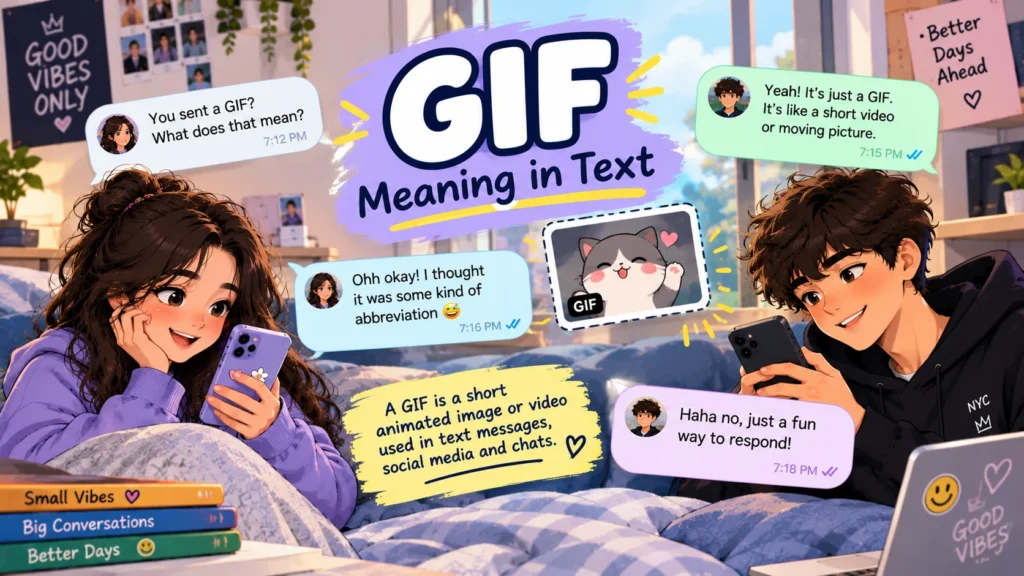
If someone sends you a short looping animation instead of a sentence, you have probably received a GIF. But what does GIF mean in text, and why has this simple format become such a major part of online communication?
GIF stands for Graphics Interchange Format. In everyday texting, however, people usually use the word “GIF” to describe a short animated image that communicates a reaction, emotion, joke, or idea.
A GIF can say “I’m laughing,” “I’m shocked,” “I agree,” or even “I have no words” without requiring a long explanation.
People search for the meaning of GIF because the term appears everywhere: WhatsApp, Instagram, Facebook, TikTok, Messenger, Discord, X, and other messaging platforms.
The interesting part is that a GIF is not always about its literal content. Its real meaning often comes from the emotion behind the animation and the situation in which it is sent.
GIF Meaning in Text – Quick Meaning
In texting, GIF usually means a short animated image used to express an emotion, reaction, joke, or response.
The original expansion is:
- G = Graphics
- I = Interchange
- F = Format
A GIF may contain a few seconds of animation that repeats continuously.
For example:
“That GIF has me crying 😂”
This means the person found the animated reaction extremely funny.
“Send me a GIF for how you feel.”
The person is asking for an animated image that represents their current mood.
“I literally have no words. sends shocked GIF”
Here, the GIF replaces a written response.
The meaning of a GIF therefore depends heavily on context, emotion, and the specific animation being shared.
Origin & Background of GIFs
The GIF format was developed by CompuServe in 1987 as a way to display images efficiently on computers and online services.
At first, GIFs were primarily associated with still images and simple graphics. Animated GIFs became especially popular as internet users discovered that several frames could be combined to create a short looping animation.
Early internet culture helped GIFs become recognizable. Websites, forums, blogs, and online communities used them for everything from decorative animations to humorous reactions.
Social media later transformed their role.
Instead of simply decorating a webpage, GIFs became a language of reaction. A person could select a scene from a movie, television show, interview, or viral video and use it to communicate an emotion.
Messaging platforms made the process even easier by adding searchable GIF libraries.
Someone no longer needed to create or upload an animation manually. They could type words such as “laughing,” “confused,” “excited,” or “awkward” and instantly find an appropriate reaction.
That shift changed GIFs from a technical image format into an important part of internet communication.
Real-Life Conversations Using GIFs
WhatsApp Conversation
Person A:
“I told my manager I forgot the deadline.”
Person B:
“WHAT 😭”
and,
Person A:
“I know. I need a miracle.”
Person B:
sends a dramatic reaction GIF
The GIF adds humor to an otherwise stressful situation.
Instagram DM
Person A:
“Did you see his outfit?”
Person B:
“YES 😂”
moreover,
Person A:
“I wasn’t prepared for that.”
Person B:
sends laughing GIF
The animation reinforces the shared amusement without requiring another sentence.
TikTok Comments
Person A:
“This transition took me out 😭”
and,
Person B:
“Same.”
moreover,
Person C:
sends a shocked GIF
The GIF works almost like a visual comment.
Text Message
Person A:
“I finally finished my exams!”
and,
Person B:
“LET’S GOOOOO”
moreover,
Person A:
sends celebration GIF
The animation communicates excitement more vividly than a plain “yay.”
Read More : LGHT Meaning in Text: What Does LGHT Mean?
Emotional & Psychological Meaning of GIFs
GIFs are powerful because human communication is not only about words.
When people speak face-to-face, they communicate through facial expressions, gestures, tone, pauses, and body language. Text messages remove many of those signals.
A GIF can partially fill that gap.
A laughing GIF can make a sentence feel playful. A dramatic reaction can show surprise. A comforting animation can make a supportive message feel warmer.
This is one reason people often choose a GIF when a plain sentence feels emotionally incomplete.
Imagine receiving:
“I can’t believe you actually did that.”
That could be admiration, anger, surprise, or humor.
Add a playful GIF, and the intended tone becomes much clearer.
From a communication perspective, GIFs often act as emotional punctuation.
A short animation can soften criticism, strengthen excitement, create humor, or show agreement.
I have also seen this happen in everyday group chats: someone sends a reaction GIF after a friend makes an unexpectedly funny comment, and suddenly everyone understands the mood without needing a long conversation.
Usage in Different Contexts
GIFs on Social Media
GIFs are common in comments, stories, direct messages, and posts.
People use them to react to celebrity moments, viral trends, memes, sports events, awkward situations, and everyday humor.
A reaction GIF can sometimes attract more attention than a simple text comment.
GIFs Between Friends
Friends often use GIFs casually.
A close friend might send a dramatic reaction after hearing surprising news or use a funny character GIF to tease someone.
The relationship matters because the same GIF can feel funny among friends but inappropriate in another setting.
GIFs in Romantic Conversations
GIFs can also appear in flirting, affection, teasing, or playful conversations.
Someone might send a smiling, blushing, waving, or heart-themed GIF to communicate warmth.
The animation does not necessarily mean something deeply romantic. Context and the relationship between the people matter.
GIFs at Work
GIFs can be acceptable in professional communication when the workplace culture is informal.
A simple celebratory GIF in a team chat might work well after completing a project.
A sarcastic, suggestive, or overly personal GIF is much riskier.
When communicating with clients, senior managers, or unfamiliar colleagues, plain language is usually easier to interpret.
Casual vs. Serious Communication
GIFs work particularly well when the conversation is lighthearted.
They can be less appropriate when discussing serious subjects such as conflict, grief, sensitive personal matters, or professional complaints.
A humorous GIF can unintentionally make someone feel that their concern is being dismissed.
When NOT to Use a GIF
A GIF is not automatically appropriate just because it is funny.
Serious Conversations
If someone is discussing a major personal problem, responding with a comedy GIF may appear insensitive.
A sincere sentence is usually better.
Professional Complaints
Avoid using sarcastic reaction GIFs when dealing with customers, supervisors, or formal complaints.
Written communication can already be difficult to interpret. Adding sarcasm through animation can create unnecessary confusion.
Sensitive Cultural Situations
A gesture, facial expression, celebrity, or joke that seems harmless to one person may carry a different meaning for another audience.
When communicating across cultures, choose reactions carefully.
When Tone Is Unclear
If you are unsure how someone will interpret your GIF, consider adding a short sentence.
For example:
“I mean this in a joking way 😂”
That small clarification can prevent unnecessary misunderstanding.
Common Misunderstandings About GIF Meaning
GIF Does Not Mean Only “Funny Image”
GIFs can be funny, but they can also express sadness, excitement, anger, confusion, affection, congratulations, or surprise.
The format itself is neutral.
A GIF Does Not Have One Fixed Meaning
A GIF showing someone clapping could mean genuine congratulations, sarcasm, or playful approval.
The surrounding conversation determines the intended meaning.
GIF and Meme Are Not Exactly the Same
A GIF is an image format, while a meme is a broader form of cultural or humorous content.
A GIF can become a meme, but not every GIF is a meme.
GIF Is Not Always an Acronym for a Texting Phrase
Unlike terms such as LOL or BRB, GIF is not primarily a texting abbreviation.
It is the name of an image format that became deeply integrated into digital communication.
GIF vs. Similar Internet Expressions
| Term | Meaning | Common Use |
|---|---|---|
| GIF | Graphics Interchange Format | Animated reactions and visual responses |
| Meme | Shareable cultural or humorous content | Jokes, commentary, trends |
| Sticker | Digital graphic or animation | Messaging and reactions |
| Emoji | Small digital symbol | Quick emotions and ideas |
| Reaction image | Image used as a response | Humor and emotional reactions |
| Video clip | Short section of video | More detailed visual communication |
| LOL | Laughing out loud | Written expression of amusement |
| LMAO | Laughing very hard | Stronger written amusement |
| 😂 | Face with tears of joy | Simple laughter reaction |
Key Insight
A GIF is best understood as a visual response tool. Its technical name is Graphics Interchange Format, but in modern conversations, people mostly think of GIFs as short animations that help communicate emotion.
Variations and Types of GIFs
1. Reaction GIF
A reaction GIF shows an emotional response such as surprise, laughter, confusion, or excitement.
2. Funny GIF
Funny GIFs are designed to make conversations more entertaining and are common among friends.
3. Reaction Meme GIF
These combine recognizable internet humor with animation and are often used in social media conversations.
4. Celebrity GIF
A celebrity’s facial expression or memorable moment can become a reusable reaction.
5. Movie GIF
Movie scenes are frequently turned into GIFs to communicate specific emotions or situations.
6. TV Show GIF
Popular television moments provide familiar reactions that people can instantly recognize.
7. Cute GIF
Cute animations may include animals, characters, hearts, smiles, or affectionate gestures.
8. Celebration GIF
These are commonly used for birthdays, achievements, victories, graduations, and other positive moments.
9. Sad GIF
A sad GIF can communicate disappointment, loneliness, sympathy, or emotional exhaustion.
10. Sarcastic GIF
Sarcastic GIFs are used when the sender intentionally wants their reaction to have a humorous or ironic edge.
The same animation can sometimes fit multiple categories depending on how it is used.
How to Respond When Someone Sends a GIF
Your response depends on the mood of the conversation.
Casual Replies
You can simply respond with:
- “LOL 😂”
- “Exactly!”
- “That’s so accurate.”
- “I’m dead 😭”
- “You win.”
Funny Replies
If the conversation is playful, you can send another GIF back.
You could also write:
“Okay, that GIF was personal.”
Or:
“Why is this so accurate?”
Mature Replies
If the GIF responds to something meaningful, acknowledge the message rather than focusing only on the animation.
For example:
“Haha, I get what you mean.”
Respectful Replies
When you are unsure of the sender’s intention, a neutral response works well:
“Haha, I see what you’re saying.”
That keeps the conversation moving without assuming too much.
Regional & Cultural Usage of GIFs
GIFs have become a global form of digital expression, but people use them differently depending on language, culture, age, and online community.
Western Culture
In many English-speaking online communities, GIFs are commonly used for humor, sarcasm, reactions, and pop-culture references.
Movie and television GIFs are particularly recognizable because people often share the same cultural references.
Asian Culture
GIF use varies significantly across Asian countries and languages.
Messaging communities may combine GIFs with stickers, emojis, local celebrities, anime references, and culturally specific humor.
In some communities, stickers may be more prominent than traditional GIFs.
Middle Eastern Culture
GIFs are also widely used in online conversations across Middle Eastern communities, especially among younger internet users.
Arabic-language reactions, regional celebrities, humor, and culturally familiar expressions can appear alongside globally popular GIFs.
Global Internet Usage
The internet has made GIF culture highly cross-cultural.
A reaction from a popular film or viral moment can become recognizable far beyond its original audience.
Translation is often unnecessary because the emotion is communicated visually.
Gen Z vs. Millennials
Both generations use GIFs, but their preferences can differ.
Millennials may have strong familiarity with classic reaction GIFs from older television shows, movies, and early social media culture.
Gen Z often combines GIFs with memes, short-form videos, emojis, stickers, and rapidly changing internet trends.
These patterns are not universal. Individual online communities can have their own communication styles.
Is GIF Safe for Kids?
Generally, GIFs are simply a digital communication format and are not inherently unsafe for children.
The important issue is what the GIF contains.
Most platforms have enormous libraries, and some GIFs may contain profanity, sexual material, violence, frightening imagery, or adult humor.
Parents and younger users should therefore consider the source and context before sharing or searching for GIFs.
For children, moderated platforms and age-appropriate content are safer choices.
The word “GIF” itself is not a warning sign. The actual animation matters.
FAQs About GIF Meaning in Text
What does GIF mean in texting?
GIF stands for Graphics Interchange Format. In texting, it usually refers to a short animated image used to express reactions, emotions, jokes, or ideas.
What does a GIF mean in a chat?
A GIF in a chat usually communicates an emotion or reaction. Its exact meaning depends on the animation and the conversation around it.
Is GIF a slang word?
Not exactly. GIF is the name of a digital image format, although it has become an everyday internet communication term.
What does sending a GIF mean?
Sending a GIF usually means the person wants to communicate a reaction visually. It may express laughter, surprise, excitement, sarcasm, affection, or another emotion.
Is a GIF the same as a meme?
No. A GIF is an image format, while a meme is a broader type of shareable cultural or humorous content. A GIF can be used as a meme.
What is the full form of GIF?
The full form of GIF is Graphics Interchange Format.
Why do people use GIFs instead of words?
People use GIFs because visual reactions can communicate tone and emotion quickly. A short animation can sometimes express what would take several sentences to explain.
Conclusion
The meaning of GIF in text is straightforward: GIF stands for Graphics Interchange Format, but in modern communication, the word usually refers to a short looping animation used as a reaction or visual response.
GIFs have evolved far beyond their original technical purpose. They now help people express laughter, surprise, excitement, sarcasm, affection, frustration, and countless other emotions.
What makes them interesting is that their meaning is rarely fixed. The same GIF can communicate completely different feelings depending on the conversation, relationship, and cultural context.
If you understand the situation around the GIF, you can usually understand the message behind it.
The next time someone sends you a GIF instead of a sentence, pay attention to the expression, scene, and timing. Sometimes that tiny animation is saying much more than a few typed words could.




1 thought on “GIF Meaning in Text: What Does GIF Mean in Chat?”