
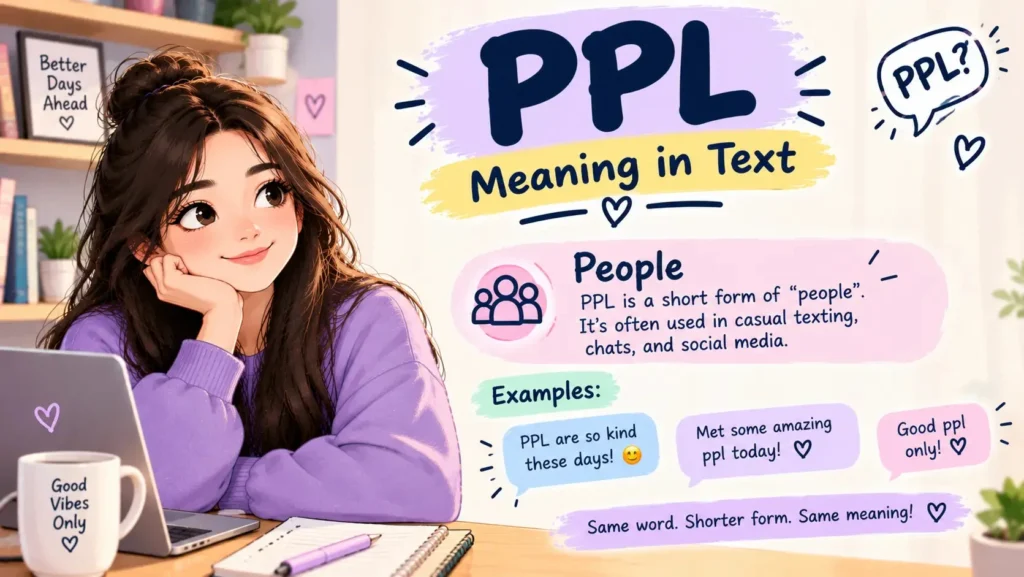
Have you ever received a message that says “Some ppl are so funny” or “I miss those ppl” and wondered what “ppl” means? This short form appears frequently in text messages, social media comments, group chats, and online conversations.
PPL usually means “people.” It is an informal abbreviation that makes typing faster while keeping a message easy to understand. Instead of writing the complete word, someone may use “ppl” when talking about friends, strangers, classmates, coworkers, or a group in general.
For example, a friend might text, “Ppl are acting weird today,” to describe how others are behaving. The abbreviation itself is neutral, but the sentence around it can express humor, frustration, affection, or disappointment.
Understanding this common texting shortcut helps you follow conversations without getting distracted by unfamiliar spelling. In this guide, you will learn the PPL meaning in text, see realistic examples, explore its emotional tone, and discover how to use it naturally in everyday communication.
PPL Meaning in Text – Quick Meaning
PPL stands for “people.”
It is an informal written abbreviation used in digital communication. People often use it because it is shorter than the complete word and fits naturally into quick messages.
Here are a few examples:
- “Ppl keep asking me the same question.” — People repeatedly ask the sender the same thing.
- “I love meeting new ppl.” — The sender enjoys meeting new people.
- “Some ppl just understand you.” — The sender is talking about certain people who understand them.
The meaning is usually easy to identify from the sentence. Unlike some abbreviations that have several unrelated interpretations, PPL is widely used online to mean “people.”
Is PPL slang?
PPL is better described as an informal abbreviation than a separate slang word. It represents an ordinary English word in a shortened form, much like “msg” for “message” or “pic” for “picture.”
It is suitable for casual conversations, although spelling out “people” is usually better in formal writing.
Origin and Background of PPL
How PPL became popular
PPL developed as part of a broader habit of shortening common words in written communication. Text messaging, internet chatrooms, and early online communities encouraged people to type quickly, especially when using small phone keyboards or dealing with character limits.
Because “people” appears frequently in everyday conversation, shortening it to three letters was convenient. The form also works well in sentences without changing the intended meaning.
There is no single, widely documented person or date responsible for introducing PPL. Like many informal abbreviations, it became familiar through repeated use in digital communication.
The influence of social media
Social media made short expressions even more visible. Users often write quick captions, leave comments, reply to stories, or communicate in group chats where brevity feels natural.
A sentence such as “Ppl need to relax” can communicate an opinion without requiring much typing. The abbreviation also appears in posts about friendships, relationships, school, entertainment, and everyday experiences.
Its popularity does not mean everyone prefers it. Some users write “people” in full because they find it clearer or more polished.
Why the spelling is still used
PPL saves a few characters while preserving the original word’s meaning. Readers who recognize the abbreviation can understand it almost immediately.
However, context remains important in professional or unfamiliar conversations. A complete word can make writing easier to read, particularly when the audience includes people who may not use texting shortcuts regularly.
Read More : DK Meaning in Text: What Does DK Stand For?
Real-Life Conversations Using PPL
The following examples show how people might use PPL in everyday digital conversations. They are illustrative scenarios designed to explain the abbreviation.
1. WhatsApp conversation between friends
Person A: Why was everyone laughing during class today?
Person B: Idk, ppl were making jokes in the back 😂
Person A: I missed everything because I was taking notes.
Person B: You missed the funniest part lol.
Meaning: PPL means “people.” Person B is referring to the students who were joking during class.
2. Instagram DM about friendship
Person A: I feel like nobody understands me sometimes.
Person B: I get that. The right ppl make a big difference.
Person A: Honestly, that’s so true.
Person B: Keep the ones who make you feel comfortable being yourself.
Meaning: The abbreviation refers to people who provide understanding and support. The sentence expresses emotional closeness rather than simply describing a group.
3. TikTok comments about a trend
Person A: Ppl really believe everything they see online 😭
Person B: Fr, some don’t even check the source.
Person C: That’s why it’s important to verify things first.
Meaning: PPL refers to people in general. The commenters are discussing how some users respond to information on the internet.
4. Text messages about a social gathering
Person A: Are you going to the party tonight?
Person B: Maybe. I don’t know many ppl there.
Person A: Come with me, then. I’ll introduce you to everyone.
Person B: Okay, that makes me feel better.
Meaning: PPL means “people” and refers to the guests the sender does not know. The message also reveals some nervousness about attending a gathering.
These examples show that PPL usually has the same basic definition in every conversation. The surrounding words reveal whether the sender is being funny, supportive, critical, or simply descriptive.
Emotional and Psychological Meaning of PPL
A neutral way to describe a group
PPL does not automatically express a particular emotion. Someone can use it to talk about people they like, people they dislike, or people they have never met.
For instance, “Ppl were waiting outside” is simply a description. The abbreviation does not suggest approval or criticism.
Expressing frustration
The emotional tone changes when PPL appears in a complaint. A message like “Ppl keep judging me” suggests that the sender feels criticized or misunderstood.
The feeling comes from the complete sentence, not from the abbreviation itself. Recognizing this distinction prevents readers from assigning emotions that the writer did not intend.
Showing affection and connection
PPL can also appear in warm or appreciative messages. Someone might write, “I’m grateful for the ppl who stayed,” to acknowledge friends or family members who offered support.
Although the word is shortened, the emotion behind the message can still feel sincere. Informal writing does not necessarily make a personal message less meaningful.
A relatable personal-style scenario
Imagine joining a new class and feeling uncertain about fitting in. A classmate tells you, “You’ll meet your ppl soon.”
They mean that you will eventually find people whose interests and personalities match yours. The sentence uses a simple abbreviation, yet it communicates encouragement and belonging.
This illustrates how ordinary words can carry emotional significance through the context in which they are used.
How PPL Is Used in Different Contexts
On social media
PPL appears in captions, comments, short posts, and direct messages. Users may write “Ppl are so creative” when praising others or “Ppl need to stop spreading rumors” when criticizing behavior.
The abbreviation fits casual online communication because it is recognizable and compact.
Between friends and family
Friends may use PPL when discussing classmates, relatives, coworkers, or mutual acquaintances. For example, “Are your ppl coming too?” might refer to someone’s friends or family, depending on the conversation.
The exact group should be clear from the surrounding messages. If it is not, asking “Who do you mean?” can prevent confusion.
In romantic relationships
PPL can appear in conversations about trust, friendships, social circles, and relationships.
A message such as “I don’t let many ppl get close to me” suggests that the sender is selective about personal relationships. The abbreviation remains neutral, while the sentence communicates a preference for emotional boundaries.
At school or work
Students may use PPL in class group chats, and coworkers might use it in informal team messages. However, the full word “people” is generally preferable in assignments, reports, formal emails, and official communication.
For example, “Several people attended the meeting” sounds more polished than “Several ppl attended the meeting.”
Casual versus serious tone
PPL can appear in both lighthearted and serious conversations. “Ppl are hilarious” sounds playful, while “I need supportive ppl around me” may express a deeper emotional need.
The abbreviation does not determine how serious the message is. The sentence, relationship, and surrounding discussion provide the necessary clues.
When Not to Use PPL
In formal writing
Avoid using PPL in academic essays, job applications, official documents, and professional reports. The complete word is clearer and follows standard written English.
Informal abbreviations may be appropriate in a friendly workplace chat, but they should not replace clear language when precision matters.
When writing for an unfamiliar audience
Some readers may not recognize texting shortcuts. If your message is intended for people from different age groups, language backgrounds, or professional settings, spelling out “people” reduces the chance of confusion.
This is particularly important when the meaning of the message matters more than typing speed.
When discussing sensitive situations
If someone is describing discrimination, grief, bullying, or a personal conflict, consider the tone of your response. PPL is not inherently disrespectful, but a rushed abbreviation-filled reply might appear careless if the other person needs thoughtful support.
A complete, considerate sentence can help communicate that you are taking the situation seriously.
When clarity matters more than brevity
Short forms are useful only when the reader understands them. If PPL makes a sentence difficult to follow, use “people” instead.
Good communication is not about using the fewest letters possible. It is about helping the other person understand what you mean.
Common Misunderstandings About PPL
Thinking PPL has a hidden meaning
In most everyday English text messages, PPL simply means “people.” It usually does not represent a secret message or an emotional code.
Specialized communities may use the same letters differently, but the surrounding subject should make that distinction clearer.
Confusing PPL with PLZ
PPL and PLZ look similar because both are shortened forms used online. Their meanings are different.
- PPL: People.
- PLZ: Please.
For example, “PPL are waiting” refers to a group, while “PLZ wait” is a request.
Assuming PPL is rude
Using PPL does not automatically make a message disrespectful. Many people use it casually without intending to sound dismissive.
However, tone depends on the complete sentence. “Ppl like you never listen” may sound critical because of its wording, not because the sender shortened “people.”
Believing PPL is always lowercase
The abbreviation may appear as “ppl,” “PPL,” or occasionally “Ppl.” These capitalization differences usually do not change its meaning.
The sender’s typing habits and the style of the platform often explain which form they choose.
PPL Compared With Similar Texting Abbreviations
| Abbreviation or word | Meaning | Main difference |
|---|---|---|
| PPL | People | Refers to a group of individuals |
| PLZ | Please | Makes a request more concise |
| IDK | I Don’t Know | Expresses uncertainty |
| FR | For Real | Adds emphasis or agreement |
| Y’all | You all | Addresses a group directly |
| BFFs | Best Friends Forever | Refers to close friends |
| Fam | Family or close friends | Often suggests closeness or belonging |
| Folks | People | A standard informal word for a group |
| Everyone | Every person in a group | Often more inclusive or specific in meaning |
Key Insight
PPL is a shortened version of an ordinary English word, while expressions such as FR and IDK communicate different ideas. Understanding these differences helps you read messages accurately instead of treating every short form as interchangeable slang.
PPL Variations and Related Expressions
The following forms include common spelling styles and expressions related to the word “people.” Some are abbreviations, while others are full words or phrases with slightly different uses.
1. ppl
The lowercase version of the abbreviation.
It is common in casual text messages because it fits naturally into informal writing.
2. PPL
The uppercase form.
It usually means the same thing as lowercase “ppl,” although some people prefer capitals for emphasis or personal style.
3. Ppl
A mixed-capitalization version.
It may appear at the beginning of a sentence or simply reflect the sender’s typing habits.
4. new ppl
This means “new people.”
It is often used when talking about meeting people, joining a community, or making friends.
5. some ppl
This means “some people.”
It refers to a particular group or a subset of people rather than everyone.
6. good ppl
This means “good people.”
It is a casual way to describe people the sender considers kind, trustworthy, or helpful.
7. real ppl
This means “real people.”
Depending on context, it may refer to genuine individuals, authentic personalities, or people in the physical world rather than fictional characters.
8. my ppl
This means “my people.”
It often refers to friends, family, or a community with whom someone feels connected.
9. ppl like me
This means “people like me.”
It describes individuals who share similar experiences, interests, identities, or circumstances.
10. folks
“Folks” is a related informal word for people.
It is not an abbreviation, but it can serve a similar purpose in everyday conversation, as in “Thanks for helping, folks.”
How to Respond When Someone Uses PPL
Since PPL means “people,” the best response depends on the message in which it appears. You usually do not need to comment on the abbreviation itself.
Casual replies
These responses fit everyday conversations:
- “Yeah, I get what you mean.”
- “True, some people are like that.”
- “Honestly, same.”
- “Haha, that’s so real.”
Funny replies
If the original message is playful, you can keep the conversation light:
- “People are a whole different species sometimes 😂”
- “Never underestimate the randomness of ppl.”
- “Some people need a user manual 😭”
- “The group chat is proof of that.”
Mature replies
Use these when the conversation involves an opinion, disagreement, or serious topic:
- “I understand your point.”
- “That can happen, but everyone’s situation is different.”
- “It depends on the people involved.”
- “I think it’s better to judge each situation individually.”
Respectful replies
When someone shares a personal experience, acknowledge their feelings without making assumptions:
- “I can understand why you feel that way.”
- “It sounds like you’ve had a difficult experience.”
- “I hope you find people who treat you well.”
- “You deserve to feel respected and supported.”
If you are unsure what the sender means
You can ask, “Do you mean people?” or “Which people are you talking about?” Such questions are especially useful when the message refers to a group that has not been mentioned earlier.
Regional and Cultural Usage of PPL
Western culture
In English-speaking communities across the United States, Canada, the United Kingdom, and other Western countries, PPL is recognizable in many informal online settings.
It may appear in social posts, text messages, and casual conversations. Still, some people prefer standard spelling, especially when writing for work or school.
Asian culture
Across Asian countries, English abbreviations often appear alongside local languages in social media posts and private chats. PPL may be familiar to users who communicate frequently in English online.
However, language preferences differ between individuals and communities. It is better not to assume that every English learner or social media user knows the abbreviation.
Middle Eastern culture
In Middle Eastern online communities, users may mix English texting shortcuts with Arabic and other languages. PPL can appear in informal conversations about friends, family, classmates, or online communities.
Its basic meaning remains “people” in ordinary English usage, though the surrounding language may affect the tone of the sentence.
Global internet usage
Social media allows abbreviations to spread across countries and language communities. PPL is relatively easy to understand because it closely resembles the first letters of “people.”
Even so, spelling out the complete word is a useful choice when communicating with an unfamiliar audience.
Gen Z versus Millennials
Gen Z users may encounter PPL through short-form videos, group chats, and social platforms. Millennials may also use it in casual communication, while others prefer typing the full word.
Neither generation has a single fixed texting style. Personal preference, language familiarity, and online communities often matter more than age.
Is PPL Safe for Kids?
PPL is generally harmless. It is simply an informal abbreviation for “people,” and children may encounter it in school chats, gaming communities, or social media comments.
Understanding common abbreviations can help young users follow digital conversations. At the same time, they should learn that online messages can have different tones and that unfamiliar phrases can always be clarified.
The abbreviation itself does not indicate a safety concern. Adults should pay attention to the broader conversation if messages include bullying, harassment, exclusion, or pressure to share private information.
Encouraging respectful communication helps children understand not only what online expressions mean but also how their words may affect others.
FAQs About PPL Meaning in Text
1. What does PPL mean in texting?
PPL usually means “people.” It is an informal abbreviation used in messages and online conversations to refer to a group of individuals.
2. What does PPL mean on Instagram?
On Instagram, PPL generally means “people.” You might see it in captions, comments, stories, or direct messages when someone talks about friends, followers, or people in general.
3. What does PPL mean from a girl?
If a girl uses PPL in a text, she most likely means “people.” The abbreviation does not have a special romantic meaning by itself; the full sentence determines her intended message.
4. What does PPL mean from a guy?
A guy generally uses PPL as a shortcut for “people.” It can refer to friends, classmates, coworkers, or a group being discussed.
5. Is PPL considered slang?
PPL is an informal abbreviation rather than a separate slang word. It represents the standard English word “people” in a shorter form.
6. What is the difference between PPL and PLZ?
PPL means “people,” while PLZ means “please.” The first refers to individuals, and the second is commonly used to make a request.
7. Should I use PPL in formal writing?
It is usually better to write “people” in formal emails, academic assignments, professional reports, and official documents. PPL is most suitable for casual digital communication.
Conclusion
PPL is a widely used texting abbreviation that means “people.” Its short form makes messages quicker to type, and you may encounter it in conversations about friendships, social experiences, opinions, and everyday life.
Although the abbreviation is simple, the sentence around it can communicate many different emotions. Someone might use it to express appreciation, share a complaint, describe a group, or talk about finding people who understand them.
Once you recognize PPL, you can understand most messages containing it without difficulty. Use it freely in casual conversations when it suits your style, but choose the complete word whenever clarity or professionalism matters most.




1 thought on “PPL Meaning in Text: What Does PPL Stand For?”