
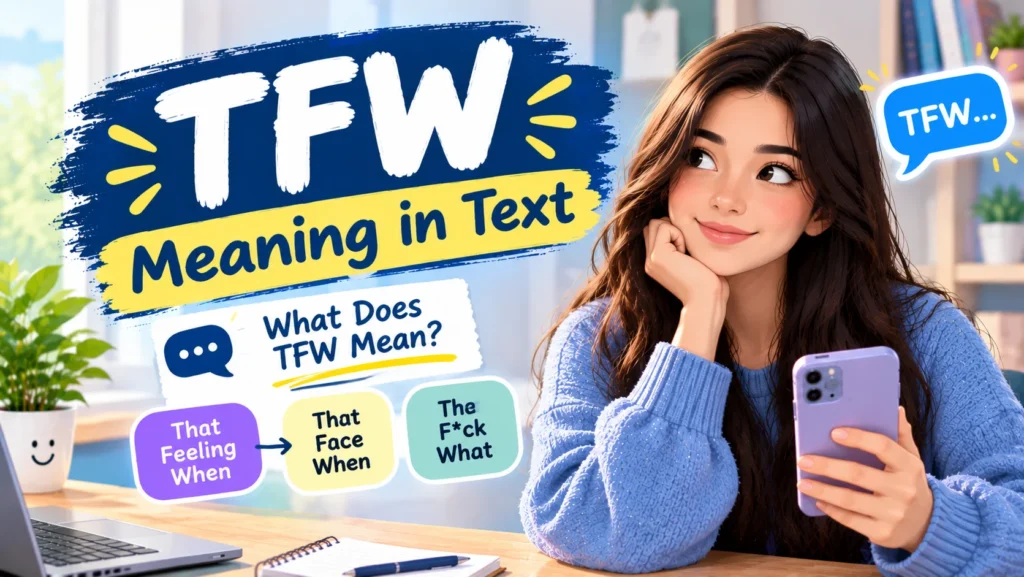
If you have seen “TFW” in a meme, caption, comment, or text message, you may have wondered what those three letters actually mean.
In online communication, TFW usually means “That Feeling When.” People use it to introduce a situation that creates a recognizable emotion, reaction, or experience.
For example:
“TFW you finally get home after a long day 😭”
This means:
“That feeling when you finally get home after a long day.”
TFW is especially popular in internet culture because it turns an ordinary experience into something other people can instantly relate to.
The expression is usually casual, humorous, emotional, or slightly dramatic. Its meaning can become even clearer when it appears with a meme, GIF, image, or reaction emoji.
TFW Meaning in Text – Quick Meaning
What Does TFW Stand For?
TFW stands for “That Feeling When.”
It is generally used to describe a particular emotional moment or relatable situation.
For example:
“TFW your alarm goes off five minutes before you planned to wake up.”
The writer is referring to the specific feeling of realizing that you have to get out of bed earlier than expected.
Simple Examples
“TFW you find money in an old jacket.”
Meaning: That feeling when you discover unexpected money.
“TFW your favorite song comes on.”
Meaning: That feeling when your favorite song suddenly plays.
“TFW nobody replies to your message.”
Meaning: That feeling when everyone seems to ignore your message.
The emotion can be happiness, embarrassment, frustration, excitement, awkwardness, nostalgia, or almost anything else.
Origin & Background
TFW developed from internet meme culture rather than traditional texting slang.
It became particularly recognizable through online communities where users shared short phrases describing highly relatable situations.
The format often appeared alongside an image or reaction that represented the emotion.
A typical structure looked like:
“TFW [something happens]”
The phrase worked because it required very few words while communicating a familiar experience.
From Forums to Mainstream Internet Culture
Internet communities helped abbreviations such as TFW spread beyond their original circles.
People began using the expression on social platforms, meme pages, forums, and messaging apps.
Its popularity came from a simple idea: people enjoy recognizing their own experiences in someone else’s post.
Why TFW Works So Well
The phrase creates an immediate emotional connection.
Instead of explaining an entire situation, the writer can name the moment and let the reader imagine the feeling.
For example:
“TFW the teacher says the test is postponed.”
Almost anyone who has experienced that situation understands the emotional reaction immediately.
TFW and Meme Culture
TFW is strongly connected with memes.
A meme might show a person looking extremely happy, tired, shocked, or embarrassed while the caption starts with “TFW.”
The image provides the emotional punch while the abbreviation establishes the situation.
Read More : Emoji Meaning in Text: What Do Emojis Mean?
Real-Life Conversations
WhatsApp Conversation
Person A:
“TFW you study for three hours and the test is about something else 😭”
Person B:
“Literally me yesterday.”
Here, TFW introduces a frustrating but relatable experience.
Instagram DM
Person A:
“TFW your crush actually likes your story 👀”
Person B:
“Don’t expose me like that 😂”
The phrase creates a playful description of an emotional moment.
TikTok Comments
Person A:
“TFW you open TikTok for five minutes and it’s suddenly midnight.”
Person B:
“Every single night 😭.”
The commenters recognize the situation from their own experience.
Text Message
Person A:
“TFW mom says ‘we need to talk’ 💀”
Person B:
“That sentence is terrifying 😂.”
Here, TFW introduces a familiar feeling of anxiety or nervousness.
Emotional & Psychological Meaning
TFW is more than an abbreviation.
It is a way of saying:
“You know that feeling when this happens?”
That makes it naturally relatable.
TFW Creates Shared Experience
People often use TFW when they believe others will understand the emotion immediately.
For example:
“TFW your favorite team finally wins.”
A fan reading it can connect with the excitement without needing a long explanation.
TFW Can Express Humor
Many TFW posts are funny because they exaggerate ordinary frustrations.
For example:
“TFW you confidently answer a question and realize you were completely wrong.”
The humor comes from recognizing an uncomfortable situation.
TFW Can Express Nostalgia
The phrase can also introduce memories:
“TFW you hear a song you used to listen to every summer.”
The feeling may be nostalgia rather than humor.
A Personal-Style Scenario
Imagine finishing a difficult assignment late at night.
You finally submit it, close your laptop, and realize you have nothing else to do.
A message such as:
“TFW you finally submit the assignment at 2 a.m. 😭”
captures the relief, exhaustion, and satisfaction in just a few words.
That is exactly why TFW remains useful in casual online communication.
Usage in Different Contexts
Social Media
TFW is particularly common in captions, memes, comments, and short posts.
It works well when the writer wants followers to recognize a familiar experience.
For example:
“TFW your weekend ends too quickly.”
The reader does not need a detailed explanation.
Friends and Relationships
Friends may use TFW to tease each other or describe shared situations.
For example:
“TFW you say you’re not hungry and then eat half my fries.”
The phrase makes the message feel humorous rather than confrontational.
Work and Professional Settings
TFW is generally too informal for formal business communication.
It may occasionally appear in a relaxed workplace chat, especially among coworkers who already use internet slang.
However, a professional email would usually be clearer without it.
Casual vs. Serious Tone
TFW is primarily casual.
It can describe serious emotions, but the abbreviation itself gives the message an informal internet style.
Compare:
“TFW you realize someone you trusted lied to you.”
with:
“That feeling when you realize someone you trusted lied to you.”
The first feels more like a social-media caption.
The second feels more like ordinary written communication.
When NOT to Use TFW
Formal Writing
Avoid TFW in academic essays, official reports, professional applications, and formal correspondence.
Write the complete phrase instead if the idea is actually needed.
Sensitive Personal Situations
TFW can sometimes make serious subjects sound overly casual.
If someone is discussing grief, trauma, or a major personal problem, a thoughtful response is usually more appropriate than turning the situation into meme-style language.
When the Audience May Not Know Internet Slang
Not everyone knows TFW.
Using it with someone unfamiliar with online abbreviations can create unnecessary confusion.
When Precision Matters
If your message needs to communicate an important fact, use direct language.
Internet shorthand is best suited to casual situations where context is already shared.
Common Misunderstandings
TFW Does Not Mean “The Feeling Was”
The standard internet meaning is “That Feeling When.”
People sometimes misinterpret the letters because they look like an ordinary acronym.
TFW Is Not Only Used for Happy Feelings
The word “feeling” can refer to any emotional reaction.
TFW can describe:
- Happiness
- Sadness
- Embarrassment
- Frustration
- Excitement
- Anxiety
- Nostalgia
- Surprise
- Relief
- Humor
TFW Is Not Necessarily a Question
Although it can be understood as:
“Do you know that feeling when…?”
TFW is normally used as a statement or caption rather than a literal question.
TFW Can Be Followed by Almost Anything
There is no requirement that the situation be dramatic.
People can use it for tiny everyday experiences:
“TFW your food arrives.”
or larger emotional moments:
“TFW you finally achieve your goal.”
Comparison Table
| Expression | Meaning | Typical Use |
|---|---|---|
| TFW | That Feeling When | Relatable situations |
| IYKYK | If You Know, You Know | Shared experiences |
| FR | For Real | Agreement |
| LOL | Laughing Out Loud | Humor |
| POV | Point of View | Scenario-based content |
| Mood | I relate to this feeling | Emotional reaction |
| Same | I feel the same | Agreement |
| Literally me | This describes me | Strong relatability |
| TBH | To Be Honest | Personal opinion |
| NGL | Not Gonna Lie | Honest reaction |
Key Insight
TFW is essentially a shortcut for introducing a relatable feeling or situation. Its strength comes from shared experience: the writer describes the moment, and the reader recognizes the emotion.
Variations / Types
1. TFW
The standard abbreviation.
It means “That Feeling When.”
2. tfw
The lowercase version is equally common in casual internet communication.
It usually feels informal and relaxed.
3. TFW + Situation
A basic structure where the abbreviation introduces an experience.
“TFW you finish your work early.”
4. TFW + Emoji
An emoji adds emotional context.
“TFW your order finally arrives 😭.”
5. TFW + Meme
The phrase may accompany a reaction image.
The picture provides the emotional punch.
6. TFW + Humor
Used to describe an awkward or funny experience.
“TFW you wave back at someone who wasn’t waving at you.”
7. TFW + Nostalgia
Used to describe a memory.
“TFW you hear a song from your childhood.”
8. TFW + Frustration
Used for everyday annoyances.
“TFW you forget your password again.”
9. TFW + Excitement
Used for positive experiences.
“TFW your favorite artist announces a new album.”
10. TFW + Relatable Reaction
Used when the writer expects other people to identify strongly with the situation.
“TFW you say one more episode and watch four.”
How to Respond When Someone Uses TFW
Casual Replies
If you relate to the situation:
“Literally 😂.”
“So true.”
“This is me.”
Funny Replies
If the post is humorous:
“Why is this so accurate? 😭”
or:
“You didn’t have to expose us like that 💀.”
Mature Replies
If the situation is emotional:
“I completely understand that feeling.”
Respectful Replies
When someone shares a personal experience through TFW, respond to the actual emotion rather than focusing only on the abbreviation.
For example:
“Yeah, that sounds really frustrating.”
Regional & Cultural Usage
Western Culture
TFW is strongly associated with English-language internet culture, especially memes and social-media humor.
It is generally understood by people familiar with online slang.
Asian Culture
Users in many Asian countries frequently combine English internet abbreviations with their local languages.
TFW can appear in captions and comments even when the rest of the sentence is not entirely in English.
Middle Eastern Culture
English-language social media has also helped abbreviations such as TFW cross language boundaries.
Users may understand the phrase from memes even if English is not their first language.
Global Internet Usage
TFW works well internationally because the emotion behind the situation is often more important than the exact wording.
Someone may not use the phrase frequently themselves but still recognize it from memes or social media.
Generational Differences
Younger internet users are generally more likely to encounter TFW through memes, TikTok-style content, comments, and online communities.
Millennials who grew up with forums and early social media may also recognize it easily.
People less familiar with internet culture may need the phrase explained.
Is TFW Safe for Kids?
Yes. TFW is generally harmless internet slang.
The abbreviation itself does not contain offensive or adult language.
However, the content following TFW determines whether a post is appropriate.
For example:
“TFW you get an extra day off 🎉”
is completely ordinary.
A TFW post could also describe mature subjects, so parents and younger users should evaluate the entire message rather than the abbreviation alone.
FAQs
What does TFW mean in text?
TFW usually means “That Feeling When.” It introduces a situation that creates a particular emotion or relatable reaction.
What does TFW mean on social media?
On social media, TFW is commonly used in memes, captions, and comments to describe a recognizable feeling or everyday situation.
Is TFW slang?
Yes. TFW is considered internet slang or an online abbreviation rather than formal English.
What does TFW mean in a text from a girl?
If a girl uses TFW, she is generally introducing a relatable feeling or situation. The abbreviation itself does not indicate romantic interest.
What does TFW mean from a guy?
A guy using TFW is usually describing an experience or emotional reaction. Its meaning depends on what follows the abbreviation.
Is TFW still used?
Yes. TFW remains recognizable in internet culture, particularly in memes, social-media posts, comments, and casual online conversations.
What is the difference between TFW and IYKYK?
TFW introduces a feeling associated with a situation, while IYKYK means “If You Know, You Know” and suggests that only people familiar with the experience will fully understand it.
Conclusion
TFW means “That Feeling When” in most internet and texting contexts.
It is a compact way to describe an emotional moment that other people can recognize. Whether the feeling is excitement, embarrassment, frustration, nostalgia, relief, or laughter, TFW turns an ordinary experience into a relatable statement.
You may see it in texts, memes, TikTok comments, Instagram captions, group chats, and other casual online spaces.
The key is to focus on the words that come after TFW. They explain the actual situation, while the abbreviation simply introduces the feeling.
If someone writes:
“TFW you finally finish everything you had to do 😭”
they are not asking a complicated question. They are inviting you to recognize that familiar feeling of relief and exhaustion.
That shared sense of “I’ve been there too” is what gives TFW its lasting appeal in internet communication





1 thought on “TFW Meaning in Text: What Does TFW Mean?”