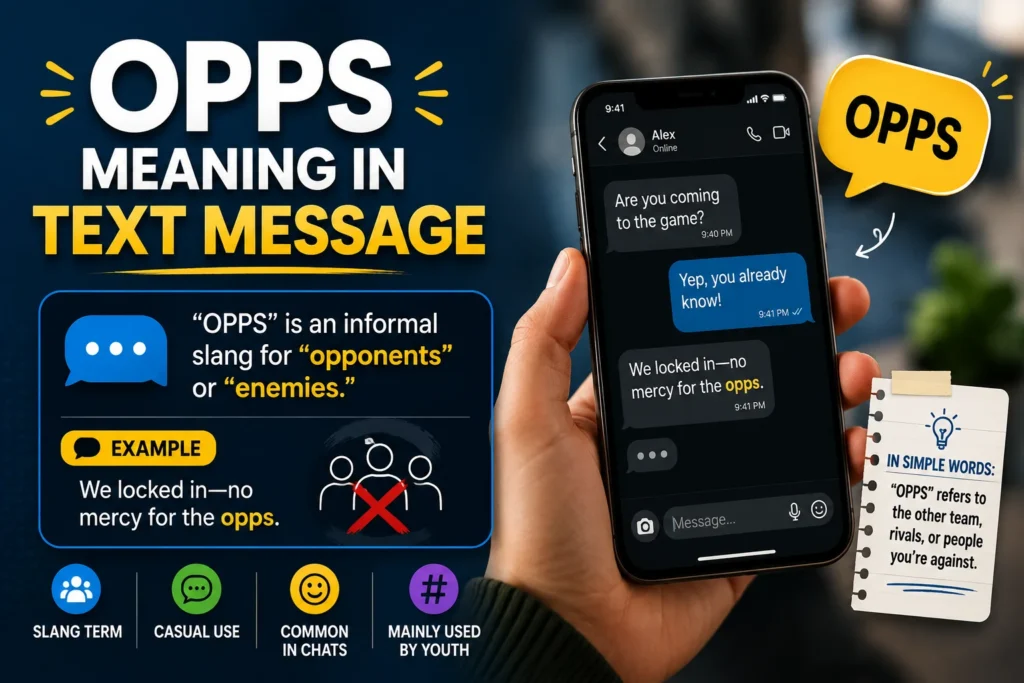
The opps meaning in text message is usually opponents, enemies, rivals, or people considered to be against you. “Opp” is the singular form, while “opps” refers to more than one opponent. Merriam-Webster similarly defines opps as one’s opposition or opponents.
You might receive a message such as, “Don’t tell the opps,” or see someone comment, “The opps are watching 👀.” In these situations, the person is talking about rivals or people they do not trust.
However, modern texting has made the word much more flexible.
Among friends, “opp” can be used jokingly for someone who stole your food, supported the opposing sports team, beat you in a game, or disagreed with you about something trivial. In more serious contexts, especially conversations involving real conflicts, the same word can genuinely mean an enemy or hostile rival.
There is also an important spelling difference: “opps” and “oops” are not the same word. “Oops” expresses a mistake. “Opps” refers to opposition or rivals in slang.
Understanding the tone and conversation around the word is therefore essential.
Opps Meaning in Text Message – Quick Meaning
In texting slang, opps means “opponents” or “opposition.”
Depending on the conversation, it can refer to:
- Enemies
- Rivals
- Opponents
- People someone dislikes
- People on the “other side”
- Competing groups
- A joking rival among friends
- Someone perceived as disloyal
- An opposing gaming team
- A person being playfully treated as the enemy
For example:
“Don’t invite him, he’s an opp 😭”
This could mean the person is genuinely disliked or simply being jokingly excluded.
“The opps won today.”
In a sports or gaming conversation, this may simply mean the opposing team won.
“You ate my fries? You’re officially an opp.”
Here, the term is clearly playful.
Opp vs. Opps
Opp = one opponent or enemy.
Opps = multiple opponents or enemies.
So:
“He’s an opp.”
“They’re the opps.”
The meaning is straightforward, but emotional intensity depends entirely on context.
Origin and Background of Opps
“Opp” developed as a shortened form connected with opposition and opponent, and the plural “opps” refers to people viewed as being on the opposing side. Merriam-Webster records the slang form with essentially this meaning.
Its modern popularity is strongly associated with informal speech, rap and hip-hop vocabulary, gaming culture, memes, and social media.
From Serious Rivalry to Everyday Humor
The word can carry genuinely hostile meaning.
Someone talking about an actual conflict might use “opps” to describe people considered enemies.
Yet internet culture often takes serious-sounding vocabulary and applies it to ridiculous situations.
Someone might write:
“My sister ate the leftovers. She an opp now.”
Clearly, a missing slice of pizza has not created a serious enemy.
The exaggerated language creates the joke.
Social Media Expanded the Meaning
TikTok, Instagram, gaming chats, and meme culture helped make “opp” understandable far outside the contexts where the slang originally circulated.
Today, someone might jokingly call:
A rival gamer an opp.
An ex an opp.
A friend supporting another football team an opp.
Even a cat that knocked over someone’s drink could become “an opp.”
The core idea remains opposition, while the seriousness has become highly flexible.
Read More : 🥔 Meaning in Text: Slang, Emoji & Chat Meaning
Real-Life Conversations Using Opps
Context makes the opps meaning in text message much easier to understand.
WhatsApp: Friend Group Drama
Person A: “Are we inviting Ryan tonight?”
Person B: “After he exposed our group chat? That man is an opp 😭”
Person A: “You’re still mad about that?”
Person B: “Absolutely.”
Here, “opp” means someone considered disloyal or temporarily on the wrong side.
The crying emoji makes the tone feel humorous, although there may still be genuine annoyance underneath.
Instagram DMs: Playful Flirting
Person A: “You seriously support their team?”
and,
Person B: “Yep 😂”
moreover,
Person A: “Wow. Didn’t know I was talking to an opp.”
Person B: “You’ll survive.”
Nobody is describing an actual enemy.
“Opp” becomes playful rivalry and can even support flirtatious teasing.
TikTok Comments
Person A: “My little brother ate the food I saved.”
and,
Person B: “Your own family became the opps 💀”
moreover,
Person A: “Trust nobody.”
The dramatic language is intentionally disproportionate to the situation.
That exaggeration creates humor.
Text Message: More Serious Context
Person A: “Why were you telling them what we said?”
and,
Person B: “I wasn’t.”
moreover,
Person A: “You keep giving information to the opps.”
Here, “opps” may reflect genuine mistrust.
There are no obvious humorous signals, so the term feels noticeably more serious.
Emotional and Psychological Meaning of Opps
Calling somebody an “opp” creates a simple social division:
us versus them.
That is the emotional idea behind much of the slang.
It Can Communicate Distrust
If someone says:
“I don’t mess with him. He’s an opp.”
they may be saying the person is:
Untrustworthy.
Disloyal.
Hostile.
Connected with people they dislike.
The word can therefore communicate social boundaries very efficiently.
It Can Turn Tiny Conflicts Into Comedy
Friends frequently exaggerate minor betrayals for entertainment.
Imagine your closest friend chooses another teammate instead of you during a game.
You text:
“Wow. So you’re an opp now?”
You probably do not genuinely believe the friendship has ended.
You are dramatizing the betrayal.
This type of exaggerated language works because both people understand the difference between the literal situation and the performance.
It Can Reveal Group Loyalty
Terms such as “opps” can also reinforce group identity.
Calling someone an opp indirectly communicates:
“They’re not with us.”
That can be playful in a sports rivalry but much more serious during genuine interpersonal conflict.
Tone determines which interpretation fits.
Opps Meaning in Different Contexts
The word changes noticeably depending on the environment.
Opps on Social Media
On TikTok, Instagram, X, and similar platforms, “opps” may describe actual rivals or be used for exaggerated humor.
Examples:
“The opps found my account.”
“My ex watching my Story like an opp.”
“Can’t even post peacefully, the opps are everywhere 😭.”
Many social-media uses intentionally make ordinary attention sound like espionage.
Opps Between Friends
Among friends, the slang is frequently teasing.
“You didn’t save me a seat? Opp behavior.”
“You voted against me? You’re an opp.”
The “enemy” meaning remains present, but only as a joke.
Opps in Dating and Relationships
An ex may jokingly—or seriously—be called an opp.
For example:
“My ex liked the post. The opps are monitoring me.”
The phrase may express tension, humor, suspicion, or all three at once.
Calling a romantic partner an opp after a tiny disagreement can also be affectionate teasing:
“You watched the episode without me? You’re an opp.”
Opps in Gaming
Gaming provides one of the clearest non-serious uses.
Opponents are literally the opposing players.
A gamer may say:
“The opps are pushing.”
“Two opps behind us.”
“Beat the opps.”
Here, the term may function almost like ordinary competitive vocabulary.
Opps in Serious Conflict
The word can also refer to real adversaries.
When the surrounding conversation involves threats, violence, criminal activity, or serious hostility, do not automatically interpret “opps” as harmless meme language.
The same slang can carry very different consequences depending on what is being discussed.
When NOT to Use Opps
“Opps” is informal slang and does not belong everywhere.
Formal Communication
Do not write:
“Our company must outperform the opps.”
in a formal business report.
Use:
“competitors”
“rivals”
or:
“the opposition.”
Academic Writing
Unless you are analyzing slang itself, write opponents or opposition rather than “opps.”
Serious Disagreements
Calling someone an “opp” can escalate tension if they do not understand that you are joking.
During an already heated argument, clear language is usually better.
With People Unfamiliar With the Slang
Someone unfamiliar with internet or youth slang may think “opps” is simply a spelling error.
If clarity matters, use the full word.
Common Misunderstandings About Opps
The most common confusion is between opps and oops.
Opps vs. Oops
Opps = opponents, rivals, or enemies.
Oops = an expression used after making a mistake.
Compare:
“The opps are here.”
Meaning: “The rivals/enemies are here.”
“Oops, I deleted it.”
Meaning: “I made a mistake.”
One extra “o” completely changes the message.
Does Opp Mean Police?
Not normally.
“Opp” generally refers to an opponent or opposition.
However, context-specific communities may develop their own meanings, and “OPP” can also exist as unrelated initials or abbreviations.
Does Opp Mean Enemy?
Yes, often—but enemy may sound stronger than the speaker intends.
If your friend calls you an opp because you took the last cookie, “playful rival” is a better interpretation than “enemy.”
Is Opp Always Gang Slang?
No.
Although the word can occur in serious street-conflict contexts, it has spread much more broadly into gaming, sports, memes, social media, and ordinary joking conversations.
Opps Compared With Similar Slang
| Term | Common Meaning | Typical Tone | Example |
|---|---|---|---|
| Opps | Opponents/enemies | Serious or playful | “The opps are here.” |
| Opp | One opponent/enemy | Serious or playful | “He’s an opp.” |
| Rival | Competitor | Neutral | “Our biggest rival.” |
| Enemy | Hostile person/group | Serious | “They became enemies.” |
| Hater | Someone negatively critical | Casual | “Ignore the haters.” |
| Snake | Disloyal person | Negative | “He switched sides—snake.” |
| Fake | Insincere person | Negative | “That friend is fake.” |
| Competition | Someone competing | Neutral | “Know your competition.” |
| Ally | Supporter/partner | Positive | “She’s an ally.” |
| Bestie | Close friend | Positive | “That’s my bestie.” |
Key Insight
Opps carries stronger “us versus them” energy than ordinary words such as competitor. However, modern slang frequently uses that intensity ironically, turning harmless friends, siblings, exes, or rival gamers into temporary “opps.”
10 Common Variations and Types of Opps
1. Opp
Meaning: One opponent, rival, or enemy.
Example: “He’s an opp now.”
2. Opps
Meaning: Multiple opponents or rivals.
Example: “The opps are watching.”
3. The Opps
Meaning: A specific rival group.
Adding “the” makes it sound like an established opposing side.
4. My Opp
Meaning: Someone personally considered a rival.
Example: “That’s basically my opp.”
5. Certified Opp
Meaning: Someone unquestionably placed on the opposing side.
Usually exaggerated for humor online.
6. Secret Opp
Meaning: Someone pretending to be friendly while supposedly working against you.
Example: “You celebrated when I lost—you a secret opp?”
7. Opp Behavior
Meaning: Something that feels disloyal or unfriendly.
Example: “Eating my leftovers is opp behavior.”
8. Moving Like an Opp
Meaning: Acting suspiciously, disloyally, or like a rival.
The exact seriousness depends on context.
9. The Opps Are Watching
Meaning: Rivals or unwanted observers are paying attention.
Often used jokingly when someone unwanted views a social-media post.
10. Became an Opp
Meaning: Someone who used to be friendly is now treated as a rival.
Example: “He joined the other team and became an opp.”
How to Respond When Someone Says Opps
Your response should match whether the term is playful or serious.
Casual Replies
If someone jokingly calls you an opp:
- “Since when? 😭”
- “I thought we were friends.”
- “That’s amazing 😂”
- “All this over one slice of pizza?”
- “I accept my new role.”
Funny Replies
Lean into the drama:
- “The betrayal arc begins.”
- “See you on the other side 💀”
- “Opp status unlocked.”
- “I’ve chosen my side.”
- “You made me this way 😭”
Mature Replies
If the message sounds genuinely hostile:
- “What do you mean by that?”
- “Why do you see me as against you?”
- “I’d rather clear this up directly.”
- “If there’s a problem, tell me what happened.”
Respectful Replies
If you do not like the label:
- “Don’t call me that.”
- “I’m not trying to be against you.”
- “Let’s not turn this into something bigger.”
You do not need to copy slang simply because someone else uses it.
Regional and Cultural Usage of Opps
“Opps” is English-language slang, but social media has helped it travel widely.
Western Internet Culture
In English-speaking digital spaces, “opp” can range from serious rivalry language to a completely unserious meme.
The surrounding context determines which end of that spectrum applies.
Asian Online Culture
Younger users exposed to English-language gaming, rap, memes, and TikTok culture may understand or use “opp” even when English is not their first language.
Local slang still varies greatly between communities.
Middle Eastern Online Culture
“Opp” may similarly appear inside English or mixed-language gaming and social-media conversations.
Its usage is more likely among people regularly interacting with global internet culture.
Global Internet Usage
The slang now travels easily between gaming, memes, music fandoms, sports discussions, and casual conversations.
A word can retain its core idea—opposition—while becoming increasingly humorous outside serious disputes.
Gen Z vs. Millennials
Gen Z users are especially likely to use “opp” ironically:
“My mom said no McDonald’s. Biggest opp.”
Millennials familiar with gaming, hip-hop, or current social media may understand it too, while people outside those communities may simply interpret it as unfamiliar slang.
Is Opps Safe for Kids?
The word opps itself is not a swear word or inherently explicit.
A child might jokingly use it for an opposing sports team or gaming opponent.
However, the context matters.
Because the term can also appear in conversations involving genuine hostility, gang conflict, threats, or violence, adults should avoid assuming that every appearance means the same thing.
A message such as:
“Our football opps beat us.”
is very different from a conversation discussing threats against real people.
Look at the whole interaction rather than reacting to a single slang word.
FAQs About Opps Meaning in Text Message
What does opps mean in a text message?
Opps means opponents, opposition, rivals, or enemies in slang. It can describe genuine adversaries or joking rivals depending on context.
What does “opp” mean from a guy?
If a guy calls someone an “opp,” he usually means that person is considered a rival, enemy, or someone on the opposing side. Between friends, it may simply be teasing.
What does “opp” mean from a girl?
The basic meaning is the same regardless of gender. She may mean opponent, rival, enemy, or jokingly someone who has done something disloyal.
What does “the opps” mean on TikTok?
“The opps” generally refers to rivals or unwanted people seen as being on the other side. On TikTok, the phrase is also frequently used humorously for exes, haters, competing groups, or people watching someone’s posts.
Is it opps or oops?
They mean different things. Opps refers to opponents or rivals, while oops is an expression acknowledging a mistake.
Is calling someone an opp an insult?
It can be. In a serious context, calling someone an opp communicates hostility or distrust. Among friends, it can be playful teasing with little real aggression.
What does “opp behavior” mean?
“Opp behavior” means acting like a rival or enemy—often through perceived disloyalty, disagreement, or betrayal. Online, the phrase is frequently exaggerated for humor.
Conclusion
The opps meaning in text message is fundamentally about opposition.
An opp is an opponent, rival, or enemy, while opps refers to multiple people on the opposing side.
But modern texting has made the word much more flexible.
“The opps are outside” could describe a genuine conflict.
“The opps beat us in ranked” could simply mean the opposing gaming team.
And:
“You ate my chicken nuggets. You’re an opp.”
is probably not the beginning of a lifelong feud.
Tone matters.
Look at the relationship, subject, emojis, and surrounding conversation before deciding how seriously the word is being used.
Most importantly, do not confuse opps with oops.
One means rivals.
The other means somebody just realized they messed up.
That missing “o” makes a surprisingly big difference.