
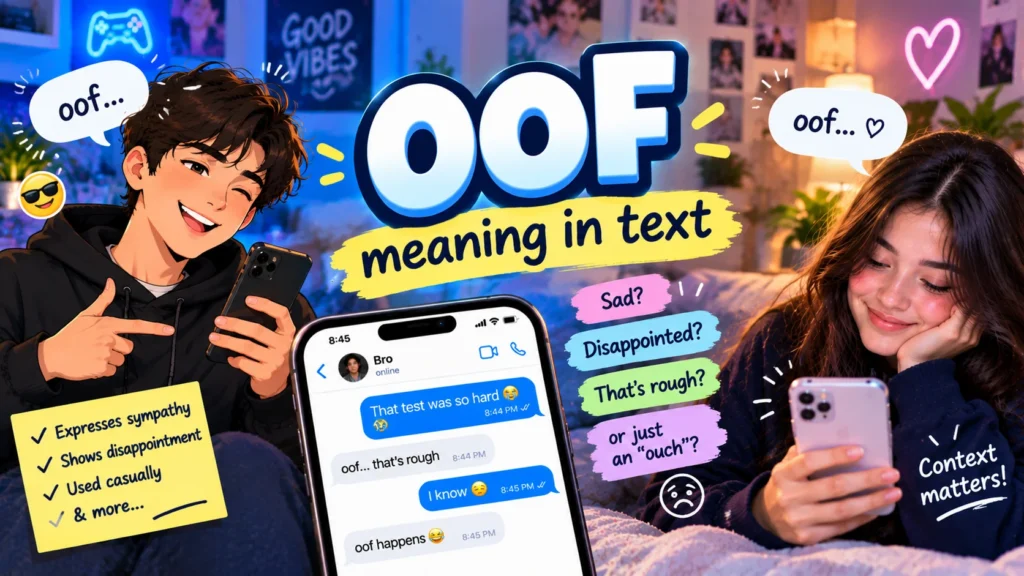
“Oof” in text is an emotional reaction used when something feels painful, awkward, difficult, embarrassing, disappointing, or unexpectedly intense.
It is not usually an abbreviation. Instead, oof is an interjection that imitates the sound or feeling of reacting to something uncomfortable.
Someone might type “oof” after hearing bad news, seeing an embarrassing mistake, receiving an expensive bill, or reading an emotionally difficult message.
For example:
“Oof, that must have hurt.”
This shows sympathy.
“Oof 😬 that was awkward.”
This signals embarrassment or discomfort.
“Oof, $500 for that?”
Here, the speaker is reacting to an unexpectedly high price.
The exact emotion depends on the situation, which makes oof meaning in text more flexible than many traditional slang terms.
Oof Meaning in Text – Quick Meaning
In everyday texting, oof can express:
- Pain — something physically or emotionally hurts.
- Sympathy — reacting to someone else’s difficult experience.
- Embarrassment — something feels awkward.
- Disappointment — an outcome did not go well.
- Shock — something is unexpectedly intense.
- Awkwardness — a situation feels uncomfortable.
- Surprise — something is more serious than expected.
- Playful teasing — reacting dramatically to a friend’s situation.
A short message can change the tone:
“Oof.” — serious or sympathetic.
“Oof 😭” — emotional or dramatic.
“Oof 😂” — often playful.
“OOF” — stronger emphasis.
Where Did “Oof” Come From?
“Oof” belongs to a much older family of expressive sounds used in spoken language.
People naturally make short sounds when experiencing pain, impact, surprise, or discomfort. Writing them down allows text conversations to reproduce some of that emotional reaction.
The word also became strongly associated with internet culture and gaming communities. Online users began using oof more broadly for situations that were not physically painful.
That expansion helped turn “oof” into a flexible reaction word.
The Internet Made “Oof” More Versatile
Today, someone can type “oof” after hearing almost anything uncomfortable.
A friend fails an exam.
“Oof.”
Someone sends a message to the wrong person.
“OOF 😭”
A player loses a close game.
“oof, that was rough.”
The expression works because the reader understands the emotional reaction even without a long explanation.
Read More : DTF Meaning in Text: What Does DTF Mean?
What Does Oof Mean on Social Media?
On social platforms, oof often works like a quick reaction.
It can appear in comments, captions, replies, memes, and direct messages.
Its meaning can range from genuine sympathy to playful humor.
For example:
“I studied for six hours and the test covered everything I skipped.”
Someone might comment:
“Oof 😭”
That does not necessarily mean the commenter is laughing at the person. It can simply communicate, “That is rough.”
Context determines whether the reaction is supportive, humorous, sarcastic, or sympathetic.
Oof in Real-Life Conversations
WhatsApp Conversation
Person A: I missed the bus and now I’m going to be late for work.
and,
Person B: Oof 😭 that’s rough.
moreover,
Person A: I know. I’m already running.
Here, “oof” communicates sympathy.
Instagram DM
Person A: I accidentally sent the screenshot to the person I was talking about.
Person B: OOF 😭
Person A: Please don’t remind me.
This version expresses embarrassment and disbelief.
TikTok Comments
Person A: Bro spent all night making this video and forgot to save it.
Person B: Oof 💀
Person A: I would literally cry.
The expression is sympathetic but also fits the humorous internet tone.
Text Message
Person A: The concert tickets were $300.
and,
Person B: Oof.
moreover,
Person A: Exactly what I said.
Here, “oof” communicates shock at the price.
What Does Oof Mean From a Girl?
“Oof” does not have a special definition when a girl uses it.
She may be expressing:
- sympathy,
- embarrassment,
- surprise,
- disappointment,
- concern,
- playful teasing,
- or emotional discomfort.
For example:
You: “I just realized I sent that email to the wrong person.”
Her: “Oof 😭”
The likely meaning is a sympathetic reaction to an awkward mistake.
The context matters more than the sender’s gender.
What Does Oof Mean From a Guy?
A guy may use oof in exactly the same broad ways.
For example:
You: “I failed the driving test by one point.”
Him: “Oof, that’s painful.”
Here, he is expressing sympathy.
In a gaming chat:
“Oof, you almost had that.”
The tone is more casual and competitive.
The word itself does not reveal romantic interest, anger, or a particular personality.
The Emotional and Psychological Meaning of Oof
“Oof” is useful because it communicates an emotional response without requiring a complete sentence.
It can acknowledge another person’s experience while keeping the conversation casual.
A longer response such as:
“I’m really sorry that happened. That sounds incredibly frustrating.”
feels more serious.
A simple:
“Oof 😭”
can communicate a similar emotional direction in a much lighter way.
Why People Like Using Oof
Modern texting often values emotional efficiency.
People want to show that they noticed something without always writing a paragraph.
“Oof” gives them a compact way to say:
“That sounds painful.”
“That is awkward.”
“Wow, that’s rough.”
The reader fills in the emotional meaning from context.
How Oof Is Used in Different Contexts
With Friends
Friends commonly use “oof” after embarrassing stories, bad luck, or disappointing outcomes.
“Oof, you really chose the worst day to forget your umbrella.”
In Romantic Conversations
It can show sympathy or playful concern.
“Oof, you had a rough day ❤️.”
The surrounding message determines whether it feels caring or casual.
During Arguments
“Oof” can become sarcastic.
“Oof, someone’s angry today.”
This can escalate an argument if the other person interprets it as mockery.
In Gaming
“Oof” is especially natural after a mistake, defeat, missed opportunity, or unexpected loss.
“Oof, almost won that round.”
At Work
It is more appropriate in informal workplace chats than in formal emails.
A colleague might write:
“Oof, that deadline is tight.”
A formal client message would usually require more professional wording.
When Not to Use Oof
Serious Personal Loss
A casual “oof” may sound too light when someone is discussing grief, trauma, or another deeply serious experience.
A more direct expression of sympathy is usually better.
Professional Emails
“Oof” can sound overly casual in formal correspondence.
Use clearer language such as:
“That sounds difficult.”
Sensitive Conversations
Sarcastic uses can easily hurt someone’s feelings.
Consider the relationship and emotional situation before replying.
With Someone You Barely Know
A playful “oof” may not communicate the level of empathy you intend.
A complete sentence can be safer when you do not know the person’s communication style.
Common Misunderstandings About Oof
“Oof Always Means Something Is Funny”
Not necessarily.
“Oof” can indicate pain, sympathy, disappointment, awkwardness, or surprise.
“Oof Means the Person Is Laughing at You”
It can be used humorously, but the word itself does not automatically mean mockery.
The emoji and surrounding words provide important clues.
“Oof Is Always Negative”
Usually, it reacts to something uncomfortable or intense.
Still, it can be playful and exaggerated rather than genuinely negative.
“Oof and Ouch Are Identical”
They overlap, but “ouch” more directly suggests pain.
“Oof” is broader and can describe emotional discomfort, awkwardness, surprise, or bad luck.
Oof Compared With Similar Expressions
| Expression | Common Meaning | Typical Tone |
|---|---|---|
| Oof | Reaction to something rough or uncomfortable | Casual, emotional |
| Ouch | Pain or something hurtful | Direct |
| Yikes | Something alarming or awkward | Concerned |
| Damn | Strong reaction | Intense |
| Aw | Sympathy or affection | Soft |
| Wow | Surprise or emphasis | Neutral |
| RIP | Something went badly / humorous loss | Playful or sympathetic |
| Bruh | Disbelief or frustration | Casual |
Key Insight
“Oof” is less specific than “ouch” or “yikes.” It can cover several emotional reactions, which is why it works so naturally in informal digital conversations.
Common Variations of Oof
1. Oof
The basic version.
Usually communicates a reaction to something difficult or uncomfortable.
2. OOF
Capital letters increase emphasis.
It often suggests a stronger reaction.
3. Oof 😭
Adds emotional exaggeration.
Common after embarrassing or unfortunate situations.
4. Oof 💀
Often creates a humorous or dramatic internet tone.
5. Oof…
The dots can make the response feel more serious or uncomfortable.
6. Oof, that’s rough
A clearer expression of sympathy.
7. Big oof
A stronger or more humorous version.
It suggests that something went particularly badly.
8. Major oof
Emphasizes the seriousness or awkwardness of a situation.
9. Oof moment
Used to describe an embarrassing, painful, or unfortunate event.
10. Oof, sorry
Combines the reaction with direct sympathy.
How to Respond When Someone Says Oof
Your reply depends on the situation.
Casual Reply
“Yeah, seriously 😭.”
Funny Reply
“Don’t remind me 💀.”
Mature Reply
“Yeah, it was a difficult situation.”
Respectful Reply
“I appreciate that. It wasn’t easy.”
If They Are Reacting to Your Mistake
“I know 😭 I’m still recovering.”
If They Seem Concerned
“I’m okay now, thanks for checking.”
These responses help match the emotional level of the original message.
Regional and Cultural Usage of Oof
Western Internet Culture
“Oof” is widely understood in informal English-language internet communities.
It is common in social media comments, gaming spaces, and casual messaging.
Asian Online Communication
English internet expressions such as “oof” are frequently mixed with local languages.
The word is often used for humor, sympathy, or reactions to embarrassing situations.
Middle Eastern Online Communication
English slang can appear alongside Arabic and other languages in social-media conversations.
“Oof” may be understood as a general internet reaction rather than a formal English expression.
Global Internet Usage
Memes and gaming culture helped spread “oof” internationally.
Its broad emotional range makes it relatively easy for non-native English speakers to understand from context.
Gen Z and Millennials
Gen Z users frequently combine “oof” with emojis, repeated letters, memes, and dramatic punctuation.
Millennials also use it, especially in informal online conversations.
Individual communication style matters more than age alone.
Is Oof Safe for Kids?
Yes. “Oof” is generally considered harmless and is commonly used to express reactions to pain, embarrassment, disappointment, or awkward situations.
Its meaning depends on context, but the word itself is not inherently inappropriate.
Children may encounter it in gaming chats, videos, comments, or conversations with friends.
Frequently Asked Questions
What does oof mean in texting?
“Oof” is an informal reaction to something painful, awkward, disappointing, surprising, or difficult. It can express sympathy or playful disbelief.
Is oof a bad word?
No. “Oof” is generally considered a mild, informal expression rather than a profanity.
What does oof mean from a girl?
It usually means she is reacting to something uncomfortable, surprising, embarrassing, or unfortunate. The exact tone depends on the conversation.
What does oof mean from a guy?
A guy may use “oof” to express sympathy, surprise, disappointment, or playful disbelief. It does not have a special male-specific meaning.
Is oof the same as ouch?
Not exactly. “Ouch” more directly refers to pain, while “oof” can describe pain, awkwardness, disappointment, shock, or bad luck.
What does “big oof” mean?
“Big oof” emphasizes that something went particularly badly, awkwardly, or painfully. It is often used humorously online.
What does oof mean on TikTok?
On TikTok, “oof” is commonly used as a quick reaction to embarrassing, unfortunate, surprising, or emotionally difficult content.
Conclusion
Oof meaning in text is best understood as a quick emotional reaction.
It can communicate “that hurts,” “that’s rough,” “that’s awkward,” “wow,” or “I feel for you,” depending on the situation.
The expression works because it is short but emotionally recognizable. A simple “oof 😭” can sometimes communicate more naturally than a long explanation.
Pay attention to the surrounding words, punctuation, and emojis before deciding what the sender means. Once you understand the context, “oof” is one of the easiest internet expressions to use naturally.





1 thought on “Oof Meaning in Text: What Does Oof Mean?”