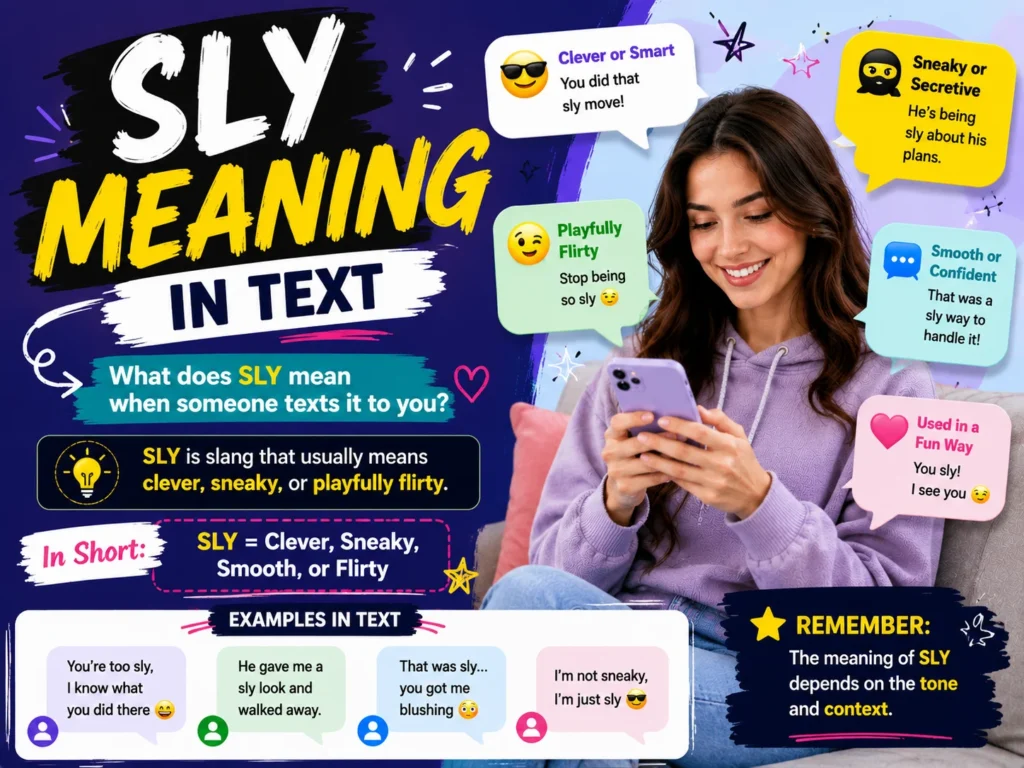
Sly meaning in text usually means clever, sneaky, secretive, or subtly mischievous. When someone calls a person “sly” in a message, they may be saying that person is quietly clever, hiding something, flirting indirectly, or doing something without making it obvious.
For example:
“You’re sly 😂”
can mean:
“I see what you’re doing, and you thought nobody would notice.”
The tone can be playful, suspicious, admiring, or slightly critical. Context matters more than the word alone.
Sly Meaning in Text – Quick Meaning
“Sly” is an English adjective, not an acronym or abbreviation.
In texting, it can mean:
- Clever in a secretive way
- Sneaky
- Mischievous
- Quietly strategic
- Flirty without being obvious
- Trying to hide an intention
- Playfully dishonest
- Smooth or subtle
For example:
“You’re so sly 😭”
often means the sender noticed something sneaky or clever.
“That was a sly move.”
means someone handled something subtly or strategically.
“Sly little flirt 😂”
suggests someone was flirting without saying it directly.
Origin & Background of Sly
Where the Word Came From
“Sly” has been used in English for centuries to describe someone who is clever in a secretive, tricky, or indirect way.
Traditionally, it could sound negative, especially when describing deception.
Someone described as sly might have been seen as cunning or untrustworthy.
Modern texting softened that meaning.
Today, friends often use “sly” jokingly:
“You posted that picture just so he’d see it. Sly 😂”
The person is not necessarily being accused of serious dishonesty. The message usually means:
“I noticed your little plan.”
How Social Media Changed Its Tone
Social media made indirect behavior common.
People post Stories hoping one specific person sees them. They like old photos strategically.
and,
They send vague captions. They flirt through reactions instead of direct messages.
“Sly” fits that kind of behavior perfectly.
It describes actions that are intentional but not openly admitted.
That is why the word frequently appears in Instagram DMs, TikTok comments, Snapchat chats, and private messages.
Read More : Body Count Meaning in Text: Dating Slang Explained
Real-Life Conversations Using Sly
WhatsApp Conversation
Person A: I saw you sat next to Maya again.
Person B: There were no other seats 😭
and,
Person A: Sure. Sly guy 😂
Person B: Stop exposing me.
Here, “sly” means secretly interested or intentionally sneaky in a funny way.
Instagram DM
Person A: You posted that song right after the argument.
Person B: Coincidence.
and,
Person A: That was sly 😂
Person B: Maybe a little.
Here, “sly” suggests the post had a hidden message.
TikTok Comments
Person A: He casually mentioned he’s single in every answer 😭
and,
Person B: Sly marketing 😂
moreover,
Person A: He knows exactly what he’s doing.
Here, “sly” means clever and calculated without being obvious.
Text Message
Person A: You knew they were giving free dessert if it was your birthday?
Person B: Maybe.
and,
Person A: And you didn’t tell us until after ordering?
Person B: Strategic planning.
moreover,
Person A: Sly 😭
This is playful rather than insulting.
Emotional & Psychological Meaning of Sly
What Emotion Does “Sly” Express?
“Sly” usually carries a feeling of recognition.
The sender believes they have noticed something beneath the surface.
That can create several emotional tones:
- Playful suspicion
- Admiration
- Teasing
- Flirtation
- Mild criticism
- Amusement
- Distrust
The exact emotion depends on the relationship.
Imagine telling a friend:
“I just happened to be near her café, so I stopped in.”
Your friend responds:
“Sly 😂”
They probably don’t believe it was completely accidental.
They are saying:
“You planned that, didn’t you?”
That hidden-understanding quality makes “sly” especially useful in casual communication.
Sly Meaning in Different Contexts
Social Media
On Instagram, TikTok, Snapchat, and X, “sly” often describes indirect behavior.
Examples include:
“Posting that selfie after he viewed your Story? Sly.”
“Dropping your business link in the comments. Sly 😂”
“Using that audio so she notices? Very sly.”
The word often points to strategy hidden inside apparently casual behavior.
Friends
Friends commonly use “sly” as teasing.
If someone quietly gets the best seat, secures free food, or arranges to sit beside their crush, a friend may call them sly.
In this context, it usually isn’t serious criticism.
Relationships and Flirting
“Sly” can have a flirtatious meaning.
Someone might say:
“That compliment was sly.”
They mean the compliment was delivered subtly rather than directly.
Another example:
“You’re sly with these late-night messages 👀”
This suggests the sender thinks there may be romantic intention behind the messages.
Work and Professional Settings
“Sly” is riskier in professional communication because it can sound accusatory.
Calling a coworker “sly” might imply manipulation or dishonesty.
Instead of saying:
“That was sly.”
professional language might be:
“That was a clever approach.”
or:
“That was strategically handled.”
Casual vs. Serious Tone
In casual conversation, “sly” often sounds playful.
In serious conversations, it can sound negative.
Compare:
“You sly thing 😂”
with:
“He was sly about the contract.”
The first is teasing.
The second suggests dishonesty.
When NOT to Use Sly
Avoid calling someone sly when trust is already sensitive.
If someone has been accused of lying, manipulation, cheating, or hiding important information, “sly” may sound like a serious accusation.
It can also be inappropriate in formal workplaces where words such as “clever,” “strategic,” or “subtle” are clearer.
Cultural differences matter too.
Some English learners may understand “sly” only through its traditional negative meaning and assume you are calling them dishonest.
When the tone could be misunderstood, choose clearer wording.
Common Misunderstandings About Sly
“Sly Always Means Sneaky in a Bad Way”
No.
It can mean sneaky, but modern casual texting often uses it playfully.
“You’re sly 😂” may actually be affectionate teasing.
“Sly Means Shy”
No.
“Sly” and “shy” sound similar but have completely different meanings.
Shy means nervous, quiet, or uncomfortable socially.
Sly means clever or secretive.
“Sly Means Someone Is Lying”
Not necessarily.
Someone can be sly without directly lying.
They may simply hide their intentions or act strategically.
“Sly Is Always an Insult”
No.
It can even sound like admiration:
“That was actually sly.”
This might mean:
“That was really clever.”
“Sly Is a Slang Acronym”
No.
Sly is a normal English word, not an abbreviation like LOL or WYD.
Sly Compared With Similar Expressions
| Word | Meaning | Tone | Example |
|---|---|---|---|
| Sly | Clever and secretive | Playful/negative | “You’re sly 😂” |
| Sneaky | Acting secretly | Often negative | “That was sneaky.” |
| Clever | Smart or skillful | Positive | “Clever move.” |
| Cunning | Clever in a tricky way | Mixed | “A cunning plan.” |
| Smooth | Socially clever/charming | Positive/playful | “That was smooth.” |
| Shady | Suspicious or dishonest | Negative | “That sounds shady.” |
| Subtle | Not obvious | Neutral/positive | “Very subtle.” |
| Tricky | Difficult or deceptive | Mixed | “That was tricky.” |
| Mischievous | Playfully troublesome | Playful | “That smile is mischievous.” |
| Strategic | Carefully planned | Neutral/positive | “Strategic move.” |
Key Insight
“Sly” sits between clever and sneaky. It can praise someone’s subtle strategy while also hinting that they are hiding their true intention.
10 Variations and Types of Sly Usage
1. “You’re Sly”
Meaning: I noticed what you were doing.
Usually playful between friends.
2. “Sly Move”
Meaning: A clever action done quietly.
Example:
“That was a sly move getting the best seat.”
3. “Sly Smile”
Meaning: A knowing or mischievous smile.
This suggests someone knows something others don’t.
4. “Sly Flirt”
Meaning: Someone who flirts subtly.
They may use compliments, eye contact, reactions, or indirect messages instead of openly flirting.
5. “Sly Comment”
Meaning: A remark with hidden meaning.
It can be teasing, sarcastic, or indirectly critical.
6. “Sly Dig”
Meaning: A subtle insult or criticism.
Example:
“That comment about her outfit felt like a sly dig.”
7. “Sly Joke”
Meaning: A joke that contains a hidden reference.
It often works only if you understand the situation.
8. “Sly Look”
Meaning: A secretive, knowing glance.
This often suggests mischief or shared understanding.
9. “Sly Strategy”
Meaning: A clever plan that isn’t immediately obvious.
This can be positive or negative depending on the purpose.
10. “Sly One”
Meaning: A playful way of calling someone sneaky or clever.
Example:
“You planned all of this, you sly one 😂”
How to Respond When Someone Calls You Sly
Casual Replies
“Who, me? 😂”
“You noticed?”
“Maybe a little.”
“I have no idea what you mean 😭”
Funny Replies
“I prefer strategically gifted 😂”
“Caught me.”
“Can’t reveal my methods.”
“Sly? I call it talent 😌”
Flirty Replies
If the conversation is clearly playful:
“You figured me out already? 👀”
“Maybe I wanted you to notice.”
“Was I that obvious? 😂”
Mature Replies
If you’re unsure whether it was criticism:
“What do you mean by sly?”
“Do you mean clever or sneaky?”
“I wasn’t trying to hide anything.”
Respectful Replies
Don’t become defensive immediately.
Tone is difficult to read through text. Asking what someone meant can prevent a playful comment from turning into an unnecessary argument.
Regional & Cultural Usage of Sly
Western Culture
“Sly” is widely understood in English-speaking countries as clever, sneaky, or mischievous.
The tone depends heavily on context.
Expressions like “sly smile” and “sly look” are also common.
Asian English Usage
English speakers across Asia may use “sly” more literally to describe someone as cunning or sneaky.
Playful Gen Z usage can still appear through global social media.
Middle Eastern English Usage
Among English-speaking social-media users, “sly” may be understood through both traditional English and internet culture.
Because tone varies between communities, emojis such as 😂 or 👀 often help clarify playful intent.
Global Internet Usage
Online, “sly” frequently appears around:
- Flirting
- Indirect posts
- Hidden jokes
- Strategic comments
- Suspicious behavior
- Clever social moves
It travels easily because its basic meaning is already part of standard English.
Gen Z vs. Millennials
Gen Z may use “sly” in teasing phrases connected with DMs, Stories, soft flirting, and indirect social-media behavior.
Millennials are also familiar with the word but may use it slightly more traditionally to mean clever or secretive.
Neither generation has a completely different definition.
Is “Sly” Safe for Kids?
Yes. “Sly” is not an offensive or adult word.
Children may encounter it in books, cartoons, schoolwork, and everyday conversation.
The only thing to explain is tone.
Calling someone “sly” can be playful, but it can also suggest dishonesty. Kids should understand that words describing someone’s character can feel stronger than intended.
FAQs About Sly Meaning in Text
What does sly mean in text?
“Sly” in text usually means clever, sneaky, secretive, or mischievous. It often describes someone doing something subtly without openly admitting their intention.
What does “you’re sly” mean?
“You’re sly” usually means “I noticed your clever or sneaky behavior.” It can be playful teasing or mild criticism depending on tone.
What does sly mean from a guy?
If a guy calls you sly, he may think you are being clever, teasing, secretive, or subtly flirtatious. The surrounding conversation determines whether he means it positively or negatively.
What does sly mean from a girl?
If a girl says “you’re sly,” she may be teasing you for doing something clever or sneaky. It can also suggest she noticed hidden flirting or another intention.
Is sly a compliment?
Sometimes. “Sly” can sound like a compliment when someone admires a clever move. It can also sound negative if it implies dishonesty.
Does sly mean flirting?
Not by itself. However, someone can describe flirting as “sly” when it is subtle or indirect.
What is the difference between sly and sneaky?
“Sneaky” usually sounds more negative. “Sly” can also mean secretive, but it often carries a clever, playful, or mischievous tone.
Conclusion
Understanding sly meaning in text comes down to tone and context.
Most often, “sly” describes someone who is clever, sneaky, mischievous, or quietly strategic. Between friends, “You’re sly 😂” usually means, “I noticed what you were doing.” In flirting, it can point to hidden interest. In serious situations, however, it may suggest dishonesty or manipulation.
Pay attention to the sentence, emojis, and relationship between the people involved.
If someone calls you sly and the meaning isn’t clear, don’t overthink one word. Ask whether they mean clever, sneaky, or playful.
Sometimes “sly” is criticism.
Sometimes it’s admiration.
And sometimes it is simply a friend telling you that your supposedly secret plan was never as secret as you thought.