You are scrolling through TikTok, reading an Instagram caption, or opening a long message when you suddenly see:
“TW:”
followed by a topic.
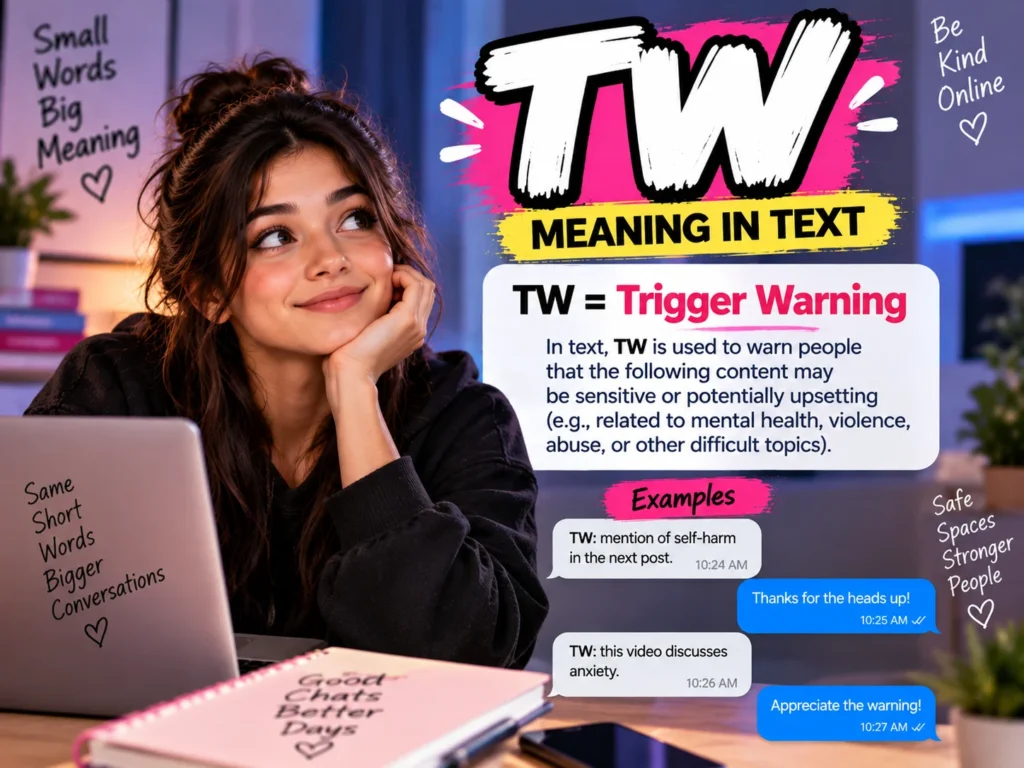
Those two letters may look like ordinary texting slang, but the most common TW meaning in text is “Trigger Warning.” Dictionary.com directly lists TW as an abbreviation for trigger warning, while Cambridge Dictionary describes a trigger warning as a notice placed before material that people may find particularly upsetting.
Unlike abbreviations such as LOL or BRB, TW is not usually the emotional reaction itself. It prepares you for what comes next.
For example:
“TW: discussion of grief.”
This tells the reader that the following message or post contains a sensitive discussion about grief.
You may see TW in private messages, TikTok captions, Reddit posts, Instagram stories, forums, Discord communities, and longer social-media discussions.
Its purpose is simple: give readers some advance context before they choose whether to continue.
TW Meaning in Text – Quick Meaning
TW most commonly stands for “Trigger Warning.”
It is placed before sensitive or potentially upsetting content.
Dictionary.com defines the full expression as a warning that immediately following text, video, or other material may cause distressing reactions, especially for someone with related past experiences.
Common formats include:
- TW: grief
- TW: violence
- TW: medical imagery
- TW: abuse discussion
- TW: disturbing content
For example:
“TW: accident details. I wanted to explain what happened yesterday.”
The abbreviation does not mean the writer is telling you that you will become distressed.
It gives you advance information so you can decide whether you want to continue.
Is TW the Same as a Content Warning?
They are closely related, but not always identical.
Cambridge defines a content warning as a notice that material may be upsetting or offensive. Its examples include subjects such as war scenes, nudity, and strong language. A trigger warning is generally framed more specifically around material that may be particularly upsetting, especially to someone with related experiences.
Online, however, people sometimes use TW and CW interchangeably.
Origin & Background of TW
Trigger warnings existed before TikTok and modern short-form social media.
Dictionary.com dates the phrase trigger warning to approximately 1990–95, showing that the concept is considerably older than today’s Instagram and TikTok culture.
As online communities expanded, the full phrase was naturally shortened.
Trigger Warning → TW
This made it easier to add a brief notice before:
- Forum posts
- Blog entries
- Personal stories
- Videos
- Discussion threads
- Social-media captions
Over time, the abbreviation became recognizable enough that users could simply write:
“TW: [topic]”
rather than explaining the purpose of the warning every time.
How Social Media Changed TW
Social media made the abbreviation more visible.
A person sharing an emotionally difficult experience on TikTok may begin the caption with TW.
A Reddit post may use:
TW // sensitive topic
A private group chat may include:
tw: hospital stuff
The presentation changes, but the basic function remains the same.
Slang.net also documents formats such as “TW: Topic” and “TW // Topic.”
This adaptability is one reason TW has remained useful across different platforms.
Real-Life Conversations Using TW
The easiest way to understand TW meaning in text is to see how it appears naturally.
WhatsApp Conversation
Person A: Can I tell you what happened at the hospital?
Person B: Yeah, of course.
and,
Person A: TW: medical details. It was a pretty difficult experience.
Person B: Thanks for telling me first. Go ahead when you’re ready.
Here, TW prepares the reader for the subject of the next message.
Instagram DM
Person A: I posted about what happened last year.
Person B: I saw it.
and,
Person A: I added a TW because some of the details are heavy.
Person B: That makes sense.
TW is being discussed as a label rather than ordinary conversation slang.
TikTok Comments
Person A: Could you add a TW before the graphic part?
and,
Person B: Sure, I’ll update the caption.
moreover,
Person C: Appreciate that.
This is a common way the abbreviation appears in comment sections.
Text Message
Person A: TW: grief. Today would have been my grandfather’s birthday.
Person B: I’m sorry. Take all the time you need.
Here, TW creates a small emotional buffer before a personal subject.
It does not replace empathy. It simply prepares the recipient for the topic.
Emotional & Psychological Meaning
TW carries an unusual emotional role because it is less about the writer’s feelings and more about the reader’s experience.
Using it can communicate:
- Awareness
- Consideration
- Caution
- Respect for personal boundaries
- Recognition that a subject may be difficult
Imagine receiving a long message with no introduction and suddenly encountering distressing details halfway through.
Now compare that with:
“TW: difficult medical experience.”
The second version gives you information before you begin.
That feeling of choice is central to how TW functions.
It Is a Warning, Not a Prediction
An important distinction is that a trigger warning does not claim that everyone will react negatively.
Two people can read the same post and respond very differently.
The warning simply tells readers what kind of material is ahead.
That makes specific wording more useful than vague wording.
For example:
Better: “TW: graphic injury description.”
Less useful: “TW: bad stuff.”
The first gives the reader meaningful information.
A Relatable Scenario
Suppose your close friend wants to tell you about a frightening accident.
Instead of suddenly sending detailed messages, they begin:
“TW: accident details. Skip this for now if you’re not in the headspace.”
You may still choose to read the story.
The difference is that you knew what was coming first.
That small courtesy captures the practical value of TW in digital communication.
Usage in Different Contexts
TW is not limited to mental-health communities. It now appears across many forms of online communication.
TikTok
TikTok creators may put TW:
- In the caption
- As text at the start of a video
- In an introductory slide
- In the comments
For example:
“TW: flashing imagery.”
The warning should ideally appear before the potentially difficult content rather than afterward.
Instagram users may add TW before:
- Personal stories
- Reels
- Carousel posts
- Captions
- Discussions of difficult events
Example:
“TW: loss. I haven’t spoken publicly about this before.”
WhatsApp and Private Messages
TW can also work between friends.
“TW: medical stuff—do you mind if I tell you what happened?”
In private communication, this can feel more personal because it gives the recipient an opportunity to say they would rather discuss the topic later.
Forums and Reddit-Style Discussions
Long-form communities helped normalize content labels before sensitive discussions.
A title might read:
“TW: discussion of grief and bereavement.”
Readers immediately know the subject before opening the full post.
Work and Professional Settings
In professional environments, spelling out “Content warning” may sometimes be clearer than TW.
For example:
Content warning: The following training material discusses workplace harassment.
This avoids assuming that every employee recognizes online shorthand.
Casual vs. Serious Tone
TW is unusual because lowercase spelling does not necessarily make it humorous.
“tw: breakup discussion”
can be every bit as serious as:
“TW: Breakup Discussion.”
Capitalization usually reflects personal style rather than a different meaning.
When NOT to Use TW and Common Misunderstandings
TW can be useful, but placing it before every mildly uncomfortable subject can make warnings less informative.
The best warning tells readers what kind of material follows.
Instead of:
“TW: sensitive.”
consider:
“TW: discussion of bereavement.”
Specificity helps readers make their own decision.
Don’t Put the Warning After the Content
Writing a detailed upsetting description and then adding:
“TW btw”
defeats the purpose.
The warning needs to appear first.
TW Does Not Mean “This Content Is Forbidden”
A trigger warning is not an automatic instruction to avoid something.
It provides advance notice.
Readers remain free to continue.
TW Does Not Mean Everyone Will Be Triggered
Individual reactions vary.
The abbreviation acknowledges that some readers may find the material difficult; it does not make a universal prediction.
TW Does Not Always Mean Trigger Warning Everywhere
Context matters.
Dictionary.com also records TW/tw as an abbreviation connected with Taiwan.
So:
“TW: disturbing imagery”
clearly means Trigger Warning.
But:
“Shipping destination: TW”
may refer to Taiwan rather than an emotional-content warning.
Don’t Use TW to Mock Someone’s Sensitivity
A sarcastic line such as:
“TW: someone disagreed with me 😂”
can trivialize why warnings are used.
Whether people personally choose to use trigger warnings frequently or rarely, using the term clearly is better than turning it into a vague insult.
TW Compared With Similar Slang and Expressions
| Term | Common Meaning | Main Purpose | Typical Context |
|---|---|---|---|
| TW | Trigger Warning | Warn before potentially distressing material | Social media/text |
| CW | Content Warning | Warn about upsetting/offensive content | Media/posts |
| NSFW | Not Safe for Work | Flag inappropriate workplace viewing | Internet |
| Spoiler Alert | Upcoming plot details | Prevent unwanted spoilers | Entertainment |
| Viewer Discretion | Caution before sensitive material | Audience warning | Video/TV |
| Heads-up | Advance notice | General warning | Everyday chat |
| FYI | For Your Information | Share useful information | Text/work |
| PSA | Public Service Announcement | Share public information | Social media |
| TW / tw | Taiwan in some contexts | Geographic abbreviation | International context |
| No Warning | Content begins directly | Opposite approach | General |
Key Insight
TW is more specific than a simple “heads-up” but often overlaps with CW. The clearest approach is not to worry endlessly about the perfect label—tell people what kind of content follows so they can make an informed choice.
Variations and Types of TW
TW does not have only one visual format. People adapt it depending on the platform.
1. TW:
The most common version.
Example:
“TW: grief.”
2. tw:
Lowercase version.
It generally carries exactly the same meaning.
3. TW //
The double-slash style is common in online communities.
Example:
“TW // medical imagery.”
4. TW —
A dash can introduce the topic.
Example:
“TW — discussion of an accident.”
5. Trigger Warning:
Writing the phrase in full provides maximum clarity.
6. CW
Content Warning is a closely related alternative.
Cambridge describes a content warning as a notice before material some people may find upsetting or offensive.
7. TW + Specific Topic
This is usually the most helpful format.
Example:
“TW: descriptions of violence.”
The topic matters more than the letters themselves.
8. Multiple TW Topics
A post may contain more than one relevant subject.
For example:
“TW: grief, hospital discussion.”
Specific labels allow readers to evaluate the content more accurately.
9. Visual TW
On videos, the warning may appear as on-screen text for several seconds before the main material begins.
10. Spoken Trigger Warning
Video creators, teachers, presenters, or podcasters may say the warning aloud rather than displaying TW in writing.
The format changes, but the purpose stays similar.
How to Respond When Someone Uses TW
TW usually does not require a special reply.
Respond to the message that follows.
Casual Replies
“Thanks for the heads-up.”
“Got it.”
“Okay, thanks for warning me.”
Supportive Replies
If a friend is about to share something difficult:
“Thanks for checking first.”
“I’m okay to talk about it.”
“You can tell me.”
When You Don’t Want to Continue
It is also completely reasonable to say:
“Thanks for the warning. I’m going to skip this one.”
“I’m not in the right headspace for that topic today.”
“Can we talk about this another time?”
A warning works best when readers feel free to act on the information it provides.
Respectful Replies
If the abbreviation is unfamiliar:
“What does TW mean here?”
That is better than guessing, especially if the context could support another meaning.
Regional & Cultural Usage
TW is primarily an English-language internet abbreviation, but social media has spread it globally.
Western Online Culture
Trigger warnings are widely recognizable across English-language social platforms, educational discussions, forums, and online communities.
Dictionary.com records the phrase itself from the early 1990s, meaning the concept predates the current social-media generation.
Asian Online Culture
English-speaking creators and users across Asia may use TW on TikTok, Instagram, YouTube, Reddit, Discord, and international communities.
Local-language equivalents may also be used alongside it.
Middle Eastern Online Culture
TW can appear among English-speaking creators, university communities, and international social-media audiences.
Its familiarity varies, so writing the topic clearly after the abbreviation is especially useful.
Global Internet Culture
TW works internationally because the format is compact:
TW: [topic]
Even users who speak different first languages can gradually learn the convention through repeated exposure.
Gen Z vs. Millennials
TW is strongly visible in Gen Z social media, but calling it exclusively Gen Z slang would be inaccurate.
The expression trigger warning dates back decades, while Millennials encountered it through blogs, Tumblr-style communities, forums, and earlier social networks.
Gen Z users have simply continued and adapted the convention across newer platforms.
Is TW Safe for Kids?
The abbreviation TW itself is harmless.
It simply means Trigger Warning.
However, the material following a TW may discuss subjects that are not appropriate for every child.
For example:
“TW: scary images.”
The letters are not the concern—the upcoming content may be.
For younger users, parents and educators can explain TW simply:
“It means there is a warning before something that some people may find upsetting.”
Children should also understand that seeing a warning does not mean they must continue watching or reading.
Choosing to skip uncomfortable content is a valid response.
FAQs About TW Meaning in Text
What does TW mean in texting?
TW most commonly means “Trigger Warning.” It appears before material that may be particularly upsetting or emotionally difficult for some readers.
What does TW mean on TikTok?
On TikTok, TW usually alerts viewers that an upcoming video, caption, or discussion contains sensitive material. It may appear as “TW: [topic]” before the main content.
What does TW mean on Instagram?
On Instagram, TW commonly means Trigger Warning and may appear before a Reel, Story, caption, carousel, or personal discussion.
What does “TW //” mean?
“TW //” is simply another formatting style for a trigger warning. For example, “TW // grief” means the following content discusses grief. Slang.net documents both colon and double-slash formats.
Does TW mean Twitter?
TW has occasionally been used as shorthand in other contexts, but Trigger Warning is the established dictionary meaning of uppercase TW in current online usage. Always check the sentence rather than assuming.
Is TW the same as CW?
They overlap, but they are not perfectly identical. TW generally focuses on potentially triggering or strongly upsetting material, while CW—Content Warning—can cover a broader range of potentially upsetting or offensive content.
Why do people put TW before posts?
People use TW to give readers advance information about sensitive material before they encounter it. This allows them to decide whether, when, or how they want to continue.
Conclusion
The most common TW meaning in text is “Trigger Warning.”
You will usually see it before a message, caption, video, story, or discussion that contains potentially difficult material.
A simple example is:
“TW: discussion of grief.”
The abbreviation tells you what kind of content is ahead before you read it.
TW is particularly common on TikTok, Instagram, Reddit-style forums, Discord, group chats, and private messages, but the underlying phrase is older than modern social media. Dictionary.com records trigger warning from approximately 1990–95.
The most useful way to write one is also the simplest:
TW + specific topic.
A vague warning such as “TW: sensitive content” provides less information than “TW: medical imagery” or “TW: discussion of loss.”
TW should also not be treated as a prediction that every reader will become distressed. It is advance information, giving people more context before they decide whether to continue.
And, as with almost every abbreviation, context matters.
TW can have other meanings—Dictionary.com also records a connection with Taiwan—so seeing the letters in a shipping address or international context does not necessarily mean Trigger Warning.
On social media, however, a format such as:
“TW: [sensitive topic]”
is a strong sign that Trigger Warning is the intended meaning.
Once you understand that pattern, TW becomes one of the easiest online abbreviations to recognize—and one of the few where what comes after the abbreviation is more important than the letters themselves.
For high CTR (click-through rate), titles and descriptions should create curiosity, a clear benefit, and a reason to click without giving everything away.