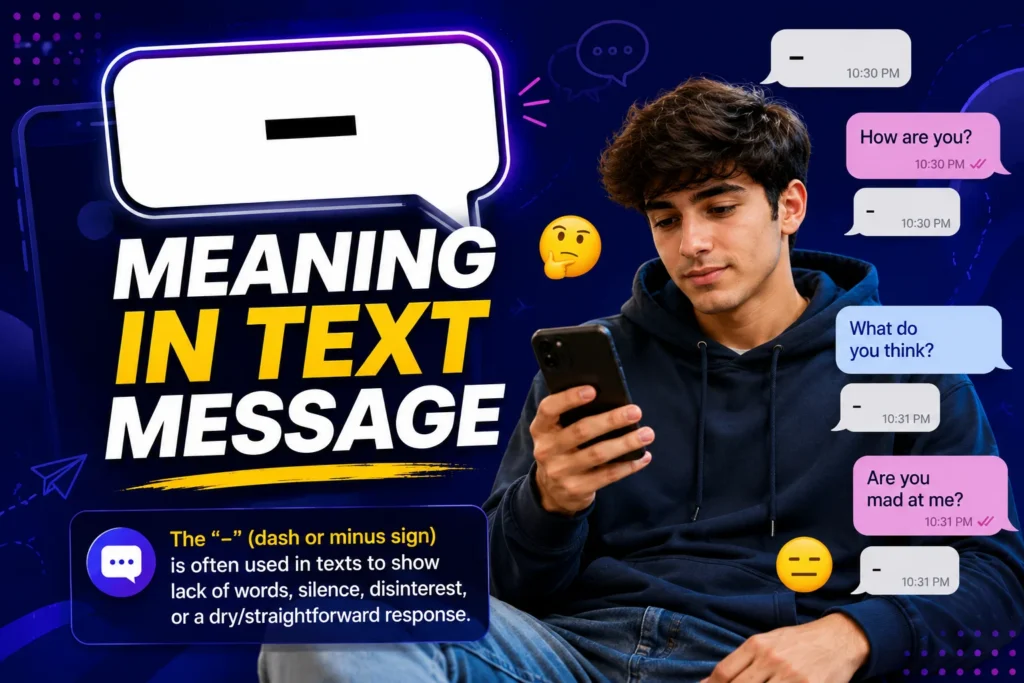
The “-” meaning in text message conversations is not always as simple as punctuation. When someone sends a single dash, ends a message with “-”, or uses several dashes, it can communicate hesitation, interruption, awkwardness, suspense, or an unfinished thought.
People often search for this because a dash can feel surprisingly emotional in a short conversation. A message like “okay-” does not always feel the same as “okay.” The dash can make the sender sound uncertain, caught off guard, playful, or as if they suddenly stopped themselves.
Its meaning depends heavily on context, the relationship between the people texting, and the sender’s normal communication style. Understanding those clues is more useful than treating “-” as having one fixed definition.
“-” Meaning in Text Message – Quick Meaning
In texting, “-” usually represents a pause, interruption, unfinished thought, hesitation, or sudden change in tone.
Unlike popular abbreviations such as “LOL” or “IDK,” the dash is not a slang acronym. Its meaning comes from how it affects the rhythm of a message.
Common interpretations include:
- A thought being cut short
- Hesitation or uncertainty
- Surprise or disbelief
- An awkward pause
- A dramatic interruption
- A playful unfinished sentence
- A sudden emotional reaction
For example:
“Wait- what?”
This usually suggests sudden surprise.
“I thought you were- never mind.”
Here, the dash shows that the speaker stopped or changed the thought.
“Okay-”
Depending on the conversation, this can sound uncertain, awkward, or slightly confused.
A Single Dash Sent Alone
When someone sends only “-”, there is no universal definition.
It may function like a digital pause. The sender might not know what to say, could be waiting for you to continue, or may be expressing awkward silence.
Context matters more than the symbol itself.
Origin & Background of the Dash in Digital Communication
The dash existed long before text messages and social media. In traditional writing, dashes have been used to mark interruptions, breaks in thought, additional information, and changes in sentence structure.
Digital communication gave the symbol a more expressive role.
People cannot easily reproduce facial expressions, pauses, voice changes, or body language through plain text. Punctuation therefore started doing emotional work.
From Grammar to Online Tone
Consider the difference between:
“Wait, what?”
and:
“Wait- WHAT?”
Both express confusion, but the second often feels more immediate. It resembles someone beginning a sentence and suddenly reacting.
Online communities gradually developed informal punctuation habits that do not always follow traditional grammar rules.
Social Media Influence
TikTok comments, Instagram DMs, Discord chats, gaming communities, and group conversations helped popularize expressive punctuation.
A dash can now imitate the rhythm of spoken conversation:
“I mean- you literally told him.”
The writer is not necessarily using formal punctuation. They are recreating how that sentence might sound aloud.
Read More : Meaning of NM in Text: Not Much or Never Mind?
Real-Life Conversations Using “-”
The “-” meaning in text message conversations becomes much easier to understand when you see it naturally.
WhatsApp Conversation
Person A: Did you actually tell Sarah everything?
Person B: I mean-
and,
Person A: You DID 😭
Person B: Okay, but let me explain.
Here, the dash suggests hesitation. Person B begins responding but seems unable to finish before Person A understands what happened.
Instagram DM
Person A: Your new profile picture is actually cute.
Person B: Actually-? 😭
Person A: I meant REALLY cute 😂
Person B: That sounded suspicious for a second.
The dash highlights playful surprise at the word “actually.”
TikTok Comments
Person A: Why did he look directly at the camera-
and,
Person B: BRO KNEW WHAT HE WAS DOING 😭
moreover,
Person A: I wasn’t ready 💀
The unfinished sentence adds humor. The first commenter does not need to complete the thought because everyone understands the reaction.
Text Message
Person A: Are you upset with me?
Person B: No, I just-
and,
Person A: Just what?
Person B: I need some time to think.
Here, the dash feels more serious. It indicates difficulty completing an emotional thought.
Emotional & Psychological Meaning of “-”
Texting removes many communication signals that humans normally rely on.
During face-to-face conversation, you can hear hesitation in someone’s voice. You can notice when they stop speaking, look away, laugh nervously, or suddenly change expression.
A dash can recreate part of that experience digitally.
It Can Show Hesitation
Someone might type:
“I wanted to ask you-”
The unfinished ending creates uncertainty. Perhaps they are nervous about what comes next.
It Can Express Shock
Messages such as:
“Hold on-”
or:
“YOU DID WHAT-”
often communicate immediate surprise.
The sender appears to have interrupted their own thought because something caught them off guard.
It Can Create Awkwardness
A message like:
“oh-”
can feel very different from:
“oh!”
The second feels energetic. “Oh-” may suggest uncomfortable realization or uncertainty.
Imagine telling a friend that the person they were joking about is standing beside you. Their response might simply be:
“Oh-”
That tiny dash can communicate the entire awkward moment without requiring another sentence.
How “-” Is Used in Different Contexts
The dash changes meaning according to where and how it appears.
Social Media
On TikTok, Instagram, X, and similar platforms, dashes are commonly used for comedic interruption and dramatic reactions.
Examples include:
“Why is nobody talking about the ending-”
“I thought that was his brother- 😭”
These sentences often intentionally remain unfinished.
Friends and Relationships
Between friends, the dash can signal teasing, confusion, hesitation, or mock shock.
In romantic conversations, however, punctuation may feel more emotionally significant.
“I like you-”
could suggest nervousness or uncertainty rather than a straightforward declaration.
Work and Professional Settings
Informal dash usage should be approached more carefully in professional communication.
A message such as:
“I reviewed the document-”
looks unfinished.
In professional writing, complete sentences and standard punctuation are usually clearer unless a dash has a legitimate grammatical purpose.
Casual vs. Serious Tone
In casual conversations, “-” can be humorous and expressive.
During serious discussions, the same symbol may indicate discomfort or emotional hesitation.
Never interpret punctuation without reading the surrounding conversation.
When NOT to Use “-”
Although dashes are common online, they are not suitable everywhere.
Avoid excessive informal dash usage in formal emails, academic assignments, job applications, official messages, or conversations where clarity is especially important.
Sensitive Conversations
During an argument, vague punctuation can create unnecessary confusion.
Writing:
“Fine-”
may sound passive-aggressive even if you simply meant “fine.”
A clearer response is often better when emotions are already high.
Cross-Cultural Communication
Not every person interprets digital punctuation in the same way.
Someone who uses texting mainly for practical communication may see a dash as nothing more than punctuation. A younger social-media user might interpret the same symbol as hesitation or dramatic interruption.
Do not assume emotional intent without evidence.
Common Misunderstandings About “-” in Text
One major mistake is assuming that every dash means the sender is angry.
It does not.
“-” Does Not Automatically Mean Annoyance
A dash can indicate surprise, hesitation, humor, interruption, or simply someone’s personal typing habit.
A Dash Is Not Always Slang
Technically, “-” is punctuation rather than a slang word.
However, its informal online usage can function similarly to internet slang because users attach conversational meaning to it.
“Okay-” and “Okay.” Are Different
“Okay.” can sound final or serious.
“Okay-” may sound hesitant, surprised, or interrupted.
and,
“Okay!” usually sounds enthusiastic.
“Okay 😂” may indicate amusement.
The word remains identical, but punctuation changes the perceived emotional tone.
“-” Compared With Similar Texting Expressions
| Expression | Common Meaning | Typical Tone | Example |
|---|---|---|---|
| – | Pause or interruption | Hesitant/dramatic | “Wait-” |
| … | Lingering pause | Awkward/uncertain | “Okay…” |
| — | Strong interruption | Dramatic | “But I—” |
| ? | Question/confusion | Curious | “Really?” |
| ?! | Shock + question | Surprised | “You did what?!” |
| !! | Strong emphasis | Excited/intense | “WAIT!!” |
| . | Completion | Neutral/serious | “Okay.” |
| 😭 | Crying/laughter | Emotional/playful | “Stop 😭” |
| 💀 | “I’m dead” reaction | Humorous | “No way 💀” |
| /j | Joking indicator | Clarifying | “You’re terrible /j” |
Key Insight
The dash is unusual because its meaning often comes from what is missing after it. It creates the impression that the sender paused or stopped before completing a thought.
10 Variations of “-” in Texting
Small changes in placement can create noticeably different meanings.
1. “-”
A dash sent alone may represent silence, hesitation, or an awkward pause.
2. “Wait-”
Usually expresses sudden realization or interruption.
3. “Oh-”
Often signals awkward surprise or unexpected information.
4. “Okay-”
May communicate confusion, hesitation, or mild disbelief.
5. “But-”
Suggests that the person wants to object but gets interrupted or does not finish.
6. “I mean-”
Often appears when someone realizes their explanation may be difficult or embarrassing.
7. “What-”
Usually expresses disbelief rather than a normal question.
8. “Bro-”
Common in humorous conversations when something is ridiculous, shocking, or embarrassing.
9. “You actually-”
Creates dramatic disbelief and leaves the listener to understand the rest.
10. “-_-”
This is different from a plain dash. The combination forms an old-school emoticon representing annoyance, disappointment, or an unimpressed facial expression.
How to Respond When Someone Uses “-”
Your response should match the situation rather than the punctuation alone.
Casual Replies
You could respond with:
- “What? 😂”
- “Go on…”
- “You were saying?”
- “Wait, what happened?”
- “Finish the sentence 😭”
Funny Replies
For playful conversations:
- “Bro stopped mid-sentence 💀”
- “Don’t leave me hanging 😭”
- “The dash is concerning 😂”
- “HELLO?? Finish that thought.”
Mature Replies
If the conversation feels emotional:
- “Take your time.”
- “You can tell me.”
- “What were you going to say?”
- “It’s okay if you’re not sure how to explain it.”
Respectful Replies
When you cannot determine the tone, ask instead of assuming.
“What did you mean by that?”
A simple question can prevent a minor punctuation choice from becoming a major misunderstanding.
Regional & Cultural Usage of “-”
There is no single worldwide rule for the “-” meaning in text message conversations. Digital communication habits differ across communities, languages, age groups, and platforms.
Western Internet Culture
In English-language social media, the dash frequently imitates interrupted speech.
“Girl-”
can communicate disbelief without needing another sentence.
Asian Digital Culture
English-speaking users across Asian online communities may use dashes similarly, particularly on globally popular platforms.
Local languages and punctuation traditions can still influence interpretation.
Middle Eastern Digital Culture
Multilingual users may switch between English, Arabic, Romanized language, emojis, and punctuation within the same conversation.
As a result, the dash may be expressive in one conversation and purely grammatical in another.
Global Internet Usage
Memes and short-form videos have made punctuation styles increasingly international.
Users often learn communication habits from online communities rather than formal grammar lessons.
Gen Z vs. Millennials
Gen Z communication often uses punctuation creatively to imitate speech, exaggerate reactions, or create ironic humor.
Millennials also use expressive punctuation extensively, although habits vary by platform and individual.
Neither generation has one universal interpretation.
Is “-” Safe for Kids?
Yes. A dash itself is simply a punctuation mark and is completely harmless.
Parents should still consider the surrounding conversation. Like almost any symbol, “-” can appear inside messages containing inappropriate language, bullying, or adult topics.
The symbol itself is not the concern; context determines whether a conversation is appropriate.
FAQs About “-” Meaning in Text Message
What does “-” mean when someone texts it alone?
A single dash may indicate a pause, awkward silence, hesitation, or an unfinished response. There is no universal meaning, so check the surrounding conversation.
What does “okay-” mean in texting?
“Okay-” often sounds hesitant, surprised, confused, or interrupted. It can feel less definite than simply writing “okay.”
What does “oh-” mean in a text?
“Oh-” commonly expresses sudden realization, awkwardness, disappointment, or mild shock. The exact emotion depends on what was said immediately before it.
Does “-” mean someone is mad?
Not necessarily. A dash can communicate many emotions, including confusion, surprise, nervousness, and humor. Look for additional signs before assuming anger.
What does “wait-” mean in texting?
“Wait-” usually signals sudden surprise or realization. It resembles someone interrupting themselves during spoken conversation.
Why do people end messages with a dash?
People may end messages with a dash to make the sentence feel unfinished, imitate interrupted speech, show hesitation, or add dramatic effect.
Is “-” slang?
The dash is technically punctuation, not slang. However, informal texting culture has given it expressive functions that go beyond traditional punctuation rules.
Conclusion
Understanding the “-” meaning in text message conversations is mostly about reading tone. A dash can represent hesitation, surprise, interruption, awkwardness, humor, or an intentionally unfinished thought.
Its flexibility is exactly why it appears so often in modern digital conversations. People use punctuation to replace some of the pauses, expressions, and vocal changes that disappear when communication moves onto a screen.
So when someone sends “wait-,” “oh-,” or simply “-”, do not immediately assume something negative. Look at the conversation, your relationship with the sender, and how that person normally texts. Those clues usually reveal far more than the dash itself.