
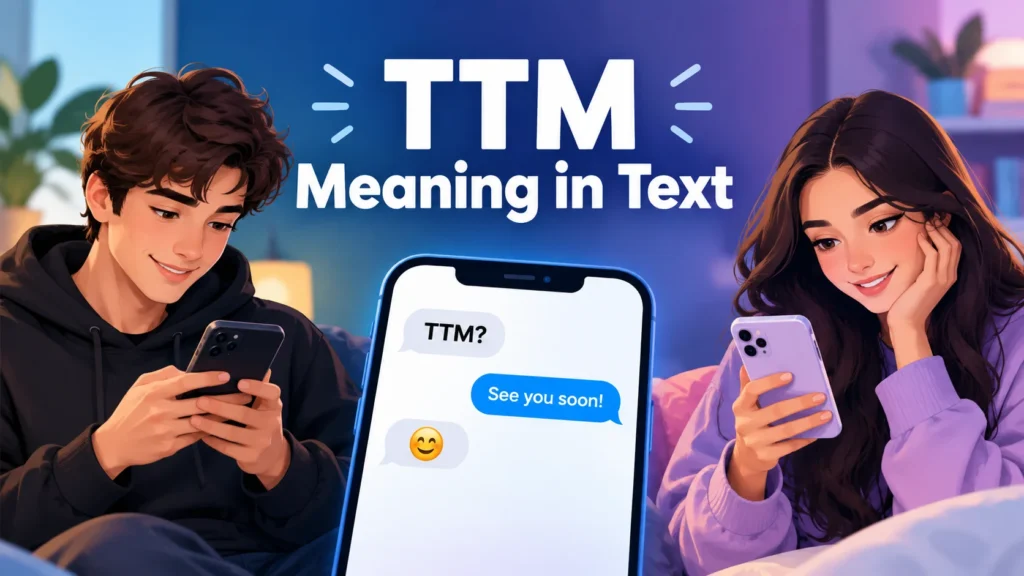
Have you received a message saying “TTM” and wondered what the sender meant? Texting abbreviations can make conversations quicker, but unfamiliar combinations of letters can leave you guessing, especially when you are chatting with friends, someone you like, or a new online contact.
TTM commonly means “Talk to Me” in casual texting. It can encourage someone to open up, start a conversation, or share what is on their mind. However, the intended meaning can vary with context, and TTM may have other meanings in specific communities or professional settings.
Understanding the surrounding message helps you recognize whether the sender wants to talk, needs your attention, or is using the abbreviation in another way. This guide explains TTM with practical examples, common interpretations, conversational tips, and answers to frequently asked questions.
TTM Meaning in Text – Quick Explanation
In casual texting, TTM often stands for “Talk to Me.” People may use it when they want someone to respond, share their thoughts, or feel comfortable discussing something personal.
The tone depends on the conversation. A friend might use TTM to check in, while a romantic interest may use it to encourage a more open conversation.
Examples include:
- “Hey, TTM. You seem quiet today.” — The sender is inviting the other person to talk.
- “If something is bothering you, TTM.” — The sender is offering a chance to share feelings.
- “TTM when you get a chance.” — The sender wants to talk when the recipient is available.
Although “Talk to Me” is a useful interpretation in casual messaging, abbreviations are not always universal. When the sentence does not fit this meaning, ask the sender what they intended.
Origin and Background of TTM
How TTM Became Useful in Digital Conversations
Texting abbreviations developed as people looked for quicker ways to communicate through SMS, instant messaging, and online chatrooms. Short expressions made it easier to send messages without typing complete sentences every time.
Common forms such as LOL, BRB, and IDK became familiar across many online communities. Other abbreviations remained less standardized, with meanings shaped by particular groups or situations.
TTM fits naturally into the habit of shortening everyday phrases. When it means “Talk to Me,” it compresses a direct invitation into three letters.
The Influence of Social Media
Social media platforms encourage short, conversational messages. On Instagram, Snapchat, TikTok, and WhatsApp, people often use abbreviations to sound relaxed or keep a conversation moving.
TTM can be especially useful when someone wants to encourage a reply without writing a long message. Its meaning still depends on the context, because not every person uses the same shorthand.
How Its Meaning Can Change
Abbreviations sometimes develop different meanings in workplaces, online communities, or specialist discussions. For example, TTM can also mean “trailing twelve months” in financial reporting, where it describes a twelve-month period of historical results.
That professional meaning is very different from the conversational use of “Talk to Me.” The subject of the discussion usually makes the intended interpretation clear.
Read More : SOL Meaning in Text: What Does SOL Mean?
Real-Life Conversations Using TTM
The following examples show how TTM might appear in everyday messaging when the intended meaning is “Talk to Me.”
Example 1: WhatsApp Conversation
Person A: You have been quiet all day. Everything okay?
Person B: Yeah, just dealing with a few things.
Person A: It’s okay if you need time. TTM when you’re ready.
Person B: Thanks. I might tell you about it later.
Meaning: The sender is letting their friend know that they are available to listen without demanding an immediate response.
Example 2: Instagram Direct Message
Person A: I saw your story. You don’t seem very happy.
Person B: It’s been a rough week, honestly.
Person A: I’m sorry. TTM if you want to talk.
Person B: I appreciate that. Thank you.
Meaning: TTM is being used as a supportive invitation to share feelings.
Example 3: TikTok Comment
Person A: I don’t know who to talk to about this.
Person B: TTM. Sometimes it helps to get things off your chest.
Person A: I might message you. Thanks.
Meaning: The reply offers a conversation rather than judging the person’s situation. In a public comment, however, sharing sensitive details privately may be safer.
Example 4: Text Messages Between Partners
Person A: You have seemed distant lately. Did I do something wrong?
Person B: No, I’m just stressed about work.
Person A: Okay. TTM when you’re ready. I don’t want you to feel alone.
Person B: That means a lot. I’ll talk to you tonight.
Meaning: The abbreviation communicates openness and patience. The full message, rather than TTM alone, conveys the emotional support.
Emotional and Psychological Meaning of TTM
What Emotion Does TTM Express?
When TTM means “Talk to Me,” it can communicate interest, concern, openness, or a desire for connection. The sender may want to understand what another person is thinking or give them space to explain a situation.
Its emotional meaning depends on the words around it. A gentle message may sound supportive, while a repeated demand to talk can feel pressuring.
Why People Use TTM
People often find it difficult to begin sensitive conversations. A short invitation can make the first step feel less intimidating, especially when someone is upset or unsure how to explain their feelings.
TTM also helps avoid a long message when the sender simply wants to let the other person know that they are available.
A Relatable Personal-Style Scenario
Imagine a friend who usually sends jokes and updates suddenly stops replying as often. You do not want to pressure them, but you want them to know you care.
You might write, “I’m here if you need me. TTM whenever you’re comfortable.” The message offers support while allowing your friend to choose when, or whether, to talk.
That balance is important: an invitation to communicate should make someone feel welcome, not obligated.
How TTM Is Used in Different Contexts
TTM on Social Media
On social media, TTM may appear in comments, captions, stories, or direct messages. A person might use it to invite replies, encourage discussion, or let a follower know they are open to conversation.
For example, “Got something on your mind? TTM” can sound like a casual invitation. The audience and surrounding content help determine whether the message is friendly, serious, or promotional.
TTM Between Friends
Friends may use TTM when they want to reconnect or check on someone. It can be a quick way to say that they are available to listen.
The abbreviation works best when the relationship already feels comfortable. A complete sentence may be better when the situation is sensitive or the recipient is unfamiliar with texting slang.
TTM in Romantic Conversations
In a romantic conversation, TTM may suggest that someone wants more communication or emotional openness. It could appear when a partner feels distant or when someone wants to understand another person’s thoughts.
Still, TTM does not automatically mean flirting or romantic interest. The surrounding conversation and the relationship provide the more reliable clues.
TTM in Work or Professional Settings
TTM is generally less suitable for formal workplace messages when the recipient may not understand it. Instead of writing “TTM about the report,” you could say, “Please contact me to discuss the report.”
In business and finance, TTM may also mean “trailing twelve months.” In that setting, it describes historical financial data covering the most recent twelve-month period, not an invitation to chat.
Casual vs. Serious Tone
In casual conversations, TTM can sound relaxed and friendly. During a serious discussion, its tone depends on how it is phrased.
“TTM 😂” may feel playful between friends, whereas “Please TTM when you’re ready” can sound more considerate. The abbreviation alone does not determine the emotional tone.
When Not to Use TTM
Avoid It When Clarity Is Important
Do not rely on TTM when communicating important instructions, deadlines, or sensitive information. If the other person does not know the abbreviation, they may misunderstand your message.
Writing “Please call me when you are available” is clearer when the meaning matters.
Avoid Pressuring Someone to Talk
Although TTM can be supportive, repeatedly sending it to someone who has asked for space may feel intrusive. People need different amounts of time to process their thoughts and feelings.
A respectful message gives the recipient a choice. For example, “I’m here if you want to talk, but take the time you need” communicates care without pressure.
Avoid It in Formal Writing
Academic assignments, official letters, job applications, and formal business emails usually require complete wording. Use “Talk to me” only when that phrase fits the situation, and spell out your request clearly.
In financial documents, define technical abbreviations when necessary so that readers understand the data being discussed.
Consider Cultural and Language Differences
People from different language backgrounds may not recognize TTM as “Talk to Me.” If you are communicating across cultures or with someone learning English, a complete sentence is often more effective.
Clear communication matters more than saving a few keystrokes.
Common Misunderstandings About TTM
Assuming TTM Always Means “Talk to Me”
“Talk to Me” is a common casual interpretation, but TTM is not limited to texting. It has other meanings in professional and specialized contexts.
Always check whether the surrounding subject is a personal conversation, a business discussion, or something else.
Assuming It Always Indicates Romantic Interest
Someone who sends TTM may simply want a conversation or be offering support. It is not reliable evidence of flirting, attraction, or a deeper emotional connection.
Look at the complete exchange before interpreting the sender’s intentions.
Confusing an Invitation With a Demand
TTM can sound welcoming when used gently. Repeatedly sending it after someone has declined to talk may feel demanding instead.
The difference often comes from the wording and the sender’s willingness to respect boundaries.
Overlooking the Financial Meaning
In business and investing, TTM often stands for “trailing twelve months.” For example, a company may report revenue for the most recent twelve months to help readers evaluate its performance.
This is a technical use of the abbreviation, not a slang definition. Financial context makes the distinction clear.
TTM Compared With Similar Texting Abbreviations
| Abbreviation | Common meaning | Typical use |
|---|---|---|
| TTM | Talk to Me | Inviting someone to talk |
| HMU | Hit Me Up | Asking someone to contact you |
| WYD | What You Doing? | Asking what someone is doing |
| WYA | Where You At? | Asking about someone’s location |
| WYM | What You Mean? | Asking for clarification |
| HBU | How About You? | Asking about the other person |
| LMK | Let Me Know | Requesting an update or answer |
| BRB | Be Right Back | Saying you will return shortly |
| IDK | I Don’t Know | Expressing uncertainty |
Key Insight
TTM focuses on inviting someone to communicate, while expressions such as HMU and LMK have different purposes. Understanding the intended action helps you choose the right abbreviation and interpret messages accurately.
Variations and Types of TTM
The following examples show common ways TTM may appear in casual messages when it means “Talk to Me.” The extra words and punctuation influence tone, rather than creating a completely new definition.
1. TTM
Meaning: Talk to Me.
The basic uppercase form can be used as a direct invitation to communicate.
2. ttm
Meaning: Talk to Me.
Lowercase lettering often feels relaxed and informal in everyday chats.
3. TTM pls
Meaning: Talk to me, please.
Adding “pls” makes the request more explicit, though its tone depends on the situation.
4. TTM when free
Meaning: Talk to me when you are available.
This version communicates that the sender would like a conversation without necessarily requiring an immediate reply.
5. TTM later
Meaning: Talk to me later.
The additional word suggests that the conversation can happen at a later time.
6. TTM if you want
Meaning: Talk to me if you feel comfortable doing so.
This phrasing gives the recipient more freedom to decide whether to open up.
7. TTM ❤️
Meaning: An invitation to talk with an affectionate or supportive tone.
The heart emoji may suggest warmth, but its exact meaning depends on the relationship.
8. TTM 😂
Meaning: An invitation to talk in a playful context.
The laughing emoji can make the message feel lighthearted rather than serious.
9. TTM ASAP
Meaning: Talk to me as soon as possible.
This wording suggests urgency. Use it carefully because it can sound demanding if the situation does not justify it.
10. TTM about this
Meaning: Talk to me about this topic.
The extra phrase clarifies what the sender wants to discuss, although the context still matters.
How to Respond When Someone Uses TTM
Your response should match the sender’s tone and your willingness to have a conversation. You do not need to overthink a short abbreviation.
Casual Replies
- “Sure, what’s up?”
- “Yeah, I’m here.”
- “What’s on your mind?”
- “Of course, tell me.”
Funny Replies
- “I’m listening. Give me the full story 😂”
- “Okay, I’m all ears!”
- “The floor is yours!”
- “What’s the latest drama? 😂”
Use playful replies only when the conversation is lighthearted and the other person is likely to appreciate the humor.
Mature Replies
- “Sure, I’m available to talk.”
- “Of course. What’s going on?”
- “I’m happy to listen. Take your time.”
- “Let me finish this task, and then we can talk.”
These responses show that you are willing to communicate while being honest about your availability.
Respectful Replies
- “I’m here if you want to share.”
- “You can tell me when you’re comfortable.”
- “I may not have all the answers, but I’ll listen.”
- “Would you prefer to talk now or later?”
If you are not ready to talk, you can set a boundary kindly: “I can’t talk right now, but I’ll message you when I’m free.”
Regional and Cultural Usage of TTM
Western Culture
In English-speaking communities across the United States, the United Kingdom, Canada, and Australia, short texting expressions are common in informal conversations. TTM may be understood as “Talk to Me” when the context supports that interpretation.
Usage still varies from person to person, so it is not safe to assume that every recipient knows the abbreviation.
Asian Culture
Across Asian countries, people often mix English abbreviations with local languages in messaging apps. TTM may appear in English-language conversations, but familiarity depends on the person’s social circle and online habits.
A complete phrase can be easier to understand when communicating across language backgrounds.
Middle Eastern Culture
People in Middle Eastern communities may use English abbreviations alongside Arabic and other languages. Friends and family members can also develop their own shorthand.
When TTM appears in a mixed-language message, the surrounding words are particularly useful for identifying the intended meaning.
Global Internet Usage
Digital communication connects people who may have very different texting habits. An abbreviation that feels obvious to one person may be unfamiliar to someone else.
TTM can be useful in casual messages, but writing the complete phrase helps avoid confusion in international conversations.
Gen Z vs. Millennials
Both Gen Z and Millennials use abbreviations, although their preferred expressions can vary by platform, community, and personal habit. Neither generation uses every abbreviation in the same way.
It is more accurate to consider the individual conversation than to assign TTM exclusively to one age group.
Is TTM Safe for Kids?
When TTM means “Talk to Me,” the abbreviation itself is generally harmless. It may simply invite a child or teenager to have a conversation.
However, the surrounding message and the sender’s identity matter. Parents can teach children not to share private information with unfamiliar online contacts and to seek help from a trusted adult if a message makes them uncomfortable.
Children should also understand that they do not have to respond immediately or continue a conversation that feels inappropriate.
FAQs About TTM Meaning in Text
1. What does TTM stand for in texting?
TTM commonly stands for “Talk to Me” in casual texting. It can invite someone to respond, start a conversation, or share their thoughts.
2. What does TTM mean from a girl?
A girl may use TTM to invite you to talk or encourage you to share something. It does not automatically indicate romantic interest; the conversation provides the best clues.
3. What does TTM mean from a guy?
A guy may use TTM to ask you to talk or let you know that he is open to a conversation. His exact intention depends on the context and your relationship.
4. Does TTM mean “Talk to Me” or something else?
In casual messaging, “Talk to Me” is a common interpretation. In finance and business reporting, TTM often means “trailing twelve months,” so the topic determines the intended meaning.
5. Is TTM flirty?
TTM can appear in a flirtatious conversation, but it is not inherently flirty. It may simply express a desire to talk or offer support.
6. How should I reply to TTM?
You can reply with “Sure, what’s up?” if you are available. If you are busy, say, “I can’t talk right now, but I’ll message you later.”
7. Is TTM appropriate for professional messages?
It is usually clearer to write the full request in formal communication. In financial reports, however, TTM is an established abbreviation for “trailing twelve months.”
Conclusion
TTM commonly means “Talk to Me” in casual text messages. People may use it to invite a conversation, offer support, or encourage someone to share what they are thinking.
Its tone can be friendly, serious, playful, or affectionate depending on the surrounding words. In professional and financial contexts, it may have a different meaning, so context remains essential.
When you understand how the abbreviation is being used, responding becomes much easier. If you are unsure, a simple question such as “What do you mean by TTM?” can clear up the confusion without making the conversation awkward.





1 thought on “TTM Meaning in Text: What Does TTM Mean?”