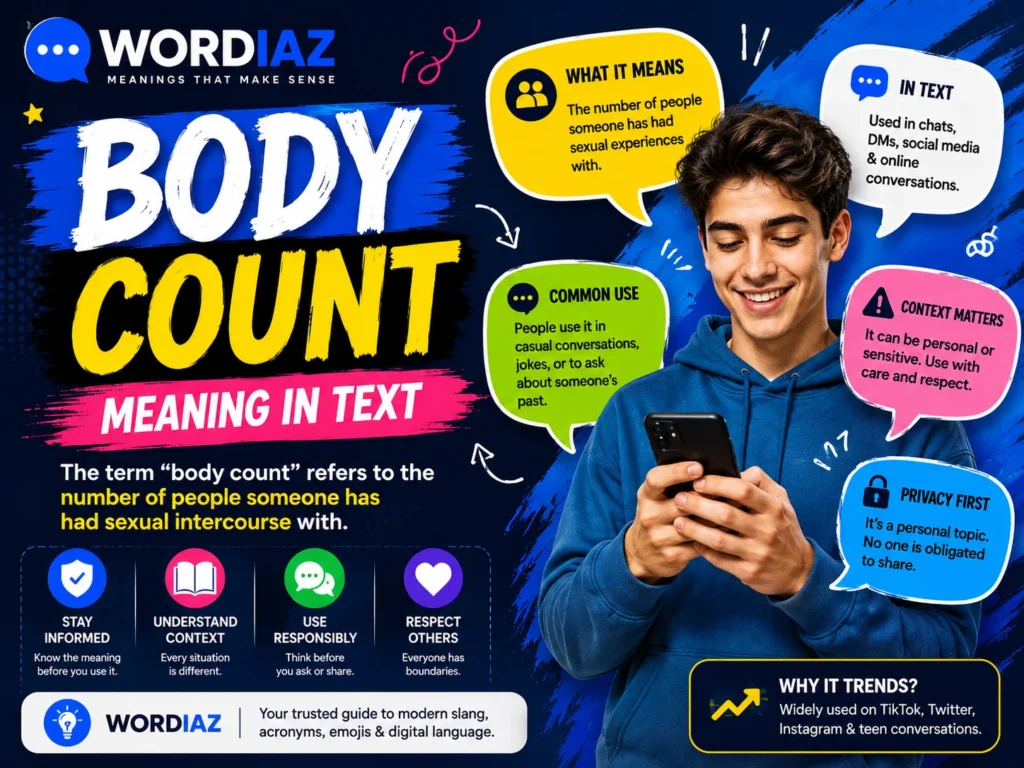
Body count meaning in text usually refers to the number of sexual partners a person has had, especially in dating conversations, TikTok comments, Instagram DMs, group chats, and modern slang. However, the phrase can also literally mean the number of people who have died in a war, disaster, crime, or fictional story.
So if someone texts:
“What’s your body count?”
they are most likely asking how many sexual partners you have had.
But if someone writes:
“The movie’s body count was crazy.”
they are talking about the number of characters who died.
The phrase can be personal or insensitive depending on context, so understanding tone is essential.
Body Count Meaning in Text – Quick Meaning
“Body count” is a slang phrase as well as a literal expression. It is not an acronym or texting abbreviation.
Its most common meanings include:
- Number of sexual partners — common dating and social-media slang
- Number of deaths — the traditional literal meaning
- Kills in a game — occasionally used jokingly for eliminations
- Deaths in movies or fictional stories — especially action and horror content
- Dark humor — sometimes intentionally playing on both meanings
For example:
“He asked my body count 💀”
Here, the phrase almost certainly means number of sexual partners.
“What’s the body count in that horror movie?”
Here, it means how many characters die.
Context changes everything.
Origin & Background of “Body Count”
The Original Meaning
Before “body count” became dating slang, the phrase referred to the number of people killed in a particular event.
It has been used in discussions involving warfare, violent incidents, disasters, crime, and fictional entertainment.
The word “body” literally referred to a deceased person.
This explains why someone might say:
“The film has a high body count.”
That means many characters die.
How It Became Dating Slang
Over time, “body” developed sexual meanings in informal English.
“Body count” was then adopted as slang for the number of people someone has had sexual relations with.
The phrase became especially visible in youth-oriented online discussions about dating and relationships.
Social Media Made It More Visible
TikTok, Instagram, YouTube, podcasts, memes, and dating discussions helped push the slang meaning into mainstream internet vocabulary.
Questions such as:
“Does body count matter?”
or:
“Would you date someone with a high body count?”
generate debate because they touch on privacy, jealousy, insecurity, compatibility, social expectations, and personal values.
As a result, many younger users now encounter the sexual meaning before the traditional one.
Read More : FW Meaning in Text Message: What Does FW Mean?
Real-Life Conversations Using “Body Count”
WhatsApp Conversation
Person A: He asked me my body count after talking for two days.
Person B: Seriously? 😭
Person A: Yeah. I didn’t answer.
Person B: You don’t have to if you’re uncomfortable.
Here, “body count” refers to past sexual partners.
The conversation also demonstrates something important: being asked doesn’t create an obligation to answer.
Instagram DM
Person A: Can I ask you something personal?
Person B: Depends.
and,
Person A: What’s your body count?
Person B: That’s a bit too personal for me.
moreover,
Person A: Fair enough.
This is a healthy example of someone establishing a boundary without turning the conversation into an argument.
TikTok Comments
Person A: Why is everyone obsessed with asking people’s body count?
and,
Person B: Social media turned dating into statistics 😭
moreover,
Person A: Compatibility matters more than one number.
Here, the phrase is being discussed as part of modern dating culture.
Text Message
Person A: That horror movie was brutal.
Person B: Seriously. The body count was ridiculous.
Person A: I stopped counting halfway through.
Here, “body count” means the number of deaths in the movie, not sexual partners.
Emotional & Psychological Meaning of Body Count
Why Does the Question Feel So Personal?
“What’s your body count?” looks like a simple numerical question, but emotionally it can carry much more weight.
People may ask because of:
- Curiosity
- Attraction
- Jealousy
- Insecurity
- Compatibility concerns
- Personal values
- Social comparison
- Peer pressure
The problem arises when a number is treated as a complete description of someone’s character.
It isn’t.
Two people may also have very different attitudes toward discussing past relationships.
Imagine you’re getting to know someone and they suddenly ask your body count. You feel uncomfortable because the relationship isn’t close enough for that conversation yet.
A perfectly reasonable response is:
“I’d rather talk about relationship expectations than compare numbers.”
That communicates a boundary while still leaving room for a meaningful discussion.
Body Count Meaning in Different Contexts
In Text Messages
When “body count” appears in a private conversation about dating, attraction, exes, or relationships, it usually refers to sexual history.
For example:
“Do you care about body count?”
is typically asking whether someone’s number of previous sexual partners matters to you.
On TikTok
TikTok frequently uses “body count” in:
- Dating debates
- Street interviews
- Relationship videos
- Memes
- Reaction videos
- Comment discussions
The term can sometimes be used provocatively because controversial relationship topics attract engagement.
That doesn’t mean every viral opinion represents normal real-world expectations.
On Instagram
Instagram Reels and DMs use the phrase similarly.
In private DMs, however, asking someone’s body count can feel significantly more personal than discussing the concept generally in comments.
In Gaming
Some gamers may jokingly use “body count” to describe eliminations or kills.
For example:
“My body count this match is 12.”
However, terms such as kills, eliminations, or K/D are usually clearer in gaming contexts.
In News and Serious Events
In reporting about warfare, disasters, or violent incidents, “body count” can refer to deaths.
However, because the phrase can sound impersonal, more respectful language such as death toll, number of people killed, or fatalities may be preferred depending on context.
When NOT to Use “Body Count”
Avoid casually asking strangers or new acquaintances about their body count.
Sexual history is personal information.
Even among friends, what seems like harmless curiosity to one person can feel invasive to another.
The phrase can also become disrespectful when used to shame someone.
A person’s relationship history should not automatically become material for ridicule, gossip, or judgment.
In serious conversations about deaths, “body count” may also sound insensitive because it reduces people to a number.
Instead of:
“The body count reached 20.”
a more humane phrasing may be:
“Twenty people were reported killed.”
Language matters, particularly when real lives are involved.
Common Misunderstandings About Body Count
“Body Count Always Means Sexual Partners”
No.
That is a popular modern slang meaning, but the phrase traditionally refers to the number of people killed.
“Body Count Means Number of Relationships”
Not exactly.
In dating slang, it generally refers to sexual partners, not the number of official relationships someone has had.
Someone might have had three relationships but a different number of sexual partners.
“Someone Has to Answer When Asked”
No.
Sexual history is personal. A person can decline to answer.
“A Number Tells You Everything About Someone”
It doesn’t.
A number alone doesn’t explain someone’s relationships, values, boundaries, experiences, current intentions, or character.
“The Phrase Is Always Offensive”
No.
People may use it casually among friends or openly discuss it with partners.
The issue is usually context, intention, and respect, not simply the phrase itself.
Body Count Compared With Related Expressions
| Expression | Typical Meaning | Context | Tone |
|---|---|---|---|
| Body count | Number of sexual partners/deaths | Dating/general | Personal/contextual |
| Sexual history | Past sexual experiences | Mature conversation | Neutral |
| Past partners | Previous partners | Relationships | Neutral |
| Exes | Former romantic partners | Dating | Casual |
| Dating history | Previous dating experiences | Relationships | Neutral |
| Death toll | Number of deaths | News/events | Formal |
| Fatalities | People killed | Reports/news | Formal |
| Kill count | Number of kills | Gaming/fiction | Casual |
| K/D | Kill/death ratio | Gaming | Technical |
| Relationship history | Previous relationships | Dating | Neutral |
Key Insight
“Body count” is much more loaded than neutral phrases such as past partners or sexual history. If you’re discussing something genuinely important with a partner, respectful and specific language usually leads to a better conversation.
10 Meanings and Variations of “Body Count”
1. Dating Body Count
Meaning: Number of sexual partners.
This is the most common slang meaning in modern dating conversations.
2. “What’s Your Body Count?”
Meaning: How many sexual partners have you had?
This is a very personal question and doesn’t require an answer.
3. High Body Count
Meaning: A comparatively larger number of previous sexual partners.
“High” is subjective. There is no universal number that defines it.
4. Low Body Count
Meaning: A comparatively smaller number of sexual partners.
Again, what counts as “low” depends entirely on the person making the comparison.
5. Zero Body Count
Meaning: In dating slang, no previous sexual partners.
Context is important because the phrase could sound very different in another setting.
6. Movie Body Count
Meaning: Number of characters killed.
This is common when discussing horror, action, crime, or thriller films.
7. Gaming Body Count
Meaning: Number of opponents eliminated.
This is usually humorous rather than formal gaming terminology.
8. Historical Body Count
Meaning: Number of people killed during a conflict or historical event.
More precise terminology may be preferable in serious writing.
9. Body Count Joke
Meaning: Humor based on the phrase having both sexual and death-related interpretations.
Many internet memes intentionally exploit this ambiguity.
10. “Body Count Doesn’t Matter”
Meaning: A statement expressing the view that someone’s number of previous sexual partners shouldn’t determine their value or relationship suitability.
Others may consider sexual history relevant to compatibility. Mature conversations distinguish personal preferences from disrespect or shaming.
How to Respond When Someone Asks Your Body Count
Casual Replies
If you’re comfortable discussing it:
“Why are you curious? 😂”
“That’s a personal question.”
“Are we really having this conversation?”
Funny Replies
“Are we talking dating or Call of Duty? 💀”
“Nice try 😂”
“My lawyer advised me not to answer.”
“Why does this feel like an interview? 😭”
Mature Replies
“I prefer keeping my sexual history private.”
“I’d rather discuss what we expect from a relationship now.”
“I’m comfortable discussing sexual health, boundaries, and exclusivity, but I don’t want to compare numbers.”
These responses shift the conversation toward information that may actually matter in a relationship.
Respectful Replies
If someone declines to answer, respect that boundary.
Don’t repeatedly ask, pressure them, or try to obtain the information from friends.
A mature relationship conversation depends on mutual consent and trust.
Regional & Cultural Usage of Body Count
Western Culture
The sexual meaning of “body count” is widely recognized in English-speaking online culture.
It frequently appears in dating discussions, podcasts, memes, and social-media debates.
Attitudes toward the question vary significantly.
Asian Culture
English-language dating slang spreads rapidly through TikTok, Instagram, YouTube, entertainment, and international online communities.
However, discussions about sexual history can be considerably more private in some families and cultures.
That makes context particularly important.
Middle Eastern Culture
In many Middle Eastern communities, sexual history may be considered an especially private or culturally sensitive topic.
English-speaking younger users may still understand the slang through global internet culture, but using the question casually can cause discomfort or offense.
Global Internet Culture
“Body count” demonstrates how dramatically slang can change a phrase.
A term once strongly associated with deaths is now immediately interpreted by many younger internet users as a dating question.
Still, both meanings remain active.
Gen Z vs. Millennials
Gen Z users are highly exposed to the sexual slang meaning through short-form videos, memes, and dating content.
Millennials are also familiar with it, although older speakers may recognize the death-related meaning more immediately depending on context.
These are general tendencies rather than fixed rules.
Is “Body Count” Safe for Kids?
The phrase itself is not profanity, but its common slang meaning involves sexual history, so age and context matter.
A child might encounter “body count” in a movie discussion where it simply means deaths. Teenagers may encounter the dating meaning through social media.
When explaining it to younger audiences, a simple context-based explanation is enough: the phrase can mean the number of deaths in an event, while older teens and adults sometimes use it as slang for someone’s number of sexual partners.
FAQs About Body Count Meaning in Text
What does body count mean in text?
In modern texting and dating slang, body count usually means the number of sexual partners someone has had. It can also mean the number of deaths in another context.
What does “what’s your body count?” mean?
It usually means “How many sexual partners have you had?” It is a personal question, and you don’t have to answer if you’re uncomfortable.
Does body count mean relationships?
Not exactly. Body count generally refers to sexual partners rather than the number of official romantic relationships.
What does body count mean from a guy?
If a guy asks your body count during a dating or personal conversation, he is most likely asking about your number of previous sexual partners.
What does body count mean from a girl?
If a girl asks the same question in a dating context, it generally carries the same meaning. The definition doesn’t change based on the sender’s gender.
Can body count mean deaths?
Yes. The traditional meaning of body count is the number of people killed in an event, conflict, crime, or fictional story.
Is asking someone’s body count rude?
It can be. Some people openly discuss sexual history, while others consider the question intrusive. The relationship, timing, wording, and willingness of both people to discuss it determine whether it is appropriate.
Conclusion
Understanding body count meaning in text requires paying attention to what people were discussing before the phrase appeared.
In modern dating slang, body count most commonly means the number of sexual partners someone has had. In news, history, movies, crime stories, and other contexts, it can instead refer to the number of deaths.
The phrase becomes more complicated because sexual history is personal. Someone may answer openly, joke about it, redirect the conversation, or simply say they would rather not discuss it.
If the conversation is about a relationship, focusing on trust, boundaries, sexual health, exclusivity, and current expectations can often be more useful than reducing someone’s past to one number.
Understanding slang helps you decode the message. Understanding boundaries helps you respond to the person behind it.