You are reading a message, screenshot, article, or social media argument when a strange little word suddenly appears:
[sic]
At first glance, it looks like slang. You might even wonder whether the writer meant “sick.” In reality, the most established sic meaning in text is quite different.
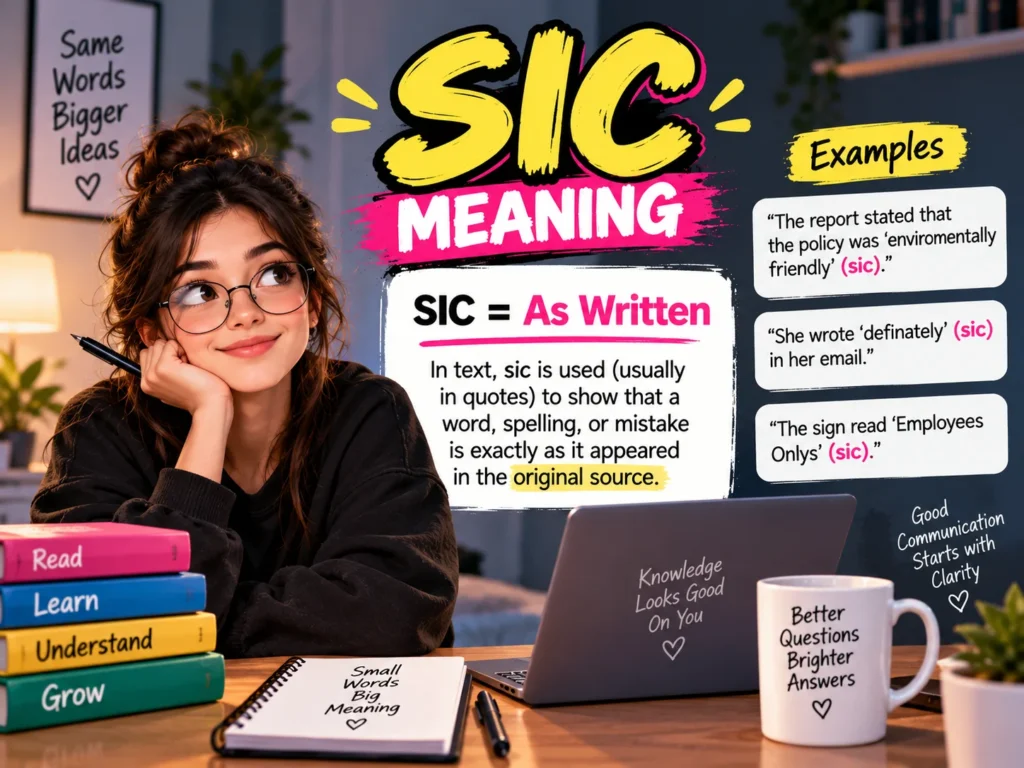
Sic is an editorial notation showing that a quoted word or phrase has been copied exactly as it originally appeared—even when it contains a mistake, unusual spelling, or strange wording. Cambridge Dictionary defines it as a word placed after copied material to show that the apparent error belongs to the original source.
For example:
“I definately [sic] remember sending it.”
The person quoting this sentence is saying: Yes, I know “definitely” was spelled incorrectly. That mistake appeared in the original.
There is also a separate casual use of sic as a stylized version of sick, meaning something impressive or cool.
Understanding which meaning applies depends almost entirely on context.
Sic Meaning in Text – Quick Meaning
The standard meaning of [sic] is:
“This appeared exactly this way in the original.”
It normally follows an error or unusual expression inside quoted material.
For example:
“She recieved [sic] the package yesterday.”
Here, recieved is misspelled. The person quoting it adds [sic] to show they did not create the mistake.
Another example:
“There was three [sic] people waiting outside.”
The grammar sounds wrong, but [sic] tells readers that the quotation is being reproduced accurately.
Cambridge explains that sic is used after copied wording to show that a spelling or usage problem belongs to the original.
What Does Sic Literally Mean?
Sic comes from Latin and means roughly “thus,” “so,” or “in this manner.”
In practical modern English, you can mentally read [sic] as:
- “Exactly as written.”
- “This is how the original said it.”
- “The mistake is not mine.”
- “Yes, it really appeared this way.”
It is not an acronym like LOL, OMG, or IDK.
Sic Can Also Mean “Cool”
In highly informal online language, sic can occasionally be a stylized spelling of sick, meaning excellent, impressive, or cool.
For example:
“That skateboard trick was sic!”
Slang.net documents this separate informal use.
The presence of brackets is usually an important clue.
[sic] = editorial notation.
sic outfit / sic move = likely slang for “sick” or “cool.”
Origin & Background
Sic did not originate on TikTok, Snapchat, or modern texting platforms.
Its history comes from editorial and scholarly writing.
The word itself is Latin, meaning “thus” or “so.” Editors, journalists, academics, and writers use it when reproducing somebody else’s wording without silently correcting what appears to be an error.
This serves an important purpose.
Imagine a journalist quoting a public notice that says:
“The office will be close [sic] tomorrow.”
Without [sic], readers might assume the journalist accidentally wrote close instead of closed.
Adding [sic] makes responsibility clear.
Why Editors Needed Sic
Accurate quotation matters.
When somebody’s exact wording is relevant, changing their spelling or grammar can alter the historical record or make the quotation less faithful.
Sic essentially tells the reader:
I noticed this. I did not accidentally type it.
The University of Wisconsin–Madison editorial style guide describes sic as a notation placed after incorrectly used quoted material to indicate that the error came from the quoted person rather than the current writer.
How Social Media Changed Its Visibility
Most people once encountered [sic] mainly in:
- Newspapers
- Academic papers
- Books
- Legal writing
- Historical documents
Today, social media constantly reproduces other people’s exact words.
Users quote:
- Tweets
- Instagram captions
- Text messages
- Reddit comments
- TikTok captions
- Political statements
- Screenshots
That has moved [sic] into everyday internet culture.
A notation that once looked highly academic can now appear in a casual group-chat argument.
Real-Life Conversations
Real examples make the difference between formal [sic] and casual sic much easier to understand.
Person A: Look what he sent me: “Your [sic] always blaming me.”
Person B: He meant “you’re,” right?
and,
Person A: Exactly 😭
Person A uses [sic] to show that the grammar mistake was present in the original message.
Instagram DM
Person A: This caption says, “Best resturant [sic] in town.”
and,
Person B: Not the spelling mistake in their own advertisement 😭
moreover,
Person A: That’s why I noticed it.
Again, [sic] flags the original spelling error.
TikTok Comments
Person A: “I could of [sic] done it better.”
and,
Person B: You quoted the comment exactly?
moreover,
Person A: Yep.
Here, the person uses [sic] because “could of” appeared in the original instead of the standard “could have.”
Text Message With Slang Sic
Person A: I finally finished customizing my car.
and,
Person B: That looks sic 🔥
moreover,
Person A: Thanks bro!
This is completely different.
Here sic is being used as a stylized form of sick, meaning cool or impressive.
Context makes the difference obvious.
Emotional & Psychological Meaning
Formal [sic] is supposed to be neutral.
Ideally, it simply protects accuracy.
The writer is saying:
I copied the original wording faithfully.
Yet human communication is rarely completely emotionless.
Depending on context, [sic] can sometimes carry a subtle tone of:
- Criticism
- Sarcasm
- Disbelief
- Mockery
- Intellectual correction
- Distance from the original wording
Imagine someone posts:
“As a profesional [sic] writer…”
The [sic] is technically identifying the misspelling of professional.
Emotionally, however, readers may perceive it as highlighting an ironic mistake.
Why Sic Can Feel Judgmental
Mistakes are normal in fast communication.
People mistype things, autocorrect changes words, and second-language speakers may use unfamiliar grammar.
When another person deliberately preserves a mistake and adds [sic], attention shifts toward that error.
That can make the original writer feel exposed.
A Relatable Scenario
Imagine sending your friend:
“I defiantly need coffee.”
You meant definitely, but autocorrect gave you defiantly.
Later, your friend posts:
“She says she ‘defiantly [sic] needs coffee.’”
You may laugh because they are intentionally highlighting your typo.
In an academic quotation, the same notation would feel completely neutral.
The notation itself has not changed. The social relationship has.
Usage in Different Contexts
Sic appears in far more places than ordinary texting slang.
Social Media
People may use [sic] when reposting or quoting somebody’s exact words.
For example:
He actually commented, “Your [sic] jealous.”
This tells readers that the incorrect your appeared in the original comment.
On social media, however, using [sic] merely to embarrass somebody over a tiny typo can appear unnecessarily smug.
Friends and Relationships
Most friends do not need formal editorial notation in everyday chat.
Using [sic] between friends is often humorous:
“You literally wrote ‘I’m board [sic].’ 😂”
The friendship and emoji make the correction playful.
During an argument, the same notation can feel condescending.
Academic Writing
This is one of the most appropriate environments for [sic].
Students and researchers may need to reproduce:
- Historical spelling
- Grammatical mistakes
- Unusual terminology
- Errors in primary sources
- Exact quotations
In these cases, [sic] protects the accuracy of the quotation.
Journalism and Professional Writing
Journalists and editors may use [sic] when exact reproduction matters.
Still, modern editorial practice often encourages writers not to overuse it, particularly when the error is irrelevant to the point being discussed.
Casual vs. Serious Tone
“Your [sic] kidding 😂”
may be playful.
“The submitted document stated that the figures were ‘completly [sic] verified.’”
sounds formal and evidentiary.
Same notation, very different setting.
When NOT to Use Sic
Sic should not be inserted after every typo you notice.
Overusing it can make your writing distracting or unnecessarily judgmental.
Avoid using [sic]:
- To show off that you noticed a trivial mistake
- When paraphrasing rather than directly quoting
- After your own ordinary typo
- When silently correcting the error would be more appropriate
- When the mistake has no relevance
- To embarrass second-language speakers
- In casual conversations where clarification would be kinder
Suppose someone writes:
“Ill call you tomorrow.”
Replying:
“You said ‘Ill [sic] call you tomorrow.’”
would usually be pointless.
The meaning was already obvious.
Cultural Sensitivity
People communicating internationally often write English as a second or third language.
Using [sic] repeatedly to highlight harmless grammar differences can feel dismissive rather than informative.
Editorial accuracy and public correction are not always the same thing.
Use [sic] when accuracy requires it—not merely because a mistake exists.
Common Misunderstandings About Sic
Sic Means “Spelling Is Correct”
No.
Some people mistakenly think SIC is an acronym for something such as “spelling is correct.”
It is not.
Sic is a Latin word, not an English acronym.
Sic Means the Writer Made the Error
Usually the opposite.
When properly used in a quotation, [sic] indicates that the unusual spelling or wording comes from the original source, not from the person quoting it.
Sic Automatically Means Someone Is Being Mocked
No.
Formal writers can use [sic] neutrally to preserve exact quotations.
However, the notation can become sarcastic when deliberately used to draw attention to someone’s mistake.
Sic and Sick Are the Same Word
Not in standard editorial usage.
Sick normally refers to illness and can also mean “excellent” in slang.
Sic is primarily an editorial Latin term.
Casual internet users sometimes deliberately spell slang sick as sic, which creates the confusion.
Sic Compared With Similar Expressions
| Expression | Meaning | Typical Context | Tone |
|---|---|---|---|
| [sic] | Exactly as in original | Quotes/editing | Formal |
| sic | Stylized “sick/cool” | Slang/social media | Casual |
| sick | Ill | Everyday English | Neutral |
| sick! | Amazing/cool | Slang | Positive |
| typo | Typing mistake | Writing/texting | Neutral |
| [emphasis added] | Emphasis was added by quoter | Academic writing | Formal |
| quote | Exact reproduced words | General writing | Neutral |
| paraphrase | Restating someone’s idea | Writing/speech | Neutral |
| correction | Fixing an error | Editing | Neutral |
| LOL | Laughing out loud | Texting slang | Casual |
Key Insight
The easiest clue is formatting. [sic] inside brackets after quoted material usually marks an original error. A standalone comment such as “that edit is sic” is much more likely to mean “cool.”
Variations and Types of Sic
1. [sic]
This is the most recognizable editorial format.
Meaning: The original wording has been reproduced exactly.
2. (sic)
Parentheses are also seen, especially in less formal writing.
The intended meaning normally remains the same, although square brackets are particularly useful because they clearly distinguish editorial material from the quotation itself.
3. [sic!]
This occasionally adds stronger emphasis or surprise.
It can make the writer’s reaction more noticeable and may therefore feel less neutral.
4. [sic?]
Sometimes used informally when a writer questions whether strange wording was really intended.
This is less standard than ordinary [sic].
5. Sic Without Brackets
In casual writing, people occasionally omit the brackets.
This can make the meaning harder to recognize.
6. sic
Lowercase sic may still be the Latin editorial word because it is traditionally lowercase.
Context determines whether it is formal notation or slang.
7. SIC
Writing it in full capitals does not turn it into an official acronym.
People sometimes capitalize it for emphasis, but standard sic is not formed from initials.
8. sic = sick
Some social media users intentionally shorten or stylize sick as sic.
Example:
“That beat is sic.”
Meaning: That beat is excellent.
9. “sic pic”
A phrase like:
“sic pic!”
usually means “awesome picture,” not an editorial correction.
10. “[sic]” After Strange Grammar
The notation does not only mark spelling errors.
It may also follow unusual grammar, factual phrasing, archaic language, or something that readers might otherwise suspect was copied incorrectly.
How to Respond When Someone Uses Sic
You usually do not need to respond specifically to [sic].
Instead, understand why it was inserted.
Casual Replies
If a friend highlights your typo jokingly:
“Okay grammar police 😂”
“I noticed it too late 😭”
“Autocorrect betrayed me.”
Funny Replies
“Please ignore my spelling career.”
“My keyboard wrote that, not me 😂”
“I officially resign from English.”
Mature Replies
If somebody corrects an important error:
“Thanks for pointing that out.”
“Yes, that wording appeared in the original.”
“I preserved the quotation exactly.”
Respectful Replies
If someone uses [sic] in a way that feels unnecessarily mocking:
“I understand the typo, but the intended meaning is clear.”
“That was simply a typing mistake.”
You do not need to turn a small spelling correction into a larger conflict.
Regional & Cultural Usage
Western Culture
Formal [sic] is widely recognized in English-language journalism, academia, publishing, historical research, and legal-style writing.
It is not exclusively American or British slang.
Asian Culture
English-language students, researchers, journalists, and professionals across Asia may encounter [sic] in academic writing.
In everyday social media communication, recognition varies because it is not as common as abbreviations such as LOL or BTW.
Middle Eastern Culture
The same principle applies in English-language educational and professional settings throughout the Middle East.
Someone unfamiliar with academic editing conventions may initially mistake it for an abbreviation.
Global Internet Usage
Social media has made [sic] much more visible to ordinary users.
Screenshots and copied comments regularly reproduce mistakes exactly, creating situations where traditional editorial notation suddenly appears in casual online spaces.
Gen Z vs. Millennials
Sic is not fundamentally a Gen Z or Millennial expression.
The editorial notation is far older than both generations.
What has changed is where people encounter it.
Older users may associate [sic] with newspapers or books. Younger users might first encounter it under a screenshot, quote-post, Reddit comment, or TikTok discussion.
The separate slang sic = cool is much closer to casual youth and subculture language.
Is Sic Safe for Kids?
Yes.
The editorial meaning of sic contains no profanity, sexual content, or offensive language.
It is actually useful for students to understand because they may encounter it in:
- History books
- Essays
- News articles
- Research papers
- Quoted primary sources
A simple explanation for children is:
“[sic] means the mistake was already in the original writing.”
The slang version meaning “cool” is also generally harmless.
Parents or teachers should simply explain that sic, sick, and [sic] can mean different things depending on context.
FAQs About Sic Meaning in Text
What does sic mean in a text?
[Sic] means that quoted wording has been copied exactly as it appeared in the original, including any mistake or unusual wording.
What does [sic] mean after a spelling mistake?
It tells readers that the spelling mistake came from the original source rather than the person currently quoting it.
For example:
“I recieved [sic] your email.”
The misspelling was intentionally preserved.
Is sic an acronym?
No. Sic is a Latin word, traditionally understood as meaning “thus,” “so,” or “in this manner.” It is not formed from English initials.
Is using [sic] rude?
Not automatically. It is a legitimate editorial tool. However, repeatedly using it to highlight insignificant mistakes can sound mocking or condescending.
Does sic mean sick?
Sometimes sic is used informally as a stylized version of slang sick, meaning excellent or cool. This is separate from editorial [sic].
What does sic mean on social media?
When placed in brackets after quoted text, it normally means “exactly as originally written.” When used in a phrase such as “sic outfit,” it may instead mean “cool.”
Why do writers put [sic] in quotes?
Writers use [sic] to preserve the original wording while making it clear that an apparent error or unusual expression did not result from inaccurate copying.
Conclusion
The standard sic meaning in text is surprisingly simple once you understand its purpose.
When you see:
[sic]
inside or immediately after quoted material, it usually means:
“Yes, this looks unusual or incorrect, but this is exactly how it appeared in the original.”
It protects the person quoting the material from being blamed for somebody else’s spelling, grammar, or wording mistake.
That makes [sic] particularly useful in journalism, academic writing, historical documents, legal-style quotations, and online discussions where exact wording matters.
Social media has added another layer of confusion because some users also write sic as a stylish version of sick, meaning cool or impressive.
The difference usually becomes obvious through context.
“Your [sic] wrong.”
uses formal editorial sic.
“That bike is sic!”
uses informal slang.
Once you learn that distinction, the word stops looking mysterious.
More importantly, understanding sic teaches a useful lesson about digital communication: the smallest piece of punctuation or formatting can completely change what a word is doing.
Use [sic] when accuracy genuinely matters, avoid turning it into a weapon for embarrassing people over harmless mistakes, and pay attention to surrounding words before deciding whether someone means “exactly as written” or simply “that’s cool.”
For high CTR (click-through rate), titles and descriptions should create curiosity, a clear benefit, and a reason to click without giving everything away.