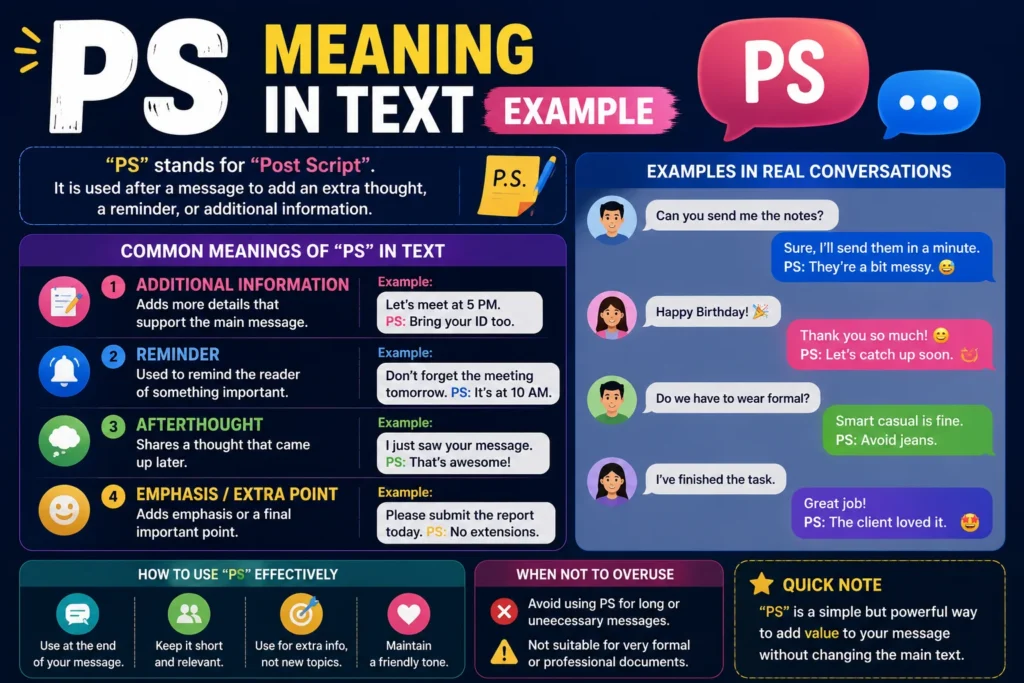
PS in a text message usually means “postscript.” It is used when someone wants to add an extra thought after the main message has already been written.
The abbreviation comes from the Latin phrase post scriptum, meaning “written after.”
You may see it at the end of texts, emails, letters, social media captions, or casual messages.
For example:
“Thanks for picking me up today. PS: I really needed that.”
The main message is complete, but the sender adds one more thought.
In casual texting, PS can also introduce something funny, personal, important, or slightly unrelated to the original topic.
PS Meaning in Text: Quick Answer
PS usually means “postscript,” an extra note added after the main message.
A simple example is:
“See you tomorrow! PS: Don’t forget the tickets.”
The first sentence is the main message.
The PS introduces an additional reminder.
You may also see:
- P.S. — traditional punctuation
- PS: — common in texting
- PS btw — casual online style
- P.S. — common in emails and letters
The meaning remains essentially the same.
Where Did PS Come From?
PS has a much older history than texting.
It comes from the Latin expression post scriptum, which literally means something written afterward.
Before digital communication, people commonly used P.S. at the end of handwritten letters.
If a writer finished a letter and then remembered another detail, they could add:
P.S. Don’t forget to call Grandma.
The postscript allowed them to add information without rewriting the entire letter.
How PS Moved Into Digital Communication
Email and texting made PS even easier to use.
People no longer needed to physically rewrite a letter, but the expression remained popular because it has a useful conversational function.
It can make an additional thought feel separate from the main message.
Why People Still Use PS
There is something slightly personal about a postscript.
It can feel like:
“Oh, and one more thing…”
That makes PS useful for reminders, jokes, affection, and small details.
Read More : Cringe Meaning in Text: What Does Cringe Mean?
PS Meaning in Text: Real Examples
Example 1: Friendly Reminder
Person A:
“Thanks for helping me study tonight. PS: Bring your calculator tomorrow.”
Here, PS introduces a reminder.
Example 2: Romantic Message
Person A:
“Goodnight ❤️ PS: I miss you already.”
The postscript adds an emotional thought after the main message.
Example 3: Funny Text
Person A:
“I promise I’m going to sleep early tonight. PS: It’s already 2 a.m. 😂”
The PS introduces a humorous extra observation.
Example 4: Family Message
Person A:
“Dinner is at 7. PS: Mom said to bring dessert.”
Here, PS adds information that was remembered afterward.
Example 5: Work Message
Person A:
“Thanks for sending the report. PS: Please update the final figure before the meeting.”
This is understandable, although a formal workplace email may sound cleaner if the extra request is included directly in the main message.
Example 6: Social Media Caption
“Finally finished the project! 🎉 P.S. Coffee deserves some credit too.”
Here, PS adds a playful afterthought.
The Emotional Meaning of PS
Although PS has a simple definition, people often use it to change the emotional tone of a message.
Affection
“Goodnight. P.S. Love you.”
The postscript creates a small emotional ending.
Humor
“I’m trying to save money. P.S. I just ordered pizza.”
The extra sentence creates a joke.
Excitement
“See you at the concert! PS: I got us front-row seats!”
The postscript reveals exciting information.
Reminder
“See you tomorrow. PS: Don’t forget your passport.”
The added thought is practical.
Vulnerability
“Thanks for talking with me. PS: I really needed that conversation.”
The postscript can make the message feel more personal.
PS vs P.S. vs PS:
These forms generally communicate the same idea.
P.S.
The traditional form.
Example:
“P.S. Don’t forget your keys.”
PS
A simplified digital version.
Example:
“PS don’t forget your keys.”
PS:
A very common texting format.
Example:
“PS: Don’t forget your keys.”
There is no major difference in meaning.
The choice is mostly about writing style and punctuation.
PS Meaning in Different Contexts
Text Messages
In casual texts, PS usually introduces an extra thought.
“See you soon! PS: Bring snacks.”
Emails
P.S. is common in personal emails and informal marketing messages.
It can highlight an important detail after the main body.
Letters
This is where the expression originally became widely familiar.
A writer could add a postscript without changing the main letter.
Social Media
People sometimes use P.S. at the end of captions to add humor, commentary, or a final thought.
Professional Communication
P.S. is acceptable in informal workplace communication but should be used carefully.
For a formal business message, putting important information in the main body is usually clearer.
When Should You Use PS?
PS works best when you genuinely have an additional thought.
Use It for a Small Reminder
and,
“See you at 6. PS: Bring the documents.”
Use It for a Personal Note
moreover,
“Thanks again. PS: You really helped me today.”
Use It for Humor
and,
“I ate healthy all week. PS: Except for Saturday.”
Use It for an Extra Detail
“The meeting starts at 10. PS: It’s in Room 4.”
The key is that the main message should already feel complete.
When Should You Avoid PS?
Important Instructions
If the information is essential, put it in the main message instead of hiding it in a postscript.
Formal Academic Writing
P.S. is generally unnecessary in essays, research papers, and formal reports.
Highly Professional Communication
If the extra information affects a deadline, payment, legal issue, or major decision, write it clearly in the main body.
Multiple PS Sections
Using several postscripts can make a message feel messy.
A single clear PS is usually enough.
Common Misunderstandings About PS
Does PS Mean “Please Send”?
Usually no.
In ordinary texting, PS most commonly means “postscript.”
Other meanings are possible in specialized contexts.
Does PS Mean “Personal Message”?
Not normally.
The meaning depends on context, but “postscript” is the standard interpretation when PS appears at the end of a message.
Is PS Only Used in Letters?
No.
It is common in emails, texts, captions, newsletters, and informal online writing.
Does PS Have to Be at the End?
Traditionally, yes.
A postscript is an additional note placed after the main message.
In casual digital communication, people may use it more creatively.
Is P.S. Formal or Informal?
It can be either.
It is traditional enough for letters and emails but casual enough for friendly messages.
PS Compared With Similar Expressions
| Expression | Meaning | Typical use |
|---|---|---|
| PS / P.S. | Postscript | Extra thought |
| BTW | By the way | Additional topic |
| FYI | For your information | Useful information |
| PPS | Post-postscript | Extra note after PS |
| Note: | Additional information | Formal/casual |
| Oh, and… | Another thought | Casual conversation |
| BTW | By the way | Topic shift |
Key Insight
PS is best when the main message is already complete and you suddenly want to add one more thought. It often feels more personal than simply adding another sentence.
Common PS Variations
1. PS
The simplest digital form.
“PS: Call me later.”
2. P.S.
Traditional punctuation.
“P.S. I miss you.”
3. PS:
Common in text messages.
“PS: Don’t forget.”
4. P.S.!
An excited postscript.
“P.S.! I have amazing news.”
5. PS BTW
A very casual combination.
“PS btw, bring your charger.”
6. PPS
Means post-postscript.
It adds another thought after an existing PS.
7. P.P.S.
The traditional punctuated version of PPS.
8. PS LOL
Adds a humorous afterthought.
“PS LOL I just realized what I said.”
9. PS ❤️
Adds affection or warmth.
10. PS Don’t Forget
Used to introduce a reminder.
How to Respond When Someone Uses PS
Usually, you do not need to respond specifically to the “PS.” Just respond to the information it contains.
Casual Reply
“Got it 😂 I’ll bring the snacks.”
Funny Reply
“The PS was definitely the important part 😂.”
Romantic Reply
“PS received ❤️ I miss you too.”
Mature Reply
“Thanks for adding that. I’ll take care of it.”
Professional Reply
“Thanks for the additional note. I’ll update it before the meeting.”
Regional and Cultural Usage
Western English
P.S. is widely recognized in American, Canadian, British, and Australian English.
Its traditional meaning is generally understood.
Asian Online Communication
English-speaking users across Asia often encounter PS through emails, school communication, social media, and texting.
Middle Eastern Online Communication
P.S. is commonly understood in English-language professional and personal communication.
Global Internet Culture
Because email and social media have spread globally, PS is now familiar to many people even when English is not their first language.
Generational Differences
Older generations may associate P.S. with handwritten letters.
Younger users are more likely to encounter it through texts, captions, emails, or memes.
The basic meaning remains the same.
Is PS Safe for Kids?
Yes.
PS is a harmless abbreviation for “postscript.”
Children may see it in school emails, messages from parents, letters, or social media posts.
The abbreviation itself does not contain inappropriate content.
Frequently Asked Questions
What does PS mean in text?
PS usually means “postscript,” an additional thought added after the main message.
What is an example of PS in a text?
For example:
“See you tomorrow! PS: Don’t forget your jacket.”
The second sentence is the postscript.
What does P.S. stand for?
P.S. stands for “postscript,” from the Latin phrase “post scriptum,” meaning “written after.”
Is PS the same as BTW?
No. PS adds an afterthought, while BTW means “by the way” and often introduces another topic during a conversation.
What does PPS mean in texting?
PPS means “post-postscript.” It adds another thought after a P.S.
Can I use PS in a professional email?
Yes, particularly in an informal or friendly email. For important professional information, however, it is usually clearer to include the information in the main body.
Does PS mean please send?
Not usually. When it appears at the end of a casual message, PS most commonly means postscript.
Final Thoughts on PS Meaning in Text
The PS meaning in text is usually simple: postscript, or an extra thought added after the main message.
It is a small abbreviation with a surprisingly long history.
Someone might use it to add a reminder:
“PS: Bring your keys.”
They might use it to add humor:
“PS: I definitely didn’t eat your fries.”
Or they might use it to add something personal:
“PS: I’m really glad we talked.”
That flexibility is why PS has survived from handwritten letters into modern digital communication.
When you see PS at the end of a message, read what comes after it as an additional thought rather than a completely separate message.
In most everyday texting situations, PS simply means “one more thing.”