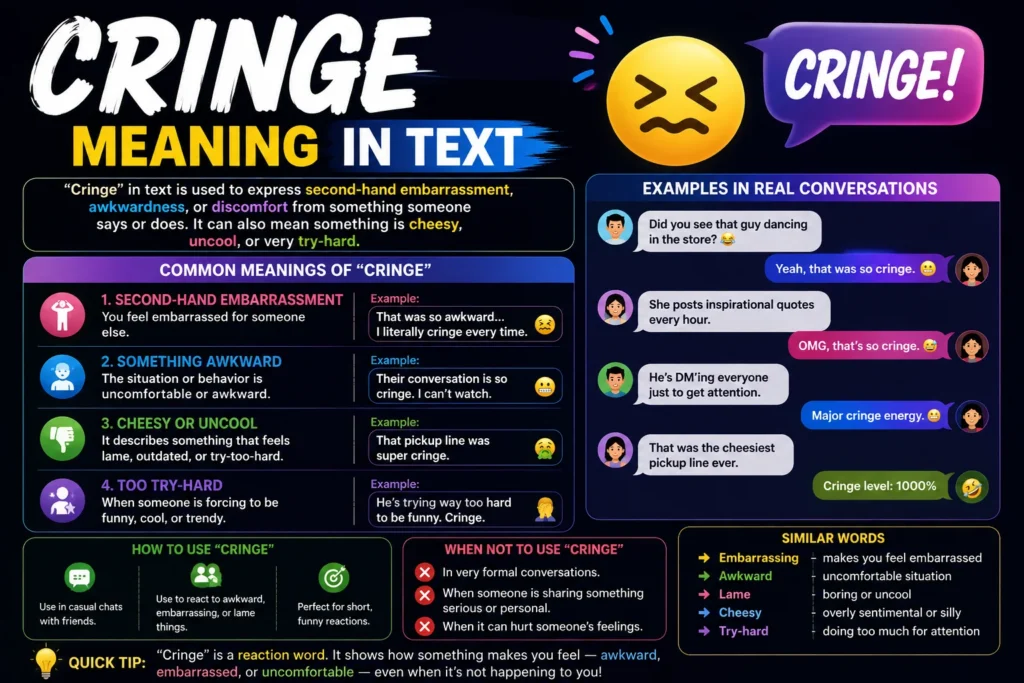
If someone texts “cringe,” they are usually saying that something feels embarrassing, awkward, uncomfortable, or socially awkward.
The word can describe a situation, behavior, message, video, joke, or even a person’s actions.
For example:
“Bro, that message was cringe 😭”
This usually means:
“That message was really embarrassing or awkward.”
Unlike some texting abbreviations, cringe is a normal English word that has become especially popular in internet slang.
Its meaning can be serious, playful, teasing, or even self-deprecating depending on the situation.
Cringe Meaning in Text: Quick Answer
“Cringe” in texting usually describes something that makes someone feel embarrassed, awkward, uncomfortable, or secondhand embarrassment.
Common examples include:
- “That’s cringe.” = That is embarrassing or awkward.
- “So cringe.” = Extremely awkward.
- “I’m cringing.” = I feel uncomfortable watching this.
- “Cringe 😂” = That was awkward, often jokingly.
- “That was cringe.” = The behavior felt embarrassing.
The word does not always mean something is objectively bad. Sometimes it simply means the sender personally found it awkward.
Where Did the Word “Cringe” Come From?
The word cringe is much older than the internet.
As a traditional English verb, to cringe means to shrink back, recoil, or show discomfort or fear.
Over time, the word developed another popular meaning: experiencing strong embarrassment or discomfort because of something socially awkward.
The internet helped turn this meaning into a common adjective.
Today, people frequently describe awkward posts, forced jokes, exaggerated flirting, or embarrassing behavior as cringe.
How Internet Culture Changed Cringe
Social media made people constantly observe other people’s behavior.
A strange video, awkward caption, or overly dramatic post can be shared thousands of times.
The word cringe became an easy way to describe the emotional reaction.
Instead of writing:
“Watching this makes me uncomfortable because the person seems unaware of how awkward the situation is.”
someone can simply write:
“Cringe 😭.”
That is much faster.
Read More : Low-Key Meaning in Text: What Does It Mean?
Real-Life Texting Conversations
WhatsApp Conversation
Person A:
“I sent her a pickup line I found online.”
Person B:
“Which one?”
and,
Person A:
“Are you a magician? Because whenever I see you, everyone else disappears.”
Person B:
“Bro 😭 that’s cringe.”
Here, the friend is teasing the sender for using an overly dramatic pickup line.
Instagram DM
Person A:
“Did you see his caption?”
Person B:
“Yeah. ‘King of everyone’s heart.’”
Person A:
“That’s so cringe 💀.”
The sender considers the caption embarrassing or overly self-important.
TikTok Comment
Person A:
“This is the funniest video ever.”
Person B:
“Why am I cringing so hard 😭”
The person is experiencing secondhand embarrassment.
Text Message
Person A:
“I accidentally called my teacher ‘Mom.’”
Person B:
“NOOO 😂”
and,
Person A:
“I wanted to disappear.”
Person B:
“That is actually so cringe.”
Here, the word describes an embarrassing but relatable moment.
The Emotional Meaning of Cringe
Cringe is interesting because it often describes an emotion that is difficult to express in one sentence.
It can involve:
- Embarrassment
- Awkwardness
- Discomfort
- Secondhand embarrassment
- Social anxiety
- Forced behavior
- Disbelief
- Amusement
When someone says “I’m cringing,” they may not be angry at the person involved.
They may simply feel uncomfortable watching what is happening.
What Is Secondhand Embarrassment?
Secondhand embarrassment happens when you feel embarrassed for someone else.
For example, imagine someone confidently telling a joke to a silent room.
You did not tell the joke, but you still feel uncomfortable.
A text might say:
“I’m cringing so hard watching this.”
That is one of the most common modern uses of the word.
Why People Say “Cringe” Online
The word is short and emotionally powerful.
Calling something cringe immediately communicates a judgment about its social tone.
It can mean:
“That feels forced.”
“That is embarrassing.”
“This doesn’t feel natural.”
“I can’t watch this.”
It is especially common when people react to content they believe is trying too hard to appear cool, funny, romantic, or impressive.
Cringe in Different Contexts
Social Media
TikTok, Instagram, YouTube, and X frequently use cringe to describe awkward videos, captions, comments, or trends.
For example:
“That influencer apology was cringe.”
Friendships
Friends often use the word jokingly.
“You actually posted that? Cringe 😂.”
The speaker may be teasing rather than genuinely criticizing.
Dating
Cringe can describe an overly dramatic pickup line, forced flirting, or awkward romantic behavior.
“He sent me a paragraph after one date. Kinda cringe.”
Gaming
Players may use the term to criticize exaggerated behavior, toxic comments, or awkward attempts to impress other players.
“That victory speech was cringe.”
Professional Settings
The word is generally too informal for formal workplace writing.
Instead of saying:
“That presentation was cringe.”
a professional might say:
“The presentation felt overly informal.”
When Cringe Is Playful vs Hurtful
This distinction matters.
Playful Cringe
“Bro, that haircut is cringe 😂.”
Friends may say this without intending serious criticism.
Genuine Criticism
“The way he treated the staff was cringe.”
Here, the speaker is making a stronger judgment about someone’s behavior.
Self-Deprecating Cringe
“I just reread my old posts. I’m cringing 😭.”
The person is laughing at their own past behavior.
Online Bullying
Repeatedly calling someone “cringe” can become insulting or humiliating.
A word that begins as a joke can become hurtful when used aggressively or repeatedly.
When Should You Not Use “Cringe”?
Formal Communication
Avoid it in professional reports, academic writing, and formal emails.
Sensitive Situations
If someone is sharing something emotionally important, calling it “cringe” may dismiss their feelings.
Personal Insecurities
Be careful when commenting on someone’s appearance, relationships, or personal expression.
Serious Discussions
If someone asks for honest feedback, simply saying “cringe” is not very useful.
Explain what specifically feels awkward.
For example:
“The opening sounds a little forced. Maybe make it more natural.”
That gives the person something they can actually improve.
Common Misunderstandings About Cringe
Cringe Means Bad
Not necessarily.
Something can be well-made but still feel awkward to a particular person.
Cringe Means Embarrassing Only
Not always.
It can also describe discomfort, forced behavior, or secondhand embarrassment.
Calling Something Cringe Means You Hate It
No.
People often use the word jokingly.
Cringe Is Always an Insult
Not necessarily.
Tone matters. Friends may use it affectionately, while strangers may use it harshly.
“Cringe” and “Cringey” Are the Same
They are closely related.
Cringe can work as a noun, verb, adjective in informal internet speech, or reaction.
Cringey/cringy is commonly used as an adjective meaning awkward or embarrassing.
Cringe vs Similar Internet Slang
| Term | Meaning | Typical tone |
|---|---|---|
| Cringe | Embarrassing or awkward | Critical/playful |
| Awkward | Uncomfortable or socially difficult | Neutral |
| Embarrassing | Causing shame or discomfort | More direct |
| Cheesy | Overly sentimental or predictable | Often playful |
| Corny | Unoriginal or overly sentimental | Casual |
| Try-hard | Trying too hard to impress | Critical |
| Secondhand embarrassment | Feeling embarrassed for someone else | Descriptive |
| Yikes | Reaction to something uncomfortable | Informal |
Key Insight
Cringe is more about the emotional reaction than the objective quality of something. What one person considers cringe may seem funny, romantic, or perfectly normal to someone else.
Common Variations of Cringe
1. Cringe
The basic form.
“That was cringe.”
2. So Cringe
Adds emphasis.
“That video is so cringe.”
3. Cringey
An adjective meaning awkward or embarrassing.
“That was a cringey comment.”
4. Cringy
An alternative spelling of “cringey.”
“This feels kinda cringy.”
5. Cringe AF
An intensified informal expression.
It means something feels extremely cringe.
6. I’m Cringing
Describes the person’s emotional reaction.
“I’m literally cringing.”
7. Cringe-Worthy
Something considered especially embarrassing.
“That speech was cringe-worthy.”
8. Maximum Cringe
A humorous exaggeration.
“That was maximum cringe.”
9. Secondhand Cringe
Feeling uncomfortable because of someone else’s behavior.
“I’m getting secondhand cringe.”
10. Cringe Compilation
A collection of awkward or embarrassing moments, commonly found online.
How to Respond When Someone Says “Cringe”
Your response can depend on whether they are joking or genuinely criticizing something.
Casual Replies
- “😂 I know.”
- “Fair enough.”
- “You didn’t have to say it like that 😭.”
- “Okay, maybe a little.”
Funny Replies
- “I specialize in cringe.”
- “That’s my brand 😂.”
- “Let me live!”
- “The cringe was intentional.”
Mature Replies
- “What specifically felt awkward?”
- “I can see why it came across that way.”
- “Thanks for the honest feedback.”
Respectful Replies
If the comment feels unnecessarily harsh:
“You don’t have to like it, but I’d appreciate keeping the conversation respectful.”
Regional and Cultural Usage
American English
“Cringe” is extremely common in American social media, gaming, and everyday online conversations.
British English
British users also commonly use “cringe,” especially online. Traditional words such as “awkward” may still appear more frequently in certain contexts.
Asian Online Communities
The word has spread widely through TikTok, YouTube, gaming, and global social media.
Middle Eastern Online Communities
English-speaking users may use “cringe” in social media and messaging, especially when discussing internet culture.
Global Internet Culture
Unlike many regional slang terms, cringe has become highly international because social platforms constantly expose users to English-language internet vocabulary.
Gen Z vs Millennials
Gen Z commonly uses “cringe” as a quick reaction to content, behavior, or social situations.
Millennials also use the word, although some may prefer awkward, embarrassing, or cheesy depending on the situation.
Is Cringe Safe for Kids?
Yes, cringe is generally an ordinary and age-appropriate word.
Children and teenagers commonly encounter it in gaming, social media, school conversations, and online videos.
The important issue is not the word itself but how it is used.
Repeatedly labeling another child as “cringe” can become bullying if it is intended to embarrass or isolate them.
Frequently Asked Questions
What does cringe mean in text?
Cringe usually means something feels embarrassing, awkward, uncomfortable, or socially awkward.
What does “that’s cringe” mean?
It generally means “that feels embarrassing, awkward, or uncomfortable to me.”
What does “I’m cringing” mean?
“I’m cringing” means the person feels uncomfortable or embarrassed while watching or thinking about something awkward.
What does cringey mean in texting?
Cringey means awkward, embarrassing, forced, or uncomfortable. It is another common form of “cringe.”
Is cringe an insult?
It can be, but not always. Friends often use it playfully, while strangers may use it as a genuine criticism.
What is secondhand cringe?
Secondhand cringe is the uncomfortable feeling you experience when someone else does something embarrassing or awkward.
Is cringe the same as awkward?
They overlap, but cringe often emphasizes the emotional discomfort or embarrassment caused by the awkward situation.
Final Thoughts on Cringe Meaning in Text
The cringe meaning in text is usually connected to awkwardness, embarrassment, or discomfort.
When someone writes:
“That’s cringe.”
they are saying that something feels socially awkward, forced, embarrassing, or uncomfortable.
But the word is highly dependent on tone.
A friend saying “bro that’s cringe 😂” may simply be teasing you.
A stranger repeatedly calling someone “cringe” may be trying to insult or embarrass them.
That is why understanding the relationship and context matters just as much as knowing the dictionary definition.
Online communication moves quickly, and one short word can express a surprisingly complicated reaction. Cringe has become one of the easiest ways to say, “I cannot watch this without feeling uncomfortable.”