
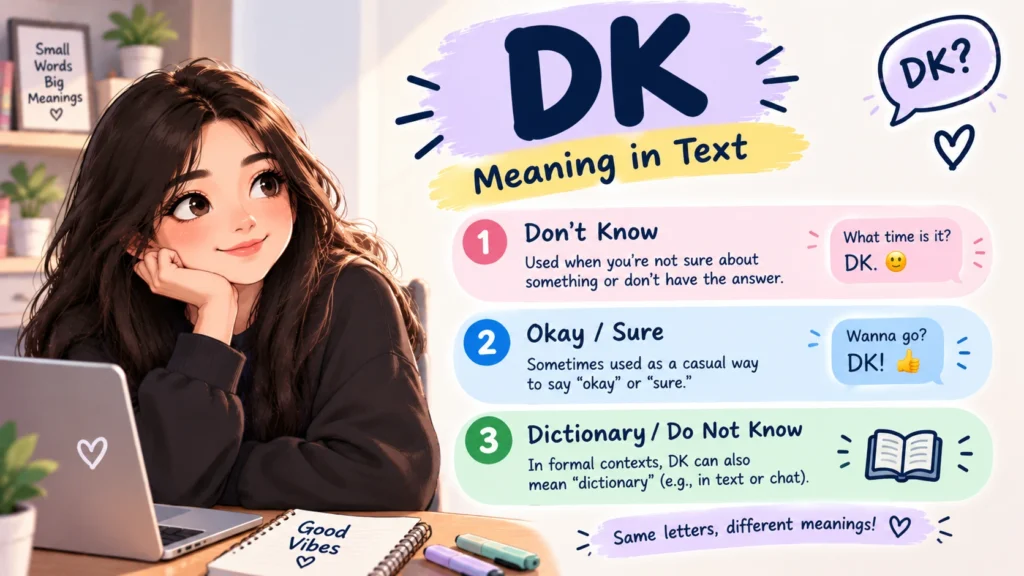
Have you ever received a message containing “DK” and wondered what the sender meant? This short abbreviation can appear in text messages, Instagram DMs, Snapchat conversations, gaming chats, and online discussions. Although it looks simple, its meaning can change depending on the situation.
In everyday texting, DK most commonly means “Don’t Know.” People use it as a quick way to say they are unsure about something or do not have an answer. For example, someone might text “dk what time we’re leaving” instead of typing the complete sentence.
The abbreviation can make conversations faster and more relaxed. However, it can also sound distant or uninterested if the recipient interprets it without considering the surrounding messages.
This article explains the DK meaning in text, its common uses, realistic conversations, emotional tone, related abbreviations, and natural ways to respond. By the end, you will understand how to interpret DK without jumping to the wrong conclusion.
DK Meaning in Text – Quick Meaning
DK usually stands for “Don’t Know” in casual texting.
It is an informal abbreviation used when someone does not know an answer, is uncertain, or has not decided something yet.
Here are a few examples:
- “dk what to wear tonight.” — The sender has not decided what to wear.
- “DK if she’s coming.” — The sender does not know whether she will come.
- “idk, dk what happened.” — The person is expressing uncertainty, although using both abbreviations together can sound repetitive.
The meaning is generally straightforward, but context matters. In some specialized conversations, DK may stand for something else, such as Donkey Kong in gaming discussions or Denmark in certain country-code contexts.
Is DK the same as IDK?
Not exactly in form, but they can communicate the same idea. IDK means “I Don’t Know,” while DK is often used as a shorter version of “Don’t Know.” IDK is more widely recognizable in everyday English texting.
Origin and Background of DK
How DK became a texting abbreviation
Shortened expressions became common as people began communicating through SMS messages, internet chatrooms, and instant messaging services. Early text messaging encouraged concise wording, particularly when phone keyboards were small or messages had character limits.
Over time, people developed shortcuts for common phrases. “Don’t know” was easy to shorten because the main words could be represented by their initial letters.
DK remains less universally recognizable than IDK. Some people use it naturally with friends, while others may interpret it as an unfamiliar abbreviation.
The influence of social media
Modern social platforms encourage quick responses. When someone asks a question in a group chat, they may type “dk” rather than write a complete sentence.
The abbreviation can appear in casual conversations about plans, relationships, school, entertainment, and everyday decisions. Its informal style makes it suitable for quick exchanges, though it is not always ideal when clarity matters.
Why abbreviations continue to evolve
Internet language changes as different communities adopt their own expressions. A term that feels familiar in one gaming group may be unfamiliar to someone who mainly uses email or professional messaging.
DK illustrates this flexibility. Its meaning depends on both the words around it and the communication habits of the people using it.
Read More : PPL Meaning in Text: What Does PPL Stand For?
Real-Life Conversations Using DK
The following examples show how DK can appear in ordinary digital conversations. They are illustrative scenarios rather than quotations from actual users.
1. WhatsApp conversation about weekend plans
Person A: Are we going to the mall on Saturday?
Person B: dk yet, my parents haven’t confirmed.
Person A: Okay, let me know when you find out.
Person B: Sure, I’ll text you later.
Meaning: Person B does not know whether the plan is confirmed. The abbreviation expresses uncertainty, not necessarily a lack of interest.
2. Instagram DM between friends
Person A: Do you know who posted that picture?
Person B: dk 😭
Person A: I thought you followed them.
Person B: I do, but I missed the story lol.
Meaning: The sender uses DK to answer quickly. The emoji and casual follow-up make the exchange feel relaxed.
3. TikTok comments about a trend
Person A: Does anyone know when the next update drops?
Person B: dk, maybe next week?
Person C: I haven’t seen an official date either.
Meaning: Person B does not have confirmed information and offers a guess. The question mark shows that the suggested timing is uncertain.
4. Text messages about a relationship
Person A: Do you think he’s upset with me?
Person B: dk honestly. Maybe ask him directly.
Person A: I’m scared it’ll make things awkward.
Person B: I get that, but guessing might make you worry more.
Meaning: Here, DK communicates genuine uncertainty. Person B does not claim to know another person’s feelings and encourages a clearer conversation.
These examples highlight an important distinction: DK tells you that someone does not know something, but it does not explain why they do not know or how they feel about the situation.
Emotional and Psychological Meaning of DK
Uncertainty and honesty
People often use DK when they do not have enough information to answer a question. In this context, the abbreviation can be a straightforward expression of honesty.
For instance, a friend might say “dk if I’ll be free tomorrow” because their schedule has not been confirmed. Giving an uncertain answer is better than making a promise they cannot keep.
A neutral or casual response
In many conversations, DK is simply a convenient shortcut. The sender may be typing quickly, multitasking, or responding from a phone.
A short reply does not automatically indicate annoyance. Some people naturally use fewer words than others, particularly in familiar group chats.
When DK may sound dismissive
Tone can become difficult to interpret in text messages because readers cannot hear the speaker’s voice or see their facial expression.
If someone replies only “dk” to a serious question, the recipient might feel ignored. That reaction may be understandable, but it does not prove the sender intended to be rude.
A fuller response, such as “I honestly don’t know, but I’ll try to find out,” communicates more care and willingness to help.
A relatable personal-style scenario
Imagine asking a friend whether your group is meeting after class. They reply, “dk.”
You might initially wonder whether they are avoiding the plan. Later, you discover that nobody has confirmed the location yet. The short message was about missing information, not about your friendship.
This is why it helps to ask a follow-up question before making assumptions about someone’s attitude.
How DK Is Used in Different Contexts
On social media
DK may appear in comments, direct messages, livestream chats, and online communities. Users often choose it when answering simple questions or admitting that they have not heard an update.
For example, “dk when the video comes out” means the person does not know when it will be released.
Between friends and family
Friends may use DK to discuss plans, recommendations, schoolwork, or everyday problems. Family members might understand it in a casual message, although some people prefer complete sentences.
The abbreviation is usually easiest to understand when the conversation already makes the subject clear.
In romantic relationships
A partner might use DK when asked about plans, emotions, or future decisions. The meaning depends on the question.
“dk what time I’ll be home” suggests uncertainty about timing. In contrast, “dk what I want” may communicate genuine confusion about a decision or relationship. The surrounding discussion determines which interpretation makes sense.
In school and gaming chats
Students may use DK when they do not know an answer or have not completed an assignment. Gamers might also use it to express uncertainty about a strategy or an upcoming match.
Remember that DK can have other meanings in gaming. For example, a conversation about Nintendo characters may use DK to refer to Donkey Kong rather than “Don’t Know.”
In professional communication
DK is generally too informal for important workplace messages, formal emails, and official reports. A clearer phrase is usually more appropriate.
Instead of writing “DK about the deadline,” try “I haven’t received confirmation about the deadline yet.” This sounds more professional and gives the reader a clearer explanation.
When Not to Use DK
When clarity is important
A one- or two-letter response may not give enough information when someone needs a reliable answer. If a colleague asks whether a task is complete, replying “dk” may leave them unsure about what you have checked.
Use a complete sentence and explain what information is missing.
During serious conversations
If a friend is discussing a personal problem, a bare “dk” may feel cold even if you genuinely do not know what to say.
You can still be honest while showing empathy. For example, “I’m not sure what the best answer is, but I’m here to listen” communicates uncertainty without dismissing the other person.
In formal writing
Avoid using DK in job applications, academic essays, formal customer support messages, or professional correspondence.
The full phrase “I don’t know” is clearer, although a more helpful explanation may be preferable in a work setting.
When someone may misunderstand the abbreviation
Not everyone recognizes DK as a texting shortcut. If the recipient is unfamiliar with internet abbreviations, spelling out the phrase prevents confusion.
Clear communication is more important than making every message as short as possible.
Common Misunderstandings About DK
Assuming DK always means “Don’t Know”
Although “Don’t Know” is a common texting interpretation, DK is not limited to that meaning. The abbreviation can represent Donkey Kong in gaming conversations, Denmark in certain country-related contexts, or other specialized terms.
Always consider the topic before deciding what the sender means.
Confusing DK with IDK
IDK means “I Don’t Know” and is widely used in casual English messages. DK can communicate a similar idea, but it is less explicit because it omits the initial “I.”
If you want the most recognizable everyday abbreviation, IDK is generally the safer choice.
Thinking a short answer means anger
A message containing only DK may feel abrupt. However, brevity alone cannot establish that someone is annoyed, upset, or uninterested.
Look at their usual communication style and the surrounding conversation. If the issue matters, ask politely rather than guessing.
Treating uncertainty as a final answer
When someone says DK about a plan, they may simply need more information. It does not necessarily mean that the plan is cancelled or that they refuse to participate.
A useful follow-up might be, “No problem. When do you think you’ll know?”
DK Compared With Similar Texting Abbreviations
| Abbreviation or phrase | Meaning | Main difference |
|---|---|---|
| DK | Don’t Know | A short expression of uncertainty |
| IDK | I Don’t Know | A more widely recognized version |
| IDC | I Don’t Care | Expresses lack of concern or interest |
| IMO | In My Opinion | Introduces a personal view |
| TBH | To Be Honest | Signals an honest or direct statement |
| NVM | Never Mind | Suggests that something can be disregarded |
| WDYT | What Do You Think? | Asks for another person’s opinion |
| Not sure | Uncertain | A clear, standard-language alternative |
| No idea | I have no idea | Often emphasizes a lack of knowledge |
Key Insight
DK and IDK can express the same basic uncertainty, but they are not interchangeable with expressions such as IDC. Not knowing an answer is different from not caring about the answer, so choosing the correct abbreviation helps prevent unnecessary misunderstandings.
DK Variations and Related Types
The following forms may appear in casual conversations. Some are spelling or punctuation variations, while others combine DK with additional words to clarify the message.
1. dk
The lowercase form of the abbreviation.
It is commonly used in informal messages when the sender wants to answer quickly.
2. DK
The uppercase form.
It usually communicates the same meaning, although capitalization may reflect the sender’s typing habits or emphasis.
3. dk?
The abbreviation followed by a question mark.
Depending on context, it may represent uncertainty or an abbreviated question about whether someone knows something. The surrounding message helps determine the intended meaning.
4. dk yet
This means “don’t know yet.”
It indicates that the person does not have an answer at the moment but may learn more later.
5. honestly dk
This means “honestly, I don’t know.”
It emphasizes that the sender is being truthful about their uncertainty.
6. dk lol
Adding “lol” can make the response feel lighter or more playful.
The sender may be acknowledging a question without making the conversation too serious.
7. dk tbh
Here, “tbh” means “to be honest.”
The combination emphasizes uncertainty, although it may sound repetitive because DK already expresses a lack of knowledge.
8. dk rn
“Rn” stands for “right now.”
The message suggests that the sender does not know at the present moment, leaving open the possibility of learning more later.
9. idk
This related abbreviation means “I don’t know.”
It is widely recognized in everyday texting and is often clearer than DK for readers unfamiliar with shorter forms.
10. no clue
This is a standard informal expression rather than an abbreviation.
It communicates that the speaker has no useful information about the question.
How to Respond When Someone Uses DK
The best reply depends on what you asked and whether you need an answer immediately.
Casual replies
Use these when the conversation is relaxed.
- “Okay, lmk when you find out.”
- “No worries.”
- “Fair enough lol.”
- “Gotcha, thanks anyway.”
Funny replies
Humor can make an ordinary exchange more entertaining when the topic is not serious.
- “Same, we’re both confused 😂”
- “Guess we’ll find out together.”
- “Mystery remains unsolved 😭”
- “Google might know, though.”
Mature replies
These responses help move the conversation forward.
- “That’s fine. Could you check and let me know?”
- “No problem. When do you think you’ll have an answer?”
- “Thanks for being honest.”
- “Understood. I’ll look for another source.”
Respectful replies
When the question concerns something personal, give the other person room to be uncertain.
- “It’s okay if you’re not sure.”
- “Take your time.”
- “You don’t have to answer immediately.”
- “I appreciate you telling me honestly.”
If DK seems unclear
Ask a simple follow-up question rather than assuming the meaning.
For example, “Do you mean you don’t know yet?” can quickly clear up confusion. If the discussion is about a game or another specialized subject, check whether DK refers to something specific in that community.
Regional and Cultural Usage of DK
Western culture
In English-speaking online communities, short abbreviations are common in casual texting. DK may be understood as “Don’t Know,” but IDK is generally more familiar across a broad range of users.
Usage varies between individuals and communities, so the abbreviation should not be treated as universal.
Asian culture
People across Asian countries use English texting shortcuts alongside local-language expressions. Some users may understand DK immediately, while others may prefer a full phrase or a local-language equivalent.
English proficiency, social circles, and platform habits can all influence familiarity.
Middle Eastern culture
Online conversations in Middle Eastern communities may mix English abbreviations with Arabic and other languages. DK can appear in informal chats, especially when participants commonly communicate in English.
Its interpretation still depends on context. The abbreviation itself does not carry one universal cultural or emotional meaning.
Global internet usage
Gaming, messaging, and social media allow abbreviations to move across national borders. Even so, different communities may use the same letters for different things.
For instance, a discussion about a Nintendo game may use DK as a name, while an ordinary chat may use it to express uncertainty.
Gen Z versus Millennials
Some Gen Z users encounter abbreviations through short-form video platforms, gaming communities, and group chats. Millennials may also use them, although individual preferences differ considerably.
Neither generation has a single texting style. Familiarity depends more on personal habits and online communities than age alone.
Is DK Safe for Kids?
DK is generally harmless when it is used to mean “Don’t Know.” It is simply a short way to communicate uncertainty.
Children and teenagers may encounter it in class group chats, gaming messages, or conversations with friends. Learning common abbreviations can help them understand digital communication, but they should also learn to ask questions when something is unclear.
The letters themselves are not the main concern. The surrounding conversation matters more, particularly if someone uses unfamiliar abbreviations to confuse, pressure, or exclude another person.
Parents and educators can encourage children to communicate clearly, avoid sharing sensitive personal information with strangers, and seek help if an online interaction feels uncomfortable.
FAQs About DK Meaning in Text
1. What does DK mean in texting?
DK commonly means “Don’t Know.” It is an informal abbreviation used when someone does not know an answer or is uncertain about something.
2. What does DK mean from a girl?
If a girl texts DK in an ordinary conversation, she most likely means “Don’t Know.” The abbreviation alone does not reveal whether she is annoyed, uninterested, or simply unsure.
3. What does DK mean from a guy?
A guy may use DK to say he does not know something. His intention depends on the question, the conversation, and his usual texting style.
4. Is DK the same as IDK?
They can express the same basic meaning. IDK stands for “I Don’t Know” and is more widely recognized in everyday English texting.
5. Does DK mean someone doesn’t care?
Not usually. DK generally expresses a lack of knowledge, whereas IDC means “I Don’t Care.” These phrases communicate different attitudes.
6. What does DK mean in gaming?
In a gaming conversation, DK may mean “Don’t Know,” but it can also refer to Donkey Kong or a game-specific term. The topic determines the intended meaning.
7. How should I reply when someone texts DK?
You can respond with “No worries,” “Let me know when you find out,” or “Could you check?” Choose a reply that fits the question and how urgently you need an answer.
Conclusion
DK is a short, informal abbreviation that commonly means “Don’t Know.” It helps people respond quickly when they are unsure about a question, a plan, or a particular situation.
Although the meaning is usually simple, context still matters. DK may have a different meaning in gaming or specialized discussions, and a brief reply should not automatically be interpreted as anger or disinterest.
When you receive DK, focus on what was being discussed and ask a follow-up question if necessary. Understanding texting abbreviations is useful, but clear communication and a little patience are even more valuable.





1 thought on “DK Meaning in Text: What Does DK Stand For?”