
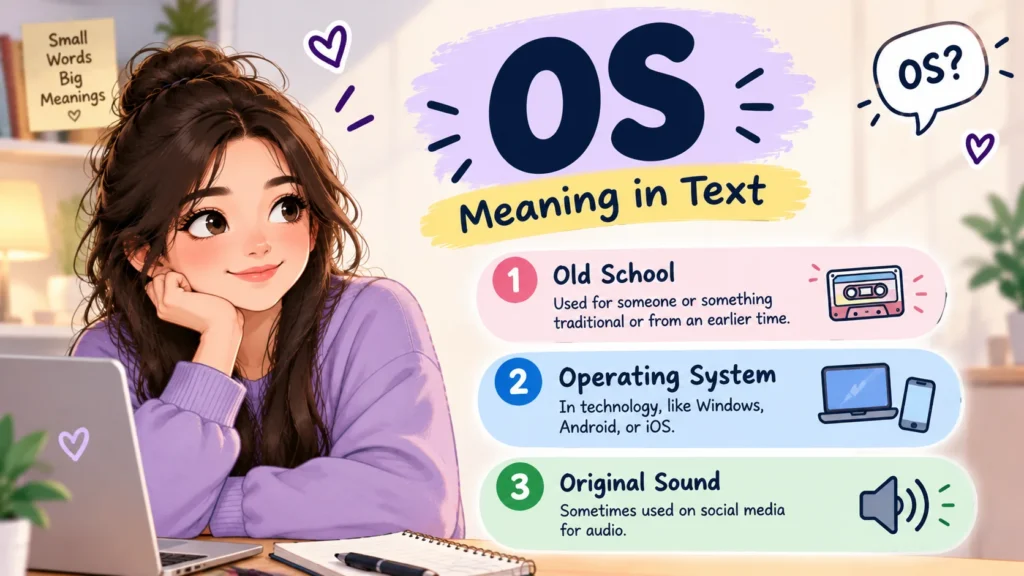
Have you received a message containing “OS” and wondered what the sender was trying to say? You are not alone. Short abbreviations can be confusing because the same letters may mean different things in texting, gaming, technology, shopping, and everyday conversations.
Unlike common texting shortcuts such as LOL or BRB, OS does not have one universally accepted meaning in casual messages. Its interpretation depends on the words around it and the subject being discussed.
For example, OS can stand for “operating system” in a technology conversation or “old school” when someone describes a classic style. In a shopping context, it may mean “out of stock.” Some people also use personal abbreviations that are understood only within their friend group.
Understanding the context is the best way to avoid misreading a short message.
OS Meaning in Text – Quick Meaning
OS is a context-dependent abbreviation. Its meaning changes according to the conversation, platform, and subject.
Here are some possible interpretations:
- Old School: Something traditional, classic, or associated with an earlier era.
- Operating System: The main software that manages a computer or smartphone.
- Out of Stock: A product that is currently unavailable for purchase.
- Obviously: A possible personal or informal shorthand, although OS is not a widely standardized abbreviation for this word in texting.
- Other Specific Meanings: Some communities use OS as an abbreviation for terms related to gaming, work, education, or their own shared vocabulary.
Simple Examples
“I love old-school hip-hop.”
If someone shortens the idea to “OS hip-hop,” they may mean old-school hip-hop, although that shortened form is not universally understood.
“What OS is your laptop running?”
Here, OS means operating system.
“Sorry, that jacket is OS right now.”
In a shopping conversation, OS might mean out of stock, depending on the seller’s terminology.
The important distinction is that these meanings are not interchangeable. The surrounding conversation tells you which interpretation makes sense.
Origin & Background
OS is an initialism formed from the first letters of a phrase. Initialisms are common in digital communication because they make longer terms quicker to type.
However, OS is not exclusively an internet slang expression. It has established meanings in several fields, particularly technology.
How OS Became Common in Digital Communication
Computer users have used OS as shorthand for “operating system” for decades. As computers and smartphones became part of everyday life, the abbreviation appeared in online forums, product discussions, technical support chats, and everyday messages.
The phrase “old school” also became common in music, fashion, entertainment, and discussions about earlier cultural trends. Although people sometimes shorten expressions in casual chats, “OS” is not a universally recognized replacement for “old school.”
Social Media Influence
Social media encourages short captions, quick replies, and compact expressions. Users often create their own abbreviations to save time or express a shared idea.
This can make a short form appear more widespread than it actually is. One group may understand OS immediately, while another may interpret it as a technical term.
That is why it is better to examine the conversation instead of assuming OS always means the same thing.
Read More : YWS Meaning in Text: What Does YWS Mean?
Real-Life Conversations
These examples demonstrate how context helps explain OS. Some interpretations are established technical or commercial uses, while others depend on informal shorthand.
WhatsApp Conversation
Person A:
Why does your computer look different from mine?
Person B:
I’m using Linux.
Person A:
Oh, so that’s your OS?
Person B:
Yeah, it’s my operating system.
Here, OS clearly refers to the software that manages the computer.
Instagram DM
Person A:
Your outfit reminds me of old-school streetwear.
Person B:
That’s exactly the look I wanted 😂
Person A:
The vintage jacket makes it work.
Person B:
I love that classic style.
This conversation illustrates the phrase “old school.” If someone shortened it to OS, the intended meaning would depend on whether both people understood that shorthand.
Shopping Message
Person A:
Can I still order the black sneakers?
Person B:
They’re OS at the moment.
Person A:
Oh, out of stock?
Person B:
Yes, but we’re expecting more soon.
In this context, OS may be used as a seller’s shorthand for “out of stock.” Because the abbreviation is not universal, confirming its meaning is sensible.
Text Message
Person A:
Which phone should I buy for gaming?
Person B:
Check the OS and how well the games run on it.
Person A:
You mean Android or iOS?
Person B:
Exactly. Also compare the processor and memory.
Here, OS means operating system, and the conversation makes that interpretation clear.
Emotional & Psychological Meaning
OS does not usually communicate one specific emotion. Unlike a laughing emoji or an expression such as “OMG,” its meaning is primarily informational.
The emotional tone comes from the surrounding sentence.
It Can Express Nostalgia
When OS is used to refer to “old school,” the conversation may involve nostalgia, appreciation, or admiration for an earlier style.
For example, someone discussing classic songs may use old-school language to show that they enjoy music from a previous generation.
It Can Be Neutral and Practical
In technical or shopping conversations, OS usually communicates information rather than emotion.
“What OS do you use?” is a straightforward question. It does not automatically imply approval or criticism.
It Can Cause Confusion
Unfamiliar abbreviations can make people feel excluded from a conversation.
A person might understand the topic but miss the meaning of the shortened expression. Asking for clarification is often the easiest solution.
A Personal-Style Scenario
Imagine a friend messages me, “What OS are you on?” If we have been discussing laptops, I would understand that the question probably concerns an operating system.
If the same letters appeared in a conversation about clothing, I would need more context before deciding what they meant.
The letters alone are not enough to determine the intended message.
Usage in Different Contexts
Social Media
OS may appear in posts about technology, music, fashion, shopping, or gaming.
Examples include:
- “Which OS works best for this app?”
- “I love old-school music.”
- “The product is currently out of stock.”
- “Does this game support your OS?”
The exact interpretation depends on the subject.
Friends and Relationships
Friends sometimes create private shorthand that makes sense only to their group.
If a friend sends “OS” without any explanation, consider the conversation that came before it. If the intended meaning is still unclear, asking a quick question is better than guessing.
Work and Professional Settings
In professional communication, OS often appears in its technical sense.
For example, an IT colleague might ask which OS a computer uses. A retailer may use a stock-status abbreviation internally.
In formal emails, however, writing the complete phrase can prevent misunderstandings when the audience may not recognize the abbreviation.
Casual vs. Serious Tone
OS is not inherently casual, rude, friendly, or serious.
Its tone depends on how it is used. A technical question may sound neutral, while a private abbreviation in a conversation between friends may carry a meaning unique to their relationship.
When NOT to Use It
When Clarity Matters
Avoid unexplained abbreviations in important instructions, professional emails, school assignments, and official documents.
Writing “operating system” instead of OS can help readers who are unfamiliar with technology terminology.
When Talking to Someone Unfamiliar With Slang
Not everyone uses the same abbreviations. If the recipient might misunderstand OS, use the complete phrase.
In Sensitive Conversations
If someone is discussing a serious personal issue, unexplained shorthand can make your message harder to understand.
Clear language is usually more helpful than trying to shorten every sentence.
When the Meaning Is Uncertain
Do not assume OS means “obviously,” “old school,” or “out of stock” without supporting context. Some interpretations are established in particular fields, while others may be specific to an individual or community.
Common Misunderstandings
Assuming OS Has One Fixed Meaning
This is the most common mistake.
OS is used in multiple contexts, so its meaning cannot be identified reliably without considering the topic.
Thinking OS Always Means “Obviously”
Although people may invent personal abbreviations, OS is not a standard, widely recognized texting equivalent of “obviously.”
If someone uses it that way, the surrounding conversation or their personal texting habits would need to support that interpretation.
Confusing “Old School” With a Standard OS Abbreviation
People commonly write “old school” in full. OS may be used as shorthand in a particular group, but readers should not automatically assume that meaning.
Assuming It Is Always Technology-Related
OS is widely recognized as “operating system” in computing, but it can appear in nontechnical contexts as well.
The subject of the message is the best clue.
Ignoring the Rest of the Sentence
Compare these questions:
- “What OS does your laptop use?”
- “Is that old-school music?”
- “Is this product out of stock?”
Each points toward a different concept. A few surrounding words can completely change the likely interpretation.
Comparison Table
| Abbreviation or Phrase | Meaning | Typical Context |
|---|---|---|
| OS | Operating System | Computers and phones |
| OS | Old School, if defined by context | Music, fashion, culture |
| OS | Out of Stock, in some retail shorthand | Shopping and inventory |
| LOL | Laughing Out Loud | Casual texting |
| BTW | By the Way | Everyday conversation |
| IDK | I Don’t Know | Questions and replies |
| TTYL | Talk To You Later | Ending a conversation |
| IMO | In My Opinion | Sharing viewpoints |
Key Insight
OS is different from many popular texting abbreviations because its meanings are spread across several fields. Rather than assigning it one universal slang definition, identify the topic first and use the surrounding words to determine what the sender means.
Variations / Types
OS does not have a single standardized set of texting variations. These examples show how it may appear in different contexts.
1. OS — Operating System
The standard technical abbreviation for the software that manages a computer or smartphone.
2. OS — Old School
A possible shorthand in conversations about classic styles, music, or older trends. It is not universally understood in this form.
3. OS — Out of Stock
A possible retail abbreviation indicating that a product is unavailable. Store terminology varies, so confirmation may be necessary.
4. OS Update
Usually refers to an operating-system update that improves software, fixes problems, or adds features.
5. OS Version
Refers to a specific release of an operating system, such as a version of Windows, Android, or iOS.
6. OS Compatibility
Describes whether software or hardware works with a particular operating system.
7. OS Support
May refer to technical assistance or the period during which an operating system receives updates.
8. OS Settings
Usually means the configuration options available within a device’s operating system.
9. OS Error
A technical problem related to an operating system or its functions.
10. OS Slang in a Friend Group
Some groups may assign OS a private or playful meaning. Such a use should not be treated as a general definition without additional context.
How to Respond When Someone Uses It
Your response should depend on the subject of the conversation.
Casual Replies
If you think you understand the intended meaning, you can respond naturally:
- “Oh, got it.”
- “That makes sense.”
- “Which one do you mean?”
- “Can you explain that abbreviation?”
Funny Replies
If you are chatting with a friend and the abbreviation is unclear:
- “Wait, what does OS mean here? 😂”
- “You can’t just drop two letters and leave me guessing.”
- “Explain before I make the wrong assumption 😂”
Mature Replies
In a technical conversation, ask a specific question:
- “Do you mean the operating system?”
- “Are you referring to the product’s stock status?”
- “Could you clarify what OS stands for in this context?”
Respectful Replies
If the abbreviation appears in an important message, you can write:
- “Just to confirm, what does OS mean here?”
- “I want to make sure I understand your message correctly.”
- “Could you write out the full phrase for clarity?”
Asking for clarification is normal. It is better to understand the sender than to reply based on an incorrect assumption.
Regional & Cultural Usage
Western Culture
In English-speaking countries, OS is widely understood in technology contexts. People who work with computers or discuss software are particularly likely to recognize it.
In everyday texting, however, the abbreviation is less predictable because it does not have one dominant slang meaning.
Asian Culture
English abbreviations appear frequently in technology discussions and online communication across many Asian countries.
OS may be understood as “operating system” by people who use English-language technology resources. Other interpretations depend on the local community and topic.
Middle Eastern Culture
Multilingual internet users may mix English abbreviations with Arabic or other languages.
OS can appear in technical conversations, shopping messages, and social media posts, but its meaning still depends on context.
Global Internet Usage
Digital communication connects people who may not share the same first language or online habits.
As a result, one abbreviation can be familiar in a technical community but unfamiliar in a casual conversation. A shared context helps people understand one another.
Gen Z vs. Millennials
Neither Gen Z nor Millennials have one universal interpretation of OS.
Younger users may encounter it in social media or gaming communities, while other users may mainly recognize it from technology. Individual interests and experience matter more than generation alone.
Is It Safe for Kids?
OS is generally harmless when used as a regular abbreviation. Its common technical meaning, “operating system,” is not offensive.
The abbreviation itself is not enough to determine the content or safety of a conversation. If a child receives an unfamiliar message containing OS, the surrounding words and context are more useful than the letters alone.
Encouraging children to ask about unfamiliar expressions can help them communicate confidently and recognize when a message needs clarification.
FAQs
What does OS mean in text messages?
OS has several possible meanings. It commonly means “operating system” in technology conversations, while other meanings depend on the subject and the sender’s usage.
Does OS mean “old school”?
It can be used as shorthand for “old school” in some contexts, but OS is not a universally recognized abbreviation for that phrase.
Does OS mean “out of stock”?
Some sellers or businesses may use OS to mean “out of stock.” Because retail abbreviations vary, check the product listing or ask the seller to confirm.
Does OS mean “obviously” in texting?
OS is not a widely standardized abbreviation for “obviously.” A person might use it as private shorthand, but the surrounding message is needed to support that interpretation.
What does OS mean from a guy or a girl?
The abbreviation does not have a special meaning based on the sender’s gender. The topic and surrounding words are more important clues.
Is OS a slang word?
OS is better described as a context-dependent abbreviation than as one specific slang word. It has established uses in technology and possible meanings in other communities.
How can I tell which OS meaning someone intends?
Look at the subject of the conversation. A question about a laptop likely concerns its operating system, while a shopping message may refer to product availability. If it remains unclear, ask the sender.
Conclusion
OS meaning in text depends on context. It is widely used to mean “operating system” in technology, while “old school” and “out of stock” may be intended in particular conversations or communities.
The key is not to assume that every abbreviation has one fixed meaning. Look at the sentence, consider what the people are discussing, and ask for clarification when needed.
Understanding internet shorthand becomes much easier when you focus on the message as a whole rather than just the letter.





1 thought on “OS Meaning in Text: Common Meanings and Examples”