
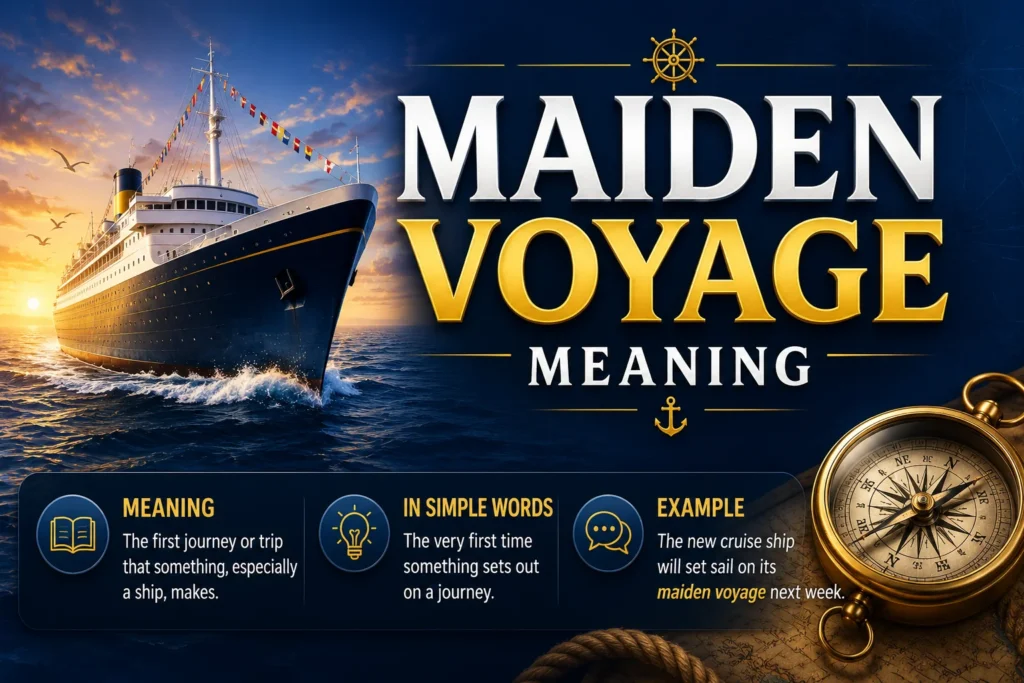
The phrase “maiden voyage” sounds old-fashioned and poetic, yet it still appears in news stories, travel writing, documentaries, books, social media posts, and everyday conversation.
Its basic meaning is simple: a maiden voyage is the first journey made by a new ship or other vessel. Cambridge Dictionary also includes spacecraft in its definition, while Collins describes it as the first voyage of a vessel.
People often search for the maiden voyage meaning because the word maiden has several unrelated meanings in modern English. Someone unfamiliar with the expression may wonder whether it refers to a female passenger, a romantic journey, or even a wedding trip.
It does not.
In this expression, maiden essentially means first, initial, or inaugural.
The phrase can also move beyond ships. In informal or figurative English, people sometimes call their first experience with a new activity, product, project, or adventure a “maiden voyage.”
Understanding that difference between the literal and figurative meanings makes the expression much easier to use naturally.
Maiden Voyage – Quick Meaning
What does maiden voyage mean?
Maiden voyage means the first official journey of a ship, vessel, or spacecraft.
In broader figurative usage, it can describe someone’s first attempt or first experience with something.
The quickest way to remember it is:
- Maiden = first or inaugural
- Voyage = journey
- Maiden voyage = first journey
Examples:
“The ship began its maiden voyage on Friday.”
This means the ship started its first official journey.
“We took our new camper van on its maiden voyage.”
Here, the phrase is being used playfully for the vehicle’s first trip.
“This is my maiden voyage into podcasting.”
This is figurative. The speaker means it is their first experience creating a podcast.
The phrase often carries a sense of beginning, excitement, uncertainty, or importance, because first journeys tend to be memorable.
Origin & Background of the Phrase Maiden Voyage
Where did “maiden voyage” come from?
The expression developed from nautical language.
Collins dates “maiden voyage” to roughly 1900–1905, while Dictionary.com notes that the specific phrase was recorded around the beginning of the twentieth century. The use of maiden to mean a first or initial experience is considerably older and can be traced back centuries.
Historically, maiden was commonly used as a noun for a young unmarried woman. English later developed an adjectival use in which maiden could mean first, earliest, or previously untried.
That sense appears in expressions such as:
- Maiden speech
- Maiden flight
- Maiden race
- Maiden voyage
The nautical phrase became especially memorable because launching a new ship has traditionally been an important public event.
The Titanic connection
One reason many people recognize the phrase today is the Titanic.
Cambridge Dictionary uses the Titanic as a familiar example: the ship sank during its maiden voyage in 1912.
Because that story is taught, filmed, and discussed around the world, generations of English learners have encountered “maiden voyage” through the Titanic disaster.
How the meaning evolved
Eventually, people began using the expression beyond the sea.
Someone might jokingly refer to the first drive in a new car as its “maiden voyage,” or a company might describe the first use of a new system in similar language.
The central idea remains unchanged: something is being experienced for the first time.
Read More : WODL Meaning in Text: What Does WODL Really Mean?
Real-Life Conversations Using “Maiden Voyage”
WhatsApp Conversation
Person A: Did your brother finally finish restoring that old boat?
Person B: Yep! We’re taking it out Saturday.
Person A: Nice. Its maiden voyage?
Person B: Exactly 😂 We’re hoping nothing falls off.
The phrase sounds natural here because the conversation involves a boat taking its first trip after restoration.
Instagram DMs
Person A: Your new camper looks amazing!
Person B: Thank you! We’re driving to the mountains this weekend.
Person A: So this is the maiden voyage?
Person B: Yes! First proper trip. I’m excited and nervous at the same time.
Here, the expression is playful rather than strictly nautical.
TikTok Comments
Person A: Taking my homemade kayak onto the lake tomorrow.
Person B: Maiden voyage? 👀
Person A: Yep. Either I become an adventurer or learn a very expensive lesson 😂
Person B: Please wear a life jacket 😭
This shows how “maiden voyage” can sound humorous while still keeping its original meaning.
Text Message
Person A: How did your first day running the food truck go?
Person B: Survived it somehow.
and,
Person A: Successful maiden voyage then?
Person B: Mostly. We ran out of fries in 40 minutes 😂
The food truck is not literally sailing anywhere. The phrase means the business had its first real outing or operational experience.
Emotional & Psychological Meaning of Maiden Voyage
A maiden voyage is more than simply “trip number one.”
The phrase often carries an emotional sense of hope, uncertainty, anticipation, pride, and risk.
First experiences matter psychologically because there is no previous experience to rely on. You may have prepared carefully, but you do not yet know exactly how events will unfold.
That is why “maiden voyage” can feel more dramatic than simply saying “first trip.”
Imagine buying a small sailing boat after saving money for years.
You spend months learning how everything works, checking the equipment, planning a route, and waiting for good weather. On the morning you finally leave the harbor, someone says:
“Enjoy the maiden voyage.”
Those words recognize more than the physical journey. They acknowledge the preparation, nervousness, and sense of achievement behind it.
Figuratively, the same emotion can appear when someone starts a business, tests a new invention, travels alone for the first time, or begins a creative project.
The expression suggests: This is the beginning, and we are about to discover what happens.
Usage of Maiden Voyage in Different Contexts
Ships and boats
This is the traditional and most precise context.
“The cruise ship completed its maiden voyage successfully.”
The ship has now completed its first official journey.
Aircraft and spacecraft
Related expressions such as maiden flight are usually more common for aircraft, but “voyage” can also appear with spacecraft.
Cambridge specifically includes the first journey of a spacecraft in its definition of maiden voyage.
Social media
Online, people often use the phrase humorously.
Examples might include:
“My new espresso machine’s maiden voyage ☕”
or:
“Taking the new motorcycle on its maiden voyage today.”
The object is not a ship, but everyone understands that it is being properly used for the first time.
Friends and relationships
Friends may use the expression jokingly when trying something new together:
“Our maiden voyage into camping did not go well.”
It creates a light, storytelling tone.
Work and professional settings
The phrase can appear professionally, especially in industries connected with transport, shipping, aviation, engineering, tourism, or product launches.
For unrelated business activities, “first launch,” “initial rollout,” “pilot,” or “first deployment” may be clearer.
Casual vs. serious tone
In literal maritime writing, “maiden voyage” sounds completely normal and serious.
Outside that context, it often sounds slightly dramatic, humorous, or metaphorical.
When NOT to Use “Maiden Voyage”
The expression does not naturally fit every first-time situation.
You normally would not say:
“My maiden voyage to the grocery store.”
Unless you are deliberately being humorous, first trip sounds much more natural.
Avoid using the phrase when simpler wording would communicate the idea more clearly, particularly in instructions, contracts, academic methodology, safety documents, or highly technical writing.
Cultural and language differences can also matter.
Some English learners know maiden only as the older literary term for a young woman. As a result, an unexplained metaphorical use may initially confuse them.
The phrase is best when either:
- An actual vessel is making its first journey, or
- You intentionally want a vivid metaphor for a first experience.
Common Misunderstandings About Maiden Voyage
It does not mean a voyage for women
Despite the older meaning of maiden, “maiden voyage” has nothing to do with the gender or marital status of passengers.
It does not mean honeymoon
A honeymoon can involve travel, but it is unrelated to the expression.
A maiden voyage describes a vessel’s first journey, not a couple’s first holiday after marriage.
It does not necessarily mean the first test
A ship may undergo tests or sea trials before its official maiden voyage.
The term generally refers to the vessel’s first significant or official journey rather than every movement it has ever made.
It can be figurative
People sometimes assume the phrase must involve a ship.
Modern English frequently stretches it metaphorically:
“Our new van survived its maiden voyage.”
The van is simply being taken on its first proper trip.
“Maiden voyage” and “maiden flight” are different
A ship normally has a maiden voyage.
An aircraft normally makes a maiden flight.
Both expressions communicate the idea of a first official journey.
Maiden Voyage Compared With Similar Expressions
| Expression | Meaning | Typical Context | Tone |
|---|---|---|---|
| Maiden voyage | First journey | Ships, spacecraft, figurative use | Formal/poetic |
| First voyage | First journey by sea | Ships | Neutral |
| Inaugural voyage | Official first journey | Ships/cruise lines | Formal |
| Maiden flight | First flight | Aircraft | Formal |
| First trip | First journey | Everyday travel | Casual |
| Debut | First public appearance | Art, sport, performance | Neutral |
| First attempt | First effort | General situations | Neutral |
| Trial run | Test before normal use | Machines, systems, events | Practical |
| Pilot run | Small first test | Business/projects | Professional |
| Final voyage | Last journey | Ships/persons metaphorically | Opposite in sequence |
Key Insight
“Maiden voyage” emphasizes a meaningful beginning. “First trip” simply describes sequence, while “maiden voyage” often makes the event sound more important, ceremonial, adventurous, or memorable.
Variations and Related Types of Maiden Voyage
1. Maiden Voyage
The original expression meaning the first journey of a vessel.
2. Maiden Flight
The first flight made by a new aircraft.
3. Maiden Journey
A broader variation referring to a first journey, although it is less fixed than “maiden voyage.”
4. Inaugural Voyage
A more formal alternative meaning the first official voyage.
5. First Voyage
The simplest literal synonym and easier for English learners.
6. First Sailing
Often used informally for the first scheduled departure of a ship or cruise vessel.
7. Maiden Speech
A person’s first formal speech in a particular role, especially in parliamentary contexts.
8. Debut Journey
A less traditional expression highlighting a first public journey.
9. First Expedition
Used when the first journey has an exploratory, scientific, or adventurous purpose.
10. First Mission
Common for spacecraft, military equipment, research vehicles, or specialized operations.
Each variation communicates a beginning, but the appropriate choice depends on what is making its first appearance or journey.
How to Respond When Someone Says “Maiden Voyage”
Casual replies
If a friend says:
“We’re taking the boat on its maiden voyage tomorrow.”
You could reply:
- “That sounds exciting!”
- “Hope the first trip goes perfectly.”
- “Have an amazing time.”
- “Send pictures!”
Funny replies
- “May the boat remember how to boat 😂”
- “Try to return with the same number of passengers.”
- “Titanic jokes are officially banned.”
- “Bon voyage, captain!”
Mature replies
- “I hope everything goes smoothly.”
- “Congratulations on getting it ready.”
- “That must feel rewarding after all the preparation.”
- “Have a safe and successful first journey.”
Respectful professional replies
For a formal launch:
- “Wishing the vessel a successful maiden voyage.”
- “Congratulations to the entire team on this important milestone.”
- “Best wishes for a safe and successful inaugural journey.”
Your reply should match the seriousness of the situation.
Regional & Cultural Usage of Maiden Voyage
Western culture
In British and American English, “maiden voyage” is a well-established nautical expression.
Collins gives both British and American definitions, with the American definition specifically referring to a ship’s first voyage after acceptance from its builders.
Asian culture
The phrase commonly appears in English-language maritime, aviation, tourism, educational, and news writing across Asia.
For English learners, however, “first voyage” may initially be clearer because maiden is less common in ordinary conversation.
Middle Eastern culture
English-language shipping and travel communication in the Middle East may use “maiden voyage” for new cruise ships, commercial vessels, or transport services.
Its meaning generally remains the same: an inaugural journey.
Global internet usage
Online culture has widened the expression dramatically.
Someone can call the first trip of a bicycle, camper, gaming setup, robot, homemade vehicle, or even kitchen appliance a “maiden voyage.”
The humorous effect comes from treating an ordinary first use like an important maritime expedition.
Gen Z vs. Millennials
Neither generation owns the expression.
Millennials may know it through travel, history, or the Titanic story, while Gen Z users often encounter it in memes, captions, documentaries, and playful social-media language.
Younger users may use it more ironically:
“New air fryer’s maiden voyage. Wish me luck.”
The literal meaning remains underneath the joke.
Is “Maiden Voyage” Safe for Kids?
Yes. Maiden voyage is a completely safe and standard English expression.
There is no offensive, sexual, or inappropriate meaning built into the phrase.
Children may simply need help understanding that maiden has a special meaning here.
A beginner-friendly explanation would be:
“A maiden voyage is the first journey made by a new ship.”
It can also be useful when teaching history because the phrase frequently appears in discussions about famous ships and exploration.
FAQs About Maiden Voyage Meaning
What does maiden voyage mean in simple words?
A maiden voyage is the first official journey made by a ship or vessel. It can also be used figuratively for someone’s first experience with something.
Why is it called a maiden voyage?
In this phrase, maiden means first, initial, or previously untried. The phrase became established in nautical English around the beginning of the twentieth century.
Does maiden voyage only apply to ships?
Ships are the traditional context, but the expression can also describe spacecraft and is frequently used figuratively for other first journeys or experiences.
What is an example of a maiden voyage?
“The new cruise ship departed Southampton on its maiden voyage.”
This means it began its first official journey.
Can a car have a maiden voyage?
Technically, “first drive” or “first trip” is more natural for a car. However, people often jokingly call a new car’s first road trip its “maiden voyage.”
What is the opposite of maiden voyage?
There is no perfect fixed opposite. Depending on context, final voyage, last voyage, or final journey can express the opposite idea.
Is maiden voyage the same as first voyage?
Essentially, yes. “Maiden voyage” sounds more traditional, ceremonial, and memorable, while “first voyage” is simpler and more neutral.
Conclusion
The maiden voyage meaning is straightforward once you understand the special use of maiden: it refers to the first official journey of a ship, vessel, or spacecraft.
What makes the phrase interesting is the emotion behind it.
A maiden voyage often represents more than movement from one place to another. It symbolizes a beginning—the moment when preparation becomes experience and uncertainty becomes reality.
That is why the expression has survived beyond traditional sailing language. Today, people use it seriously for ships and spacecraft and playfully for cars, campers, projects, products, and personal adventures.
If you are talking about a genuine first sailing, “maiden voyage” is precise and natural. If you are using it metaphorically, it adds a sense of adventure and occasion to an otherwise ordinary “first time.”
Use it confidently when you want a beginning to feel like the start of a journey.
For high CTR (click-through rate), titles and descriptions should create curiosity, a clear benefit, and a reason to click without giving everything away.





1 thought on “Maiden Voyage Meaning: Definition, Origin & Examples”