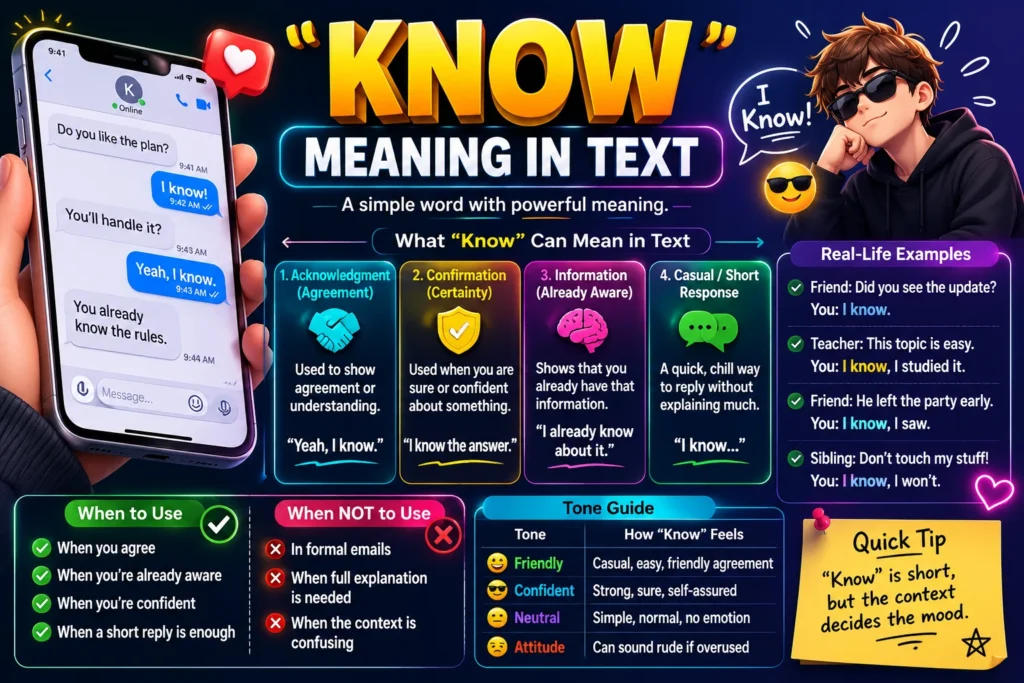
The word “know” in a text message usually has its normal English meaning: to understand, recognize, or be aware of something.
Unlike texting abbreviations such as “LOL” or “IDK,” know is not normally a special piece of slang. Its meaning comes from the sentence, punctuation, and tone surrounding it.
For example:
“I know.”
can mean “I understand” or “Yes, I’m aware.”
But:
“You know?”
can mean “Do you understand?”, “Do you agree?”, or simply invite the other person to connect with what was just said.
A short message such as:
“Know.”
can feel much sharper. Depending on context, it might mean “I know”, “I understand,” or an abbreviated response used casually.
Know Meaning in Text: Quick Answer
“Know” in texting usually means being aware of, understanding, or recognizing something.
Common uses include:
- I know = I understand / I’m aware.
- You know? = Do you understand or agree?
- Know what I mean? = Do you understand my point?
- Good to know = That information is useful.
- I know, right? = I strongly agree.
- You know him? = Are you familiar with him?
The emotional tone can change dramatically depending on punctuation.
Compare:
“I know.” — neutral or possibly annoyed.
“I know!” — excited agreement.
moreover,
“I know…” — resignation, sadness, or frustration.
“You know?” — checking whether the other person understands.
Is “Know” a Texting Slang Word?
No. “Know” is an ordinary English verb, not a standard texting abbreviation.
However, people often use it in shortened or conversational constructions online.
For example:
“yk” can sometimes stand for “you know.”
You may also see:
“yk what I mean?”
This is different from the word know itself.
Because texting encourages shorter messages, familiar expressions can become compressed into abbreviations.
Where Does “Know” Come From?
“Know” is an old English word with roots in Germanic languages.
Its basic meaning has remained remarkably stable: being aware of information, understanding something, or being familiar with a person or thing.
Digital communication has not fundamentally changed the word.
What has changed is how people use it conversationally.
A text message removes voice tone and facial expression, so a simple phrase such as “I know” can carry several emotional meanings.
Why Context Matters So Much
Imagine someone texts:
“I know.”
You cannot hear whether they sound happy, frustrated, sarcastic, tired, or calm.
The previous messages have to provide the missing information.
That is why the same two words can feel completely different in different conversations.
Read More : Meaning of Ops in Text: Slang & Work Meanings
Real-Life Texting Conversations
WhatsApp Conversation
Person A:
“You need to bring your ID tomorrow.”
Person B:
“I know.”
Here, the response simply means the person is already aware.
Instagram DM
Person A:
“That restaurant is expensive.”
Person B:
“I know 😭 but the food is so good.”
Here, “I know” expresses agreement.
Text Message
Person A:
“You’ve been working really hard lately.”
Person B:
“I know… I’m exhausted.”
The dots make the response sound more reflective or emotionally tired.
TikTok Comment
Person A:
“This song is way too addictive.”
Person B:
“I KNOW 😭”
The capitalization shows strong agreement and enthusiasm.
The Emotional Meaning of “Know”
The word itself is neutral, but “know” can carry a lot of emotional weight.
Agreement
“I know!”
The person strongly agrees.
Understanding
“Yeah, I know what you mean.”
The sender understands the other person’s perspective.
Frustration
“I know. You don’t have to keep telling me.”
The same word becomes defensive.
Empathy
“I know how you feel.”
The speaker is expressing understanding or sympathy.
Sarcasm
“Oh, I know.”
Depending on the conversation, this can imply irritation or disbelief.
The key point is that the emotional meaning comes from the surrounding language rather than the word alone.
Common Texting Phrases With “Know”
“I Know”
Usually means “I’m aware” or “I understand.”
“I Know Right?”
Often written as “IKR?”, this expresses strong agreement.
Example:
“That movie was amazing.”
“I know right?!”
“You Know?”
Used to check whether someone understands or agrees.
Example:
“It just felt weird, you know?”
“You Know What?”
Usually introduces a new thought, decision, or reaction.
Example:
“You know what? Let’s just go.”
“Good to Know”
Means the information is useful or helpful.
Example:
“The store closes at 9.”
“Good to know.”
“I Know What You Mean”
Shows understanding or empathy.
Example:
“I feel like nobody listens sometimes.”
“I know what you mean.”
“You Know Me”
Can express familiarity or confidence that another person understands your personality.
Example:
“You know me. I never say no to pizza.”
“Know” With Different Punctuation
Punctuation can completely change how the message feels.
“I know.”
Usually neutral, although it can sometimes sound blunt.
“I know!”
Excited, enthusiastic, or strongly agreeing.
“I know…”
Often suggests sadness, resignation, frustration, or hesitation.
“Know?”
Very informal. It may mean “Do you understand?” depending on context.
“I KNOW 😂”
Strong agreement, usually playful.
“I know 🙄”
May communicate annoyance or sarcasm.
Know vs No: A Common Texting Confusion
One of the most common mistakes involving know is confusing it with no.
They sound similar in English but have completely different meanings.
Know = understand or be aware.
No = negative answer or opposite of yes.
Examples:
“I know the answer.”
means:
“I am aware of the answer.”
“No, I don’t know.”
contains both words with completely different functions.
Autocorrect can occasionally make this confusion worse in casual texting.
Know vs “Knew”
These words also appear frequently in text conversations.
Know refers to present awareness:
“I know what happened.”
Knew refers to past awareness:
“I knew something was wrong.”
A message saying:
“I knew it!”
usually expresses that the sender’s previous suspicion or prediction turned out to be correct.
How “Know” Is Used in Modern Internet Communication
Social media has created many informal expressions built around “know.”
Examples include:
- “You know the vibes.”
- “You know what I mean.”
- “I know, right?”
- “You already know.”
- “If you know, you know.”
- “You know what?”
- “Now you know.”
These phrases are conversational rather than formal.
“If You Know, You Know”
One particularly popular expression is:
“If you know, you know.”
Often shortened to IYKYK, it means that people familiar with a particular experience, joke, place, trend, or situation will understand the reference.
For example:
“That late-night food spot after a concert… IYKYK.”
The expression creates a sense of shared knowledge.
When “Know” Can Sound Rude
The word itself is not rude, but short responses can sometimes sound dismissive.
For example:
Person A:
“Please remember to call Mom.”
Person B:
“Know.”
This may feel abrupt.
A warmer alternative would be:
“Yeah, I know. I’ll call her.”
Adding a few words removes uncertainty about the tone.
Why Short Replies Cause Problems
Text messages do not include voice tone.
A person may intend:
“I know 😊”
as friendly agreement.
The recipient may read:
“I know.”
as irritation.
This is one reason punctuation and emojis can influence how a message is interpreted.
When Not to Use “Know” Alone
Sending only “know” can be confusing because it is not a complete response in most standard English contexts.
If clarity matters, use:
- “I know.”
- “Yes, I know.”
- “I understand.”
- “I know what you mean.”
- “Good to know.”
A complete phrase makes your intention easier to understand.
This is especially important in professional communication.
Common Misunderstandings About “Know”
Does “Know” Have a Secret Slang Meaning?
Usually no.
It normally carries its standard English meaning.
Does “Know” Mean “Okay”?
Sometimes “I know” can function conversationally like acknowledgment, but it does not literally mean “okay.”
Does “Know” Mean Agreement?
It can.
For example, “I know!” often means “I completely agree.”
However, “know” itself means awareness or understanding.
What Does “Know…” Mean?
The ellipsis can make the message sound emotional, hesitant, tired, disappointed, or resigned.
Context determines the exact feeling.
Is “Know” the Same as “No”?
No.
Know relates to awareness.
No expresses negation.
Similar Expressions to “Know”
| Expression | Meaning | Typical tone |
|---|---|---|
| I know | I’m aware / I understand | Neutral |
| I know! | Strong agreement | Enthusiastic |
| I know right? | I strongly agree | Casual |
| Good to know | Useful information | Friendly |
| I get it | I understand | Casual |
| Gotcha | I understand | Informal |
| I understand | I comprehend | More formal |
| You already know | You understand/familiar | Casual |
| IYKYK | If you know, you know | Internet slang |
Key Insight
“Know” is not usually slang; its meaning comes from context and phrasing. A tiny change from “I know” to “I know…” or “I KNOW!” can completely change the emotional tone.
Common Variations of “Know” in Texting
1. I Know
A straightforward acknowledgment.
2. I Know!
Strong agreement or excitement.
3. I Know…
A more emotional or hesitant response.
4. I Know Right?
Used to strongly agree with someone.
5. You Know?
Checks whether the other person understands.
6. Good to Know
Shows appreciation for useful information.
7. You Already Know
Suggests shared understanding.
8. You Know Me
Highlights familiarity between people.
9. I Knew It
Shows that a prediction or suspicion was correct.
10. IYKYK
An internet abbreviation meaning “If You Know, You Know.”
How to Respond When Someone Says “Know”
Your response depends on what they mean.
Casual Replies
- “Exactly!”
- “Right? 😂”
- “Same!”
- “I get you.”
Funny Replies
- “Look at us agreeing for once 😂”
- “You already know.”
- “Finally, you understand 😭”
Mature Replies
- “I’m glad you understand.”
- “Exactly—that’s what I was trying to explain.”
- “Thanks for understanding.”
Respectful Replies
If their message sounds annoyed:
“I understand. I wasn’t trying to repeat myself.”
If they seem confused:
“Do you mean you already knew?”
Regional and Cultural Usage
Western English
“Know” is used in its standard English sense, while phrases such as “I know, right?” and “you already know” are common in casual conversation.
Asian Online Communities
English phrases containing “know” are widely used in messaging, gaming, and social media. Abbreviations such as IKR and IYKYK are also common among internet users familiar with English slang.
Middle Eastern Online Communities
English-language texting often combines standard English with internet abbreviations. “Know” generally keeps its ordinary meaning, while surrounding slang determines the tone.
Global Internet Culture
Expressions such as IYKYK have crossed language boundaries because social media spreads phrases quickly.
Gen Z vs Millennials
Both generations use “know” normally, but younger users may rely more heavily on shortened expressions, memes, and abbreviations such as IYKYK.
Is “Know” Safe for Kids?
Yes. “Know” is an ordinary, age-appropriate English word.
Children encounter it in school, books, games, conversations, and messaging.
Some expressions containing the word may require contextual explanation, but the word itself is completely normal.
Frequently Asked Questions
What does know mean in a text message?
“Know” usually means to be aware of, understand, or recognize something. It is not normally a special texting abbreviation.
What does “I know” mean in texting?
“I know” usually means “I’m aware” or “I understand.” It can also express agreement depending on the conversation.
What does “I know!” mean in text?
“I know!” often expresses strong agreement, excitement, or shared understanding.
What does “I know…” mean in texting?
“I know…” can communicate sadness, frustration, hesitation, resignation, or emotional agreement, depending on context.
What does “you know?” mean in a text?
“You know?” can mean “Do you understand?”, “Do you agree?”, or simply invite the other person to relate to what was said.
Is know a slang word?
No. Know is a standard English word, although it appears in many informal texting phrases and internet expressions.
What is IYKYK?
IYKYK means “If You Know, You Know.” It refers to an inside reference or experience that only certain people will understand.
Final Thoughts on Know Meaning in Text
The know meaning in text is usually straightforward: it expresses awareness, understanding, or familiarity.
What makes the word interesting in texting is not its dictionary definition but its tone.
“I know.” can sound calm.
and,
“I KNOW!” can sound excited.
moreover,
“I know…” can sound disappointed or tired.
“You know?” can invite agreement.
The lack of facial expressions and vocal tone means these small differences matter more in digital conversations.
So if someone texts “know,” “I know,” or “I know…”, look beyond the word itself. Consider the punctuation, previous messages, relationship, and overall mood.
In most cases, there is no hidden slang code. The sender is simply communicating what they know, understand, or recognize—with the surrounding context supplying the emotion.