
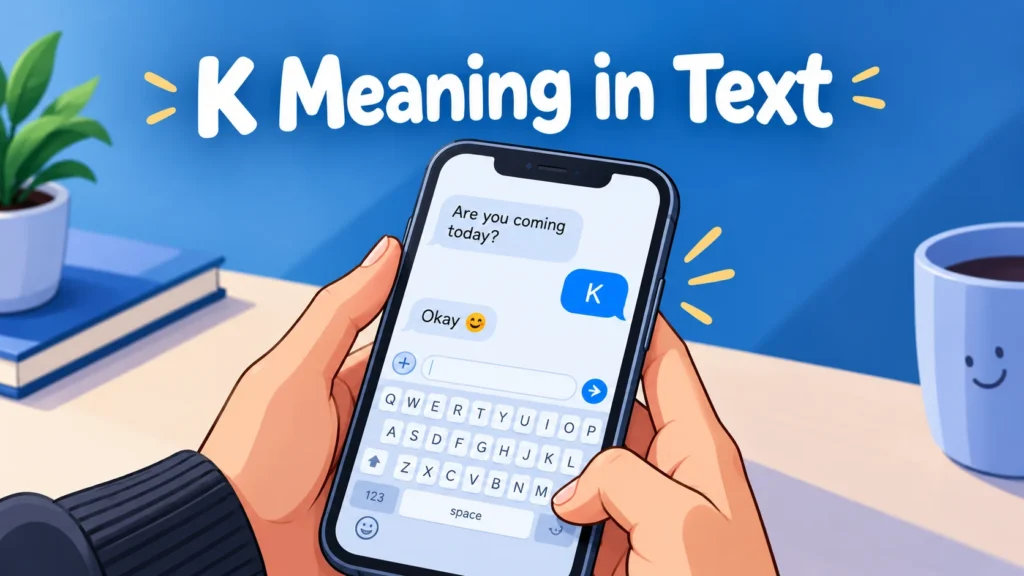
If someone replies with just “K”, the message may look simple, but its tone can be surprisingly difficult to read.
In texting, K usually means “okay.” It can show agreement, acknowledgment, or that the person has understood what you said.
The tricky part is that “K” can feel very different from “okay,” “ok,” or “okayyy.” A one-letter response may sound perfectly normal between two friends, while in another conversation it may come across as cold or annoyed.
That is why people often search for “K meaning in text” after receiving this short reply. They want to know whether the sender is simply acknowledging the message or expressing an attitude.
The answer depends on the conversation, relationship, punctuation, and what happened immediately before the message.
K Meaning in Text – Quick Meaning
What Does K Mean in Texting?
In most casual conversations, K means “okay.”
It is a shortened form used to acknowledge something without writing the complete word.
For example:
“I’ll call you after dinner.”
“K.”
The sender may simply mean:
“Okay, understood.”
However, the same reply can have a different emotional tone:
“Fine, do whatever you want.”
“K.”
Here, the response may feel more distant or irritated.
Simple Examples
“K, I’ll be there.”
Usually means “Okay, I’ll be there.”
“K thanks.”
A brief acknowledgment or acceptance.
“K.”
Can mean “Okay,” but may feel more abrupt depending on the conversation.
Origin & Background
The use of “K” comes from the natural tendency to shorten words in fast communication.
Before smartphones became central to everyday conversation, people already used abbreviated forms in text messages because typing was slower and mobile keyboards were less convenient.
“K” became one of the simplest possible responses.
It requires only one character and communicates basic acknowledgment.
Why Did “K” Become Popular?
The word “okay” itself has a long history, but its shortened forms became especially common in digital communication.
Texting encouraged people to remove unnecessary letters.
Instead of:
“Okay, I understand.”
someone could simply write:
“K.”
The convenience is obvious.
Social Media Changed the Tone
Modern messaging has also made people more sensitive to tiny differences in wording.
Compare:
- K
- OK
- Okay
- Okay!
- Okaaay
- Kkk
- kk
They can all communicate some form of acknowledgment, but their emotional impressions may be different.
That difference is one reason short replies can create misunderstandings online.
Read More : SH Meaning in Text: What Does SH Mean?
Real-Life Conversations
WhatsApp Conversation
Person A:
“Can you send me the notes tonight?”
Person B:
“K.”
and,
Person A:
“Are you mad?”
Person B:
“No 😭 I’m just busy.”
In this situation, the first person interpreted the short response emotionally, while the sender intended it as a simple acknowledgment.
Instagram DM
Person A:
“I’m going to post the picture tomorrow.”
Person B:
“K, sounds good.”
Here, the added words make the response feel warmer than simply “K.”
TikTok Comments
Person A:
“I’m not watching the new episode until Friday.”
Person B:
“K 😂”
The emoji makes the short reply feel playful rather than necessarily cold.
Text Message
Person A:
“Don’t forget we’re meeting at 6.”
Person B:
“K.”
moreover,
Person A:
“Got it.”
Here, there may be no hidden emotion at all. The sender could simply be confirming the information.
Emotional & Psychological Meaning
The interesting thing about “K” is that its emotional meaning often comes from what is missing.
A longer response gives the recipient more information about the sender’s mood.
A one-letter response provides very little.
That uncertainty can cause people to fill in the blanks themselves.
K Can Be Neutral
Sometimes “K” simply means:
“I understand.”
There may be no hidden message.
This is especially likely when the conversation is practical or straightforward.
K Can Feel Cold
If someone normally sends detailed messages and suddenly replies with “K,” the change may feel noticeable.
For example:
“I really don’t want to argue about this anymore.”
“K.”
The response might be interpreted as emotional distance.
K Can Sound Annoyed
In certain situations, “K” can communicate:
“Fine.”
or
“Whatever.”
That interpretation depends on the preceding conversation.
A Short Personal-Style Scenario
Imagine texting a friend about weekend plans.
Normally, they reply with emojis, jokes, and several sentences. One day you send:
“Want to grab coffee tomorrow?”
They answer:
“K.”
You might immediately wonder whether something is wrong.
Yet they could simply be driving, working, tired, or typing quickly.
This is why reading too much emotion into a single letter can sometimes create unnecessary tension.
Usage in Different Contexts
Social Media
“K” can appear in comments, DMs, and private messages as a quick acknowledgment.
Its tone can range from casual to sarcastic depending on the surrounding conversation.
Friends and Relationships
Among close friends, “K” may be completely normal.
Some people naturally prefer short messages and do not intend any emotional meaning.
In relationships, however, the interpretation can become more complicated because people often know each other’s normal texting habits.
Work and Professional Settings
Using “K” in professional communication is possible, but it is usually less polished than writing “Okay,” “Understood,” or “Thanks.”
For example:
“K.”
can look overly brief in an email or workplace message.
A clearer alternative is:
“Okay, understood. Thanks.”
Casual vs. Serious Tone
Casual:
“K”
Friendly:
“Okay 😊”
More enthusiastic:
“Okay!”
Potentially blunt:
“K.”
The punctuation and surrounding words can influence how the response feels.
When NOT to Use K
Important Conversations
If someone is sharing something emotionally serious, replying only with “K” may appear dismissive.
For example:
“I’m really worried about what happened today.”
A simple:
“K.”
could sound uncaring even if that was not the intention.
A better response would acknowledge the person’s feelings.
Professional Communication
In formal situations, “K” can appear too casual.
Instead of:
“K.”
consider:
“Understood.”
or:
“Okay, I’ll take care of it.”
When You Need to Show Emotion Clearly
If you are genuinely happy, grateful, or supportive, a single “K” may not communicate your intention.
More descriptive wording prevents unnecessary confusion.
During an Argument
This is where “K” can become especially risky.
During conflict, the recipient may interpret it as:
“Whatever.”
or
“I’m done talking.”
If you simply mean that you understand, saying so directly is clearer.
Common Misunderstandings
“K” Does Not Always Mean Someone Is Mad
This is one of the biggest misconceptions.
A person might send “K” because they are busy, distracted, tired, or simply prefer short replies.
The message alone cannot prove their emotional state.
“K” Is Not Automatically Rude
Some people naturally use minimal responses.
For them, “K” may have the same meaning as “okay.”
Others may use it intentionally to sound distant.
The relationship and context matter.
The Period Can Change the Feeling
Compare:
K
and:
K.
The second can sometimes appear more final or serious because the period visually closes the message.
That does not mean a period automatically indicates anger.
It is simply one factor that can influence how the message is perceived.
“K” and “Okay” Are Not Always Emotionally Identical
Both can communicate agreement.
However, “okay” provides more linguistic warmth than a single letter in many situations.
That is why people sometimes interpret “K” as colder.
Comparison Table
| Text Expression | Common Meaning | Possible Tone |
|---|---|---|
| K | Okay | Brief, neutral, or blunt |
| OK | Okay | Neutral |
| Okay | Agreement or acknowledgment | Neutral/friendly |
| Okay! | Stronger agreement | Positive |
| Okk | Okay | Casual |
| Kk | Okay | Relaxed |
| Sure | Agreement | Friendly or neutral |
| Got it | Understanding | Clear and direct |
| Fine | Acceptance | Can sound reluctant |
| Alright | Agreement | Neutral/casual |
Key Insight
The meaning of “K” is usually “okay,” but its tone depends on context. A one-letter response is not enough to determine whether someone is annoyed, uninterested, or simply busy.
Variations / Types
1. K
The simplest form.
It usually means “okay” or “understood.”
2. K.
The period can make the response appear more final.
Depending on the conversation, it may feel slightly more serious.
3. Kk
A more relaxed variation.
It commonly means “okay, okay” or simply “okay.”
4. KKK
In some casual conversations, repeated K’s can emphasize acknowledgment.
However, meanings can vary between communities, so context matters.
5. Okay
The complete word feels clearer than “K.”
It generally carries less ambiguity.
6. OK
A standard shortened form.
It can be neutral and practical.
7. Okay!
The exclamation mark can add enthusiasm.
It often feels warmer than a plain “K.”
8. Okk
A casual spelling commonly seen in texting.
It can sound relaxed or friendly.
9. K, got it
This removes much of the ambiguity.
The sender clearly communicates that they understand.
10. K thanks
This adds appreciation to the short response.
It usually sounds more cooperative than a standalone “K.”
How to Respond When Someone Uses K
Casual Replies
If the conversation is normal, you can simply continue:
“Cool.”
“Thanks!”
“Sounds good.”
Funny Replies
If a friend sends an unusually serious-looking “K,” you might joke:
“That was the most powerful K I’ve ever seen 😂.”
Or:
“Just K? 😭”
Mature Replies
If you think something may be wrong:
“Everything okay?”
This gives the person an opportunity to explain without assuming they are angry.
Respectful Replies
If the message is unclear:
“Got it. Let me know if you meant something else.”
This keeps the conversation calm and avoids unnecessary assumptions.
Regional & Cultural Usage
Western Culture
“K” is widely recognizable in English-language texting.
Its basic meaning is generally understood as “okay,” although the emotional interpretation varies.
Asian Culture
English abbreviations are frequently mixed with local languages in digital conversations.
“K” may be understood simply as an acknowledgment, particularly in short practical conversations.
Middle Eastern Culture
Many people who communicate online in English also use short forms such as “K,” “OK,” and “kk.”
The interpretation can still depend strongly on the relationship between the people communicating.
Global Internet Usage
Because “K” is extremely short, it has spread across many messaging platforms.
Yet global internet communication does not have one universal texting rulebook.
A “K” from one person may be completely different in tone from a “K” sent by another.
Gen Z vs. Millennials
Younger and older users can both use “K,” but their preferred texting styles may differ.
Some users consider extremely short replies normal, while others interpret them as signs of annoyance.
Personal communication habits matter more than age alone.
Is K Safe for Kids?
Yes. “K” is generally harmless texting language when it means “okay.”
It is not inherently offensive or inappropriate.
The important lesson for younger users is that short replies can sometimes be misunderstood.
A child or teenager may assume that someone is angry simply because they received “K,” when the sender may have intended nothing more than acknowledgment.
Teaching context and respectful communication is more useful than treating the abbreviation itself as problematic.
FAQs
What does K mean in text?
K usually means “okay” in text messages. It can indicate agreement, acknowledgment, or understanding.
Does K mean someone is mad?
Not necessarily. “K” can sound annoyed or cold in some conversations, but the sender may simply be responding quickly.
Why does K sound rude?
Because it is extremely short. Compared with “okay” or “okay, thanks,” the one-letter response can sometimes feel abrupt or emotionally distant.
What does K mean from a girl?
A girl using “K” usually means “okay,” but the tone depends on the conversation. It does not automatically mean she is angry or uninterested.
What does K mean from a guy?
A guy may use “K” simply to acknowledge a message. If it appears during an argument, it could also sound dismissive or annoyed.
Is K the same as OK?
They generally communicate the same basic idea, but “K” can feel more abrupt because it is shorter.
Should I reply when someone says K?
You do not always need to. If the conversation requires a response, you can continue naturally or ask whether everything is okay if the tone seems unusual.
Conclusion
K means “okay” in most text conversations. It is one of the shortest ways to acknowledge a message, confirm information, or show agreement.
The interesting part is its tone.
A simple “K” can be neutral between friends, practical in a quick conversation, playful with an emoji, or slightly cold during an argument. The surrounding words and the sender’s usual texting style are important clues.
If someone sends you “K,” it is better not to assume they are angry immediately. Look at the conversation as a whole before deciding what they mean.
And if you want your own message to sound warmer, writing “Okay,” “Got it,” “Sure,” or “Sounds good” can make your intention much clearer.





1 thought on “K Meaning in Text: What Does K Mean?”