Imagine you are waiting for someone to come home and receive this message:
“Still out with friends. DWU ❤️”
If you have never seen the abbreviation before, those three letters can feel surprisingly confusing.
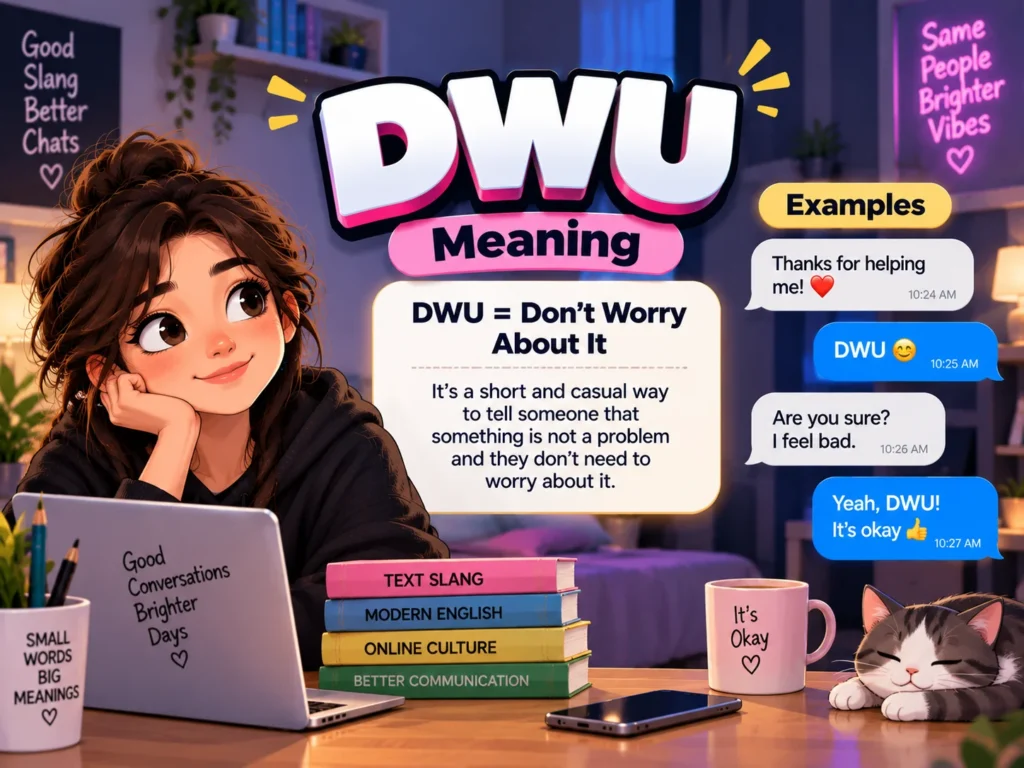
In texting, DWU most commonly means “Don’t Wait Up.” It tells another person not to stay awake, delay their plans, or keep waiting because the sender expects to be late or unavailable.
Dictionary.com describes DWU as an internet acronym for “don’t wait up” and notes that the phrase can also casually communicate “don’t worry about me.”
That sounds simple, but tone changes everything.
“DWU ❤️” may feel caring.
“Whatever. DWU.”
can feel cold.
The letters remain identical, yet punctuation, timing, relationship, and conversation history completely change the emotional message.
This guide explains the DWU meaning in text, how people use it on social media, what it means from a girl or guy, how to reply, and when another interpretation might apply.
DWU Meaning in Text – Quick Meaning
DWU = Don’t Wait Up
It usually means:
- Don’t stay awake waiting for me.
- I’ll probably be late.
- You can go to sleep.
- Don’t expect me soon.
- Continue with your plans without me.
- You don’t need to worry about me.
Cyber Definitions identifies “Don’t Wait Up” as the main meaning of DWU in texting and describes it as a relatively uncommon abbreviation that can be difficult to guess without context.
Consider these examples:
“Work is crazy tonight, DWU.”
Meaning: I’ll be home late, so don’t stay awake waiting.
“Might not reply for a while. DWU.”
Here, the speaker may mean: Don’t keep waiting for my message.
“I’m fine, DWU ❤️.”
Depending on the situation, this can carry the softer meaning: Don’t worry about me.
The core idea is always similar: the sender is releasing the other person from the expectation of waiting.
Origin and Background of DWU
Where Did DWU Come From?
The phrase “don’t wait up” existed long before smartphones.
Traditionally, people used it when leaving home and expecting to return late:
“Don’t wait up for me tonight.”
The meaning was literal. Someone in the household did not need to remain awake waiting for the speaker to return.
Dictionary.com notes examples of the phrase dating back more than a century and reports that people began shortening it to DWU in texts and social media during the 2000s.
Text messaging made the abbreviation convenient.
Instead of typing:
“I’m probably going to be late, so don’t stay awake waiting for me,”
someone could simply write:
“Running late. DWU.”
How Its Meaning Expanded
Digital communication gave DWU a slightly broader meaning.
Originally, waiting up usually meant literally staying awake.
Online, people can also use DWU to suggest:
“Don’t wait for my reply.”
“Carry on without me.”
or even:
“Don’t worry about me.”
That evolution makes sense because modern conversations often continue across the entire evening.
Is DWU Popular Slang?
DWU is recognizable, but it is less universal than abbreviations such as LOL, BTW, BRB, or IDK.
Recent slang references still consistently define it as “Don’t Wait Up,” but users unfamiliar with the abbreviation may need context to understand it.
That makes DWU useful but slightly niche.
Real-Life Conversations Using DWU
Seeing the abbreviation inside realistic conversations makes its meaning much easier to understand.
WhatsApp Conversation
Person A: What time are you coming home?
Person B: Probably after midnight. We’re still at dinner.
Person A: Okay, I’ll stay awake.
and,
Person B: Nah, DWU ❤️ I’ll text you when I’m home.
moreover,
Person A: Okay. Be safe.
Here, DWU sounds caring and considerate.
The sender does not want the other person losing sleep unnecessarily.
Instagram DM
Person A: You still want to talk tonight?
Person B: I do, but I’m stuck finishing this project.
and,
Person A: I’ll wait.
Person B: DWU 😭 I have no idea when I’ll finish.
moreover,
Person A: Fair. Message me tomorrow.
Here, DWU means don’t wait around for my reply tonight.
TikTok Comments
User A: Part two tonight??
Creator: Editing until like 3 a.m. 😭 DWU.
User B: Okay I’m going to sleep then 😂
The phrase humorously tells followers not to stay awake expecting immediate content.
Text Message Between Partners
Person A: Are you still out?
Person B: Yeah.
and,
Person A: When are you coming back?
Person B: Not sure. DWU.
Person A: Okay, goodnight.
This example feels different.
There is no heart emoji, explanation, or reassurance. If the relationship is already tense, DWU may sound emotionally distant, even though the literal meaning remains “don’t wait up.”
Emotional and Psychological Meaning of DWU
DWU is practical slang, but it often carries emotional information.
DWU Can Show Consideration
Someone saying:
“DWU, get some sleep ❤️”
is thinking about the other person’s comfort.
The hidden emotional message is:
“I don’t want you inconveniencing yourself because of me.”
That can feel caring in relationships and families.
DWU Can Signal Independence
Sometimes the message feels more like:
“You don’t need to keep track of me.”
For example:
“Going out tonight, DWU.”
The speaker may simply be establishing independence rather than asking permission.
DWU Can Create Emotional Distance
Tone becomes important after disagreement.
Imagine two partners argue earlier in the evening.
Later, one sends:
“Going out. DWU.”
Technically, the message is logistical.
Emotionally, however, it may sound like:
“I don’t want to talk about this right now.”
That does not mean DWU itself is rude. The surrounding relationship creates the emotional meaning.
A Personal-Style Scenario
Imagine your close friend works a night shift.
You normally wait until they finish so you can talk.
One evening they text:
“Long shift tonight. DWU, I’ll call tomorrow.”
The message probably does not mean they are avoiding you.
It may actually be thoughtful—they know you would stay awake and do not want you sacrificing sleep.
Learning to separate the literal message from anxious assumptions is important in digital communication.
DWU Usage in Different Contexts
and,
DWU on Social Media
moreover,
DWU may appear in captions, DMs, stories, or replies when someone expects to be unavailable.
For example:
“Studying all night. DWU 😭”
Recent slang guides also describe its use in Snapchat, TikTok, and other casual messaging environments, particularly around late-night plans or delayed replies.
DWU Between Friends
Friends can use DWU very casually:
“Movie is running late, DWU.”
It simply tells the other person to continue their evening rather than waiting.
DWU in Relationships
This is one of the most emotionally interesting contexts.
From a partner, DWU can mean:
“Go to sleep, love.”
“I’ll be late.”
“Don’t worry.”
or, occasionally:
“I need space tonight.”
Never interpret the abbreviation alone. Look at the message around it.
DWU From a Girl or Guy
The meaning does not change based on gender.
If a girl texts:
“Out with my friends, DWU ❤️”
and a guy texts:
“Working late, DWU,”
both are using the same basic expression.
Their tone, relationship with you, and circumstances matter more than whether the sender is male or female.
DWU in Professional Settings
DWU is generally too casual for professional emails.
Instead of:
“Meeting may run late, DWU.”
write:
“Please don’t feel that you need to wait for my response this evening.”
Clear language prevents unnecessary confusion at work.
When NOT to Use DWU
Avoid DWU when your message needs to be completely unambiguous.
For example, imagine someone is genuinely worried about your safety.
Sending only:
“DWU.”
may sound dismissive.
A better message is:
“I’m safe, but I’ll be late. Please don’t wait up.”
That extra reassurance matters.
You should also avoid DWU in:
- Formal emails
- Academic writing
- Workplace reports
- Emergency communication
- Sensitive relationship discussions
- Situations where the recipient does not understand internet slang
DWU can also sound abrupt when sent without context.
Compare:
“DWU.”
with:
“Dinner’s taking longer than expected. DWU ❤️ I’ll text when I’m home.”
Both contain the same abbreviation, but the second feels considerably warmer.
Common Misunderstandings About DWU
“DWU Means the Person Is Angry”
Not automatically.
Most of the time, DWU is simply practical.
Someone may be working late, socializing, traveling, studying, or unable to reply quickly.
“DWU Means Don’t Worry”
Not exactly.
The standard expansion is “Don’t Wait Up.”
However, because telling someone not to wait can also reassure them, it can indirectly communicate “don’t worry about me.” Dictionary.com specifically notes this extended conversational sense.
“DWU Means Done With You”
Some informal sources list unusual alternative expansions, including “Done With U,” but that is not the dominant texting definition.
Do not interpret DWU as a breakup message unless the surrounding conversation clearly supports that meaning.
“DWU Is Always Romantic”
No.
Parents, siblings, roommates, friends, and partners can all say:
“DWU.”
The expression describes waiting, not relationship status.
“DWU Means BRB”
Not quite.
BRB means “be right back.”
DWU suggests the opposite expectation: don’t count on me returning or replying soon.
DWU Compared With Similar Text Slang
| Slang | Meaning | Typical Message |
|---|---|---|
| DWU | Don’t Wait Up | “I’ll be late, DWU.” |
| BRB | Be Right Back | “Getting food, BRB.” |
| GTG | Got to Go | “Meeting starting, GTG.” |
| TTYL | Talk to You Later | “Busy now, TTYL.” |
| GN | Good Night | “I’m exhausted, GN.” |
| DW | Don’t Worry | “DW, it’s okay.” |
| NVM | Never Mind | “NVM, figured it out.” |
| LMK | Let Me Know | “LMK when you’re home.” |
| HMU | Hit Me Up | “HMU tomorrow.” |
| AFK | Away From Keyboard | “AFK for dinner.” |
Key Insight
DWU is more specific than most conversation-ending slang. GTG says the speaker must leave, while TTYL promises another conversation later. DWU specifically removes the expectation that the other person should continue waiting.
10 DWU Variations and Related Expressions
1. DWU
Meaning: Don’t Wait Up.
The standard abbreviation.
2. Don’t Wait Up
Meaning: Go ahead with your evening or sleep without waiting for me.
This is the complete phrase.
3. DW
Meaning: Don’t Worry.
DW is sometimes confused with DWU, but the two abbreviations are not identical.
4. TTYL
Meaning: Talk To You Later.
It ends a conversation without specifically mentioning waiting.
5. GTG
Meaning: Got To Go.
Used when someone needs to leave the conversation immediately.
6. BRB
Meaning: Be Right Back.
This usually implies a short absence, making it almost the opposite expectation of DWU.
7. GN
Meaning: Good Night.
A person receiving DWU may naturally reply with GN when going to sleep.
8. LMK
Meaning: Let Me Know.
A common response might be:
“Okay, DWU.”
“Cool, LMK when you’re home.”
9. “Don’t Worry About Me”
Meaning: A softer idea sometimes implied by DWU.
It appears especially when someone reassures a worried partner, parent, or friend.
10. Alternative DWU Slang
A few informal slang sources list less-common meanings such as “Dats Wassup” or “Done With U.” These are secondary and should only be assumed when “Don’t Wait Up” clearly does not fit the conversation.
How to Respond When Someone Says DWU
Casual Replies
If someone says:
“Working late. DWU.”
you can reply:
- “Okay, goodnight!”
- “No worries.”
- “Got it.”
- “Alright, talk tomorrow.”
- “Okay, text me when you’re free.”
Funny Replies
With someone close:
- “Fine, abandoning my night watch 😂”
- “Okayyy, I’m going to bed 😭”
- “You didn’t have to tell me twice 😂”
- “Sleep wins tonight.”
Caring Replies
If you want to show concern without pressure:
- “Okay, just text me when you’re safe.”
- “No worries. Have a good night ❤️.”
- “I’ll sleep. Let me know when you’re home.”
- “Take care and don’t rush.”
Mature Replies
If the message comes after tension:
- “Okay. We can talk tomorrow.”
- “Understood. Have a safe evening.”
- “No problem. Let’s speak when we’re both free.”
A calm response avoids turning a practical abbreviation into unnecessary conflict.
Regional and Cultural Usage of DWU
Western Culture
“Don’t wait up” has long been part of everyday English, especially when someone expects to return home late.
The texting abbreviation DWU simply compresses that established phrase.
Asian Culture
English internet abbreviations often appear inside multilingual chats across Asia.
Someone might write an otherwise Urdu, Tagalog, Malay, or another-language message and still add:
“DWU.”
However, because DWU is less universally recognized than LOL or BTW, some users may simply spell out the full phrase.
Middle Eastern Culture
Similar code-switching occurs across Middle Eastern digital conversations.
English abbreviations can appear naturally between Arabic or other local-language sentences, especially among younger bilingual users.
The emotional interpretation may still depend strongly on family and relationship expectations around staying out late.
Global Internet Usage
DWU has become less literal online.
You no longer have to be waiting physically at home.
You might be waiting for:
- A reply
- A call
- A gaming session
- A social-media upload
- Someone to finish work
Digital waiting has expanded what “wait up” can mean.
Gen Z vs. Millennials
Millennials encountered abbreviations through SMS, instant messaging, and early social media.
Gen Z communicates across Snapchat, TikTok, Instagram, Discord, and other platforms.
Both can understand DWU, although it remains less universal than highly established shorthand such as LOL or IDK.
Is DWU Safe for Kids?
Yes. DWU is harmless texting slang.
It simply means “Don’t Wait Up.”
There is no inherently sexual, offensive, or profane meaning in the standard abbreviation.
A teenager might text a parent:
“Study group is running late, DWU.”
The more important issue is not the abbreviation itself but the situation.
Parents may still reasonably want information about where a child is, who they are with, and when they expect to return.
DWU should not replace important safety communication.
For example:
“DWU.”
provides far less useful information than:
“Study group ends around 10:30. Sarah’s dad is driving me home. DWU.”
The slang is safe; responsible communication still matters.
FAQs About DWU Meaning in Text
What does DWU mean in texting?
DWU means “Don’t Wait Up.” It tells someone not to stay awake or continue waiting because the sender expects to be late, busy, or unavailable.
What does DWU mean from a girl?
From a girl, DWU normally still means “Don’t Wait Up.” It does not automatically indicate anger or lack of interest. Read the surrounding conversation and tone.
What does DWU mean from a guy?
A guy using DWU is usually saying he may be late or unavailable and does not want you waiting. Gender does not change the core meaning.
What does DWU mean on Snapchat?
On Snapchat, DWU generally means “Don’t Wait Up.” Someone may use it when they expect to stop replying, stay out late, or continue an activity for several hours.
Is DWU rude?
Not usually. DWU can actually be considerate because it tells someone they do not need to sacrifice their time or sleep. It may sound cold only when the surrounding conversation is tense or the message is unusually abrupt.
Does DWU mean “Don’t Worry”?
Not literally. The correct expansion is “Don’t Wait Up,” although the phrase can sometimes carry the reassuring idea of “don’t worry about me.”
How should I respond to DWU?
A natural response is “Okay, goodnight,” “No worries,” or “Text me when you’re home.” Match your reply to your relationship and the tone of the conversation.
Conclusion
The DWU meaning in text is much simpler once you know the phrase behind it:
DWU = Don’t Wait Up.
Someone might send it because they are working late, spending time with friends, studying, traveling, gaming, or simply unsure when they will be available again.
Most of the time, the message is practical rather than negative.
“DWU ❤️” may be caring.
“Work is amazing, DWU” is logistical.
“Whatever, DWU” may feel distant because of the words around it—not because DWU itself has suddenly changed meaning.
That distinction is important.
Modern texting compresses entire emotional conversations into a few characters, but abbreviations do not exist in isolation. Punctuation, emojis, previous messages, relationship history, and timing all contribute to meaning.
So if someone sends DWU, do not immediately assume they are upset or losing interest.
In most cases, they are simply saying:
“You don’t need to wait for me.”