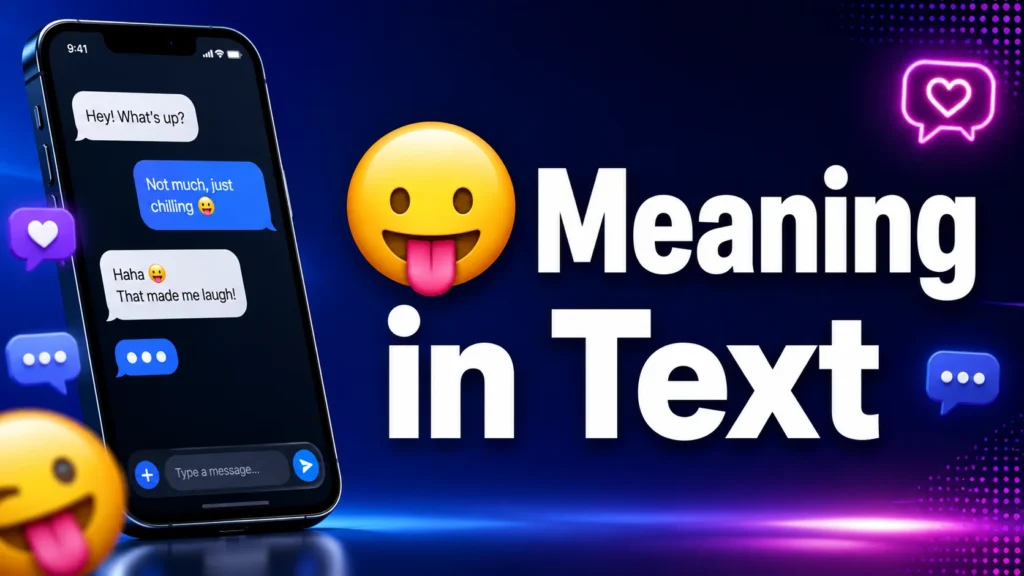
Seeing 😛 in a text can make you wonder whether someone is joking, teasing you, flirting, or simply being silly.
The emoji is officially known as the Face with Tongue emoji. In everyday texting, it usually communicates a playful, unserious, cheeky, or joking mood.
Someone might send:
“Okay, maybe I ate the last slice 😛”
The tongue-out face tells you that the message is probably meant playfully rather than as a serious confession.
However, emoji meaning changes with context. The same 😛 can feel innocent between friends, teasing between siblings, or slightly flirtatious between people who like each other.
That flexibility is exactly why people search for the 😛 meaning in text, especially after receiving it from a crush, friend, girl, guy, or someone they have just started talking to.
Understanding the words around the emoji—and your relationship with the sender—is more useful than treating 😛 as having one fixed definition.
😛 Meaning in Text – Quick Meaning
The 😛 emoji usually means “I’m joking,” “I’m being silly,” or “don’t take this too seriously.”
It represents someone sticking their tongue out in a playful way.
Common emotions behind 😛 include:
- Playfulness
- Teasing
- Joking
- Silliness
- Mischief
- Friendly sarcasm
- Light flirting
- Playful embarrassment
For example:
“You know you missed me 😛”
This could be playful teasing or flirting.
“I stole one of your fries 😛”
Here, the emoji makes the confession humorous.
“Guess who forgot their homework again 😛”
The sender is probably laughing at themselves.
Does 😛 Always Mean Flirting?
No.
One of the biggest mistakes people make is assuming every tongue-out emoji is romantic.
Friends use 😛 constantly without any attraction being involved.
If someone sends:
“You’re such an idiot 😛”
they are often making the insult affectionate or playful rather than hostile.
But if a person says:
“You looked really good today 😛”
the same emoji may create a noticeably more flirtatious tone.
Context decides the meaning.
Origin and Background of the 😛 Emoji
The idea behind 😛 comes from a real-world facial gesture: sticking out your tongue.
People have used this expression for generations to communicate silliness, mockery, teasing, rebellion, or playful disrespect.
Emoji simply brought that familiar expression into digital conversations.
From Facial Expression to Texting Language
Early online conversations relied heavily on punctuation-based emoticons such as:
:P
That sideways face represented someone sticking their tongue out.
Before colorful emoji keyboards became common, people frequently typed:
“Fine, you win :P”
The meaning was similar to modern 😛—playful annoyance or joking acceptance.
As smartphones made graphical emojis mainstream, 😛 became the more expressive version.
Social Media Changed Its Meaning
Instagram, Snapchat, WhatsApp, TikTok, Discord, and messaging apps helped expand the emoji beyond simple silliness.
People now use 😛 to soften sarcasm, make teasing feel friendly, or add personality to short messages.
Consider:
“You’re terrible.”
That sounds harsh.
Now compare:
“You’re terrible 😛”
The emoji changes the emotional temperature of the sentence.
Instead of a straightforward insult, it can feel like affectionate teasing.
This ability to change tone is one reason emojis have become so important in modern communication.
Read More : SMT Meaning in Text: What Does SMT Really Mean?
Real-Life Conversations Using 😛
The easiest way to understand the tongue-out emoji is to see how it behaves in realistic conversations.
WhatsApp Conversation
Person A: Did you seriously finish all the chocolate?
Person B: Maybe 😛
and,
Person A: I was saving that!
Person B: Should’ve hidden it better 😂
Here, 😛 communicates playful guilt. Person B knows they did something annoying but is joking about it.
Instagram DMs
Person A: Your new picture actually looks good.
Person B: “Actually”? 😭
Person A: You know what I mean 😛
Person B: Sure I do 😂
The emoji softens the awkward wording and shows that Person A is teasing rather than insulting them.
TikTok Comments
Person A: Who else watched this five times?
Person B: Only five? Amateur 😛
Person A: Okay, you win 😂
Here, 😛 communicates lighthearted competition.
Text Message With a Crush
Person A: You were looking at me today.
Person B: Maybe you were looking at me 😛
and,
Person A: So you’re not denying it?
Person B: I didn’t say that 👀
In this situation, 😛 feels more flirtatious because the conversation already has romantic tension.
The emoji itself did not suddenly acquire a different dictionary definition. The relationship changed how it was interpreted.
Emotional and Psychological Meaning of 😛
Emojis often act as emotional punctuation.
People cannot hear your voice through text, so a sentence intended as a joke may accidentally sound rude, arrogant, or serious.
😛 helps communicate:
“I’m not being completely serious here.”
Why People Use 😛 When Teasing
Teasing is risky in text messages.
Suppose someone writes:
“You’re so annoying.”
Without context, that might hurt.
But:
“You’re so annoying 😛”
usually feels lighter.
The tongue-out expression gives the reader an emotional clue that the sender is probably being playful.
😛 Can Signal Comfort
People often become more playful once they feel comfortable with someone.
Using 😛 can therefore suggest familiarity.
Imagine you have recently become friends with a coworker or classmate. At first, your messages are polite:
“Thanks for sending the notes.”
A few weeks later:
“Finally decided to send the notes? 😛”
The second message indicates greater comfort because playful teasing usually requires some level of social trust.
It Can Also Hide Mild Embarrassment
Sometimes people use 😛 after saying something slightly bold.
For example:
“I guess you’re kinda cute 😛”
The emoji gives the sender emotional protection.
If the comment is received well, it can be interpreted as flirting.
If not, they can mentally retreat behind:
“I was just joking.”
That ambiguity makes playful emojis especially common during early-stage flirting.
Using 😛 in Different Contexts
The meaning of 😛 changes according to the platform, relationship, and seriousness of the conversation.
Social Media
On Instagram and TikTok, 😛 frequently appears in playful captions and comments.
Examples:
“Caught me being productive for once 😛”
“Don’t be jealous 😛”
“Best outfit and I won’t debate it 😛”
The emoji prevents confident statements from sounding overly serious.
Friends
Between friends, 😛 usually means teasing or joking.
Friend A:
“You owe me coffee.”
Friend B:
“Prove it 😛”
There is normally no romantic meaning.
Relationships and Flirting
With a boyfriend, girlfriend, crush, or someone you are talking to romantically, 😛 can become flirtatious.
For example:
“Maybe you should come see me 😛”
Here, the emoji adds cheekiness.
Still, never assume attraction based on one emoji alone.
Look for patterns such as compliments, consistent attention, playful teasing, romantic topics, or attempts to spend time together.
Work and Professional Settings
😛 is generally too casual for formal professional communication.
Sending:
“The financial report is attached 😛”
would create a strange tone.
However, close coworkers may occasionally use it in informal team chats:
“Guess who gets to run Monday’s meeting 😛”
Even then, consider your workplace culture and relationship.
Casual vs Serious Conversations
😛 works best when the subject is light.
It can feel inappropriate after serious news.
Someone saying:
“I failed an important exam.”
Replying:
“That sucks 😛”
could appear insensitive because the playful emoji conflicts with the emotional situation.
When NOT to Use 😛 and Common Misunderstandings
The tongue-out emoji is harmless in most casual conversations, but timing matters.
Avoid It During Serious Emotional Moments
Do not use 😛 when someone is discussing grief, illness, serious conflict, financial trouble, relationship pain, or another sensitive subject unless playful communication is clearly appropriate between you.
Emojis can change tone dramatically.
A badly placed 😛 may make genuine concern appear sarcastic.
Be Careful With New People
Friends understand your personality.
Strangers do not.
If you use 😛 while teasing someone you barely know, they may interpret your message differently than you intended.
Build familiarity before relying heavily on playful sarcasm.
Misunderstanding: 😛 Always Means Sexual Flirting
It does not.
😛 can certainly appear in flirtatious conversations, but its basic meaning is playful silliness or teasing.
There is nothing inherently sexual about the emoji.
Misunderstanding: 😛 Means the Sender Is Mocking You
Sometimes it can signal mild mockery, but usually in a playful way.
For example:
“Told you I was right 😛”
This contains a little teasing triumph.
Whether it feels friendly or irritating depends on your relationship.
Literal vs Figurative Meaning
Nobody necessarily expects you to imagine the sender literally sticking their tongue out.
The emoji functions figuratively as a tone marker.
It tells you how to emotionally “hear” the sentence.
😛 Compared With Similar Emojis
| Emoji | Common Meaning | Typical Tone | Example |
|---|---|---|---|
| 😛 | Playful, silly, teasing | Lighthearted | “You wish 😛” |
| 😜 | Joking, cheeky, playful | More mischievous | “Caught you 😜” |
| 😝 | Wild silliness, exaggerated teasing | Energetic | “That was hilarious 😝” |
| 😋 | Tasty, pleased, enjoying food | Happy | “Pizza tonight 😋” |
| 😉 | Hinting, teasing, flirting | Suggestive/playful | “Maybe I know 😉” |
| 😏 | Smugness, flirting, suggestiveness | More confident | “You know why 😏” |
| 😂 | Strong laughter | Humorous | “Stop 😂” |
| 🙃 | Irony, awkwardness, frustration | Dry/sarcastic | “Everything is fine 🙃” |
| 😇 | Innocence, pretend innocence | Cute/cheeky | “Wasn’t me 😇” |
| 😈 | Mischief, naughty humor | Bolder | “I have an idea 😈” |
Key Insight
😛 is one of the safer playful emojis because it usually communicates harmless teasing. 😏 and 😈 are more likely to carry suggestive undertones, while 😂 focuses more directly on laughter.
10 Common Variations and Types of 😛 Usage
1. Playful 😛
Meaning: “I’m just having fun.”
Example: “You can’t catch me 😛”
2. Teasing 😛
Meaning: Friendly provocation.
Example: “I told you I would win 😛”
3. Flirty 😛
Meaning: Playful romantic interest.
Example: “Maybe I wanted you to notice me 😛”
4. Guilty 😛
Meaning: Admitting something while joking.
Example: “I may have eaten your snacks 😛”
5. Sarcastic 😛
Meaning: Light sarcasm without serious hostility.
Example: “Great idea, genius 😛”
6. Self-Mocking 😛
Meaning: Laughing at yourself.
Example: “Forgot my keys again 😛”
7. Competitive 😛
Meaning: Playful bragging.
Example: “Still undefeated 😛”
8. Cute 😛
Meaning: Acting silly or intentionally adorable.
Example: “Look what I made 😛”
9. Awkward 😛
Meaning: Reducing the seriousness of an uncomfortable statement.
Example: “Yeah, I definitely sent that to the wrong person 😛”
10. Mischievous 😛
Meaning: Suggesting harmless trouble.
Example: “I may know where your hoodie went 😛”
These variations are not separate official definitions. They show how context changes emotional interpretation.
How to Respond When Someone Sends 😛
You do not need to respond with the same emoji.
Match the mood of the conversation.
Casual Replies
If someone says:
“You’re slow 😛”
you could reply:
- “Still faster than you 😂”
- “Keep talking.”
- “Sure 😭”
- “Whatever you say 😛”
Funny Replies
Try:
- “The disrespect 😭”
- “Blocked immediately 😂”
- “Bold words from you.”
- “I’m remembering this.”
- “You’re enjoying this way too much.”
Flirty Replies
If the context is clearly romantic:
- “Oh, is that how we’re playing? 😉”
- “You’re trouble.”
- “Careful 😏”
- “I noticed that 😛”
- “Keep teasing me and see what happens.”
Mature Replies
You do not always need to match playful energy.
If someone makes a joke you do not understand, simply respond naturally.
“Lol, what do you mean?”
If their teasing bothers you:
“I know you’re joking, but that one didn’t really land for me.”
Healthy communication matters more than perfectly decoding emojis.
Respectful Replies
When unsure about someone’s intention:
“Are you joking? 😂”
That gives them an easy opportunity to clarify without turning the conversation awkward.
Regional and Cultural Usage of 😛
Emoji are understood globally, but their emotional intensity can vary across communities.
Western Culture
In North American and European texting, 😛 commonly communicates silliness, friendly teasing, and occasionally flirting.
It is often treated as the graphical equivalent of the older :P emoticon.
Asian Culture
Across many Asian online communities, expressive emojis and stickers play a major role in casual communication.
😛 may be combined with English, Urdu, Hindi, Korean, Japanese, Indonesian, Filipino, or other languages while still conveying broadly similar playful energy.
Local internet cultures may favor other emoji combinations, but the basic expression remains recognizable.
Middle Eastern Culture
In Arabic-speaking and other Middle Eastern digital communities, 😛 can similarly indicate joking or playful teasing.
As always, relationship boundaries matter.
A playful emoji between close friends may be interpreted differently when sent to someone unfamiliar.
Global Internet Usage
TikTok, Instagram, gaming communities, fandoms, and group chats have made emoji meanings increasingly international.
People often understand the emotional idea of 😛 even when they do not share the same first language.
That is one of emoji’s strengths: facial expressions can bridge some linguistic differences.
Gen Z vs Millennials
Millennials may associate 😛 closely with the classic :P emoticon used in older internet chats.
Gen Z users often have a much wider emoji vocabulary and may choose 😭, 💀, 😜, 🤪, or other emojis depending on the precise mood.
Some younger users may consider 😛 slightly more straightforward or intentionally cute than newer ironic emoji combinations.
Individual texting style matters more than generation alone.
Is 😛 Safe for Kids?
Yes. 😛 is generally a harmless and child-friendly emoji.
Its basic meaning is playful, silly, or teasing.
Children might use it after jokes such as:
“I beat you 😛”
or:
“You can’t have my candy 😛”
Parents and teachers should still teach children that context matters.
Even harmless emojis can accompany bullying or hurtful teasing if the words around them are cruel.
The emoji itself is not inappropriate; the surrounding message determines whether the communication is friendly.
FAQs About 😛 Meaning in Text
What does 😛 mean in texting?
😛 usually means playfulness, silliness, teasing, or joking. It often tells the reader not to interpret the message too seriously.
What does 😛 mean from a girl?
From a girl, 😛 may indicate friendly teasing, joking, comfort, or light flirting. The meaning depends on the conversation rather than her gender.
What does 😛 mean from a guy?
A guy using 😛 is usually being playful or teasing. It can be flirtatious if the surrounding conversation already contains romantic interest.
Is 😛 a flirting emoji?
It can be, but not always. 😛 is primarily playful. Romantic context, compliments, teasing, and your relationship with the sender determine whether it feels flirtatious.
What is the difference between 😛 and 😜?
😛 feels generally silly or playful, while 😜 often appears more mischievous because of the wink. Both can be used for teasing.
What does 😛 mean on Snapchat?
On Snapchat, 😛 generally means the sender is joking, being goofy, teasing, or trying to make the message feel less serious.
What does 😛 mean after a compliment?
A compliment followed by 😛 can make the message feel playful or shy. For example, “You looked cute today 😛” may suggest light flirting, especially from someone already showing romantic interest.
Conclusion
The 😛 meaning in text is usually simple: the sender is being playful, silly, teasing, or intentionally unserious.
It can transform an ordinary sentence.
“You’re annoying.”
sounds negative.
“You’re annoying 😛”
can sound affectionate.
“You missed me.”
sounds confident.
“You missed me 😛”
feels playful and possibly flirtatious.
That small difference shows why emojis matter so much in digital communication.
Still, avoid interpreting 😛 in isolation. Look at the sentence, your relationship with the person, previous conversations, and the overall emotional tone.
A best friend using 😛 probably means something different from a new crush sending it after a compliment.
Once you understand that distinction, the tongue-out emoji becomes easy to read.
Most of the time, its message is simply:
“I’m teasing you—don’t take me too seriously.”
For high CTR (click-through rate), titles and descriptions should create curiosity, a clear benefit, and a reason to click without giving everything away.