
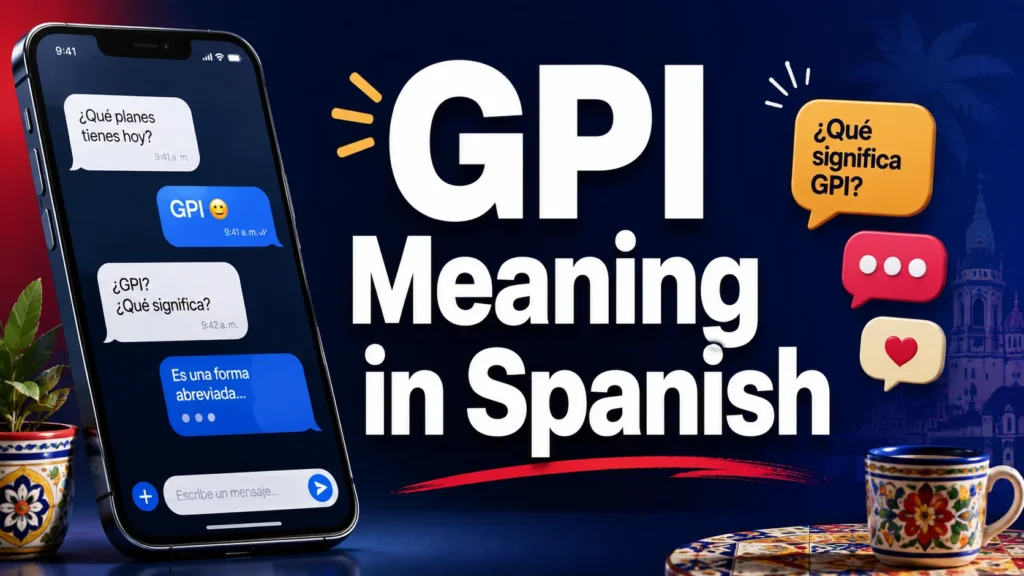
If a Spanish-speaking friend comments “GPI” under a photo of your dinner, party, vacation, or weekend hangout, they probably are not thanking you for something you did.
In Spanish texting, GPI usually stands for “Gracias Por Invitar,” which translates as “Thanks for inviting” or, more naturally in English, “Thanks for the invite.”
The interesting part is the tone.
GPI is frequently used when the person was not invited at all. The “thank you” becomes ironic, similar to an English speaker joking, “Wow, thanks for the invite!”
Mexican outlet NMás describes GPI as an abbreviation of gracias por invitar that is commonly used sarcastically when someone was left out of an event, meeting, trip, or other plan.
That hidden sarcasm is why the GPI meaning in Spanish text can be confusing for someone translating the letters literally.
Understanding the relationship, situation, and emoji beside GPI tells you whether the sender is joking, slightly jealous, or genuinely hurt.
GPI Meaning in Spanish Text – Quick Meaning
What Does GPI Stand For?
GPI = Gracias Por Invitar
In English:
“Thanks for inviting me.”
or
“Thanks for the invite.”
Most of the time, though, the real message is closer to:
- “Why didn’t you invite me?”
- “Nice of you to leave me out.”
- “Looks fun. Where was my invitation?”
- “Remember me next time.”
- “Wow, thanks for inviting me… not.”
For example:
“¿Salieron sin mí? GPI 😂”
Translation:
“You went out without me? Thanks for the invite 😂”
Another example:
“Qué bonita fiesta, GPI 😒”
Translation:
“Nice party. Thanks for inviting me 😒”
And a softer version:
“GPI para la próxima 😭”
Meaning:
“Thanks for the invite—remember me next time 😭”
The letters themselves are simple. The emotional meaning comes from the situation.
Origin and Background of GPI
GPI belongs to the wider culture of shortened Spanish internet expressions.
Just as English-speaking users write LOL, IDK, BTW, or NVM, Spanish speakers regularly shorten common phrases when chatting quickly.
“Gracias por invitar” naturally becomes:
G + P + I = GPI
The abbreviation became particularly recognizable in Mexican online communication and is associated with sarcastic reactions to being excluded from social plans. NMás notes that it can appear across WhatsApp, Facebook, Instagram, TikTok, and other social platforms rather than belonging to one specific app.
Why Sarcasm Became Part of the Meaning
Imagine opening Instagram and seeing five close friends eating tacos together.
Nobody mentioned the plan to you.
Instead of sending a serious message saying:
“I’m disappointed that you didn’t invite me.”
you comment:
“GPI 😂”
Three letters communicate almost everything.
The abbreviation allows someone to point out the exclusion while keeping the interaction light.
Of course, the humor can sometimes hide genuine disappointment.
Social Media Made GPI More Useful
Social platforms constantly reveal activities we were not included in.
Stories show parties.
Photo dumps show weekend trips.
TikTok videos show group outings.
WhatsApp statuses reveal dinners and celebrations.
Because these moments are visible immediately, GPI became an efficient reaction: short enough for a comment, but emotionally meaningful enough to get the point across.
Real-Life Conversations Using GPI
GPI makes more sense when you see how Spanish speakers might use it naturally.
Person A: Fuimos por tacos anoche.
Person B: ¿Todos fueron? GPI 😂
Person A: Fue de último momento. La próxima te avisamos.
Person B: Más les vale 😭
Meaning: Person B is jokingly complaining about not being invited.
Instagram DMs
Person A: posts photos from a beach trip
Person B: GPI 🙄
and,
Person A: Jajaja, pensé que estabas ocupado.
Person B: Una invitación no hacía daño 😂
Here, the eye-roll emoji suggests mild annoyance, but the laughter keeps the conversation playful.
TikTok Comments
Person A: Weekend con los mejores ❤️
Person B: GPI 😭
and,
Person A: La próxima vienes sí o sí.
Person B: Guardé captura como evidencia 😂
This version feels friendly. Person B wants to be included next time rather than starting an argument.
Text Message
Person A: Todos vamos a cenar después de clase.
Person B: ¿Todos menos yo o qué? GPI.
Person A: Pensé que Carlos te había dicho.
Person B: Nope.
Without an emoji or laughter, the final “GPI” feels more serious.
That difference matters.
The letters remain identical, but punctuation and emotional context can change the message dramatically.
Emotional and Psychological Meaning of GPI
GPI is interesting because the literal words and emotional message often contradict each other.
“Gracias por invitar” sounds grateful.
Sarcastic GPI may actually express disappointment.
It Can Mean Playful Jealousy
Between close friends, GPI frequently means:
“That looked fun. I wish I had been there.”
There may be no genuine anger at all.
A friend sees your restaurant story and replies:
“GPI 😂”
They might simply be teasing you because the food looks good.
It Can Reveal FOMO
GPI also connects naturally with FOMO—the fear of missing out.
Watching friends enjoy something without you can create a small emotional sting.
Rather than directly admitting:
“I feel left out,”
someone can send:
“GPI 😭”
The humor protects the sender from appearing overly vulnerable.
Sometimes the Joke Isn’t Completely a Joke
Imagine a close friend group repeatedly making plans without one person.
After seeing another photo, that person comments:
“GPI.”
No emoji.
and,
No “jajaja.”
moreover,
No playful follow-up.
In that situation, the abbreviation may carry genuine hurt.
This is an important communication lesson: sarcastic slang often gives people a safer way to express emotions they do not want to state directly.
If someone repeatedly uses GPI after being excluded, it may be worth checking whether they actually feel forgotten.
GPI Usage in Different Contexts
GPI works best in casual Spanish conversations, especially when plans, invitations, or social activities are involved.
On Instagram
Instagram may be one of the most natural places to see it.
Someone posts:
“Cena con mis favoritos ❤️”
A friend comments:
“GPI 😒”
They are jokingly asking why they were not included.
On TikTok
GPI can appear beneath videos showing parties, vacations, restaurants, concerts, or friend-group activities.
Example:
“Ese lugar se ve increíble, GPI 😭”
Meaning:
“That place looks amazing—thanks for inviting me 😭.”
On WhatsApp
In group chats, GPI can be especially funny because everyone involved understands who organized the plan.
Example:
Person A: Estamos en el cine.
and,
Person B: GPI.
moreover,
Person C: Pensamos que estabas trabajando 😂
Between Friends
Among close friends, GPI is often harmless teasing.
The stronger the friendship, the easier it is to understand the intended sarcasm.
In Dating and Relationships
GPI can also appear between partners or people flirting.
Suppose someone posts dinner at a beautiful restaurant.
Their partner responds:
“GPI 👀”
That may mean:
“And why wasn’t I invited?”
The tone can be cute, possessive, playful, or mildly annoyed depending on the relationship.
At Work
GPI is usually too informal for professional emails.
It can work jokingly between close coworkers:
“¿Todos fueron por café sin mí? GPI 😂”
But it would sound inappropriate in a formal message to a client, supervisor, or someone you barely know.
When NOT to Use GPI and Common Misunderstandings
GPI is casual slang, so not every situation suits it.
Avoid using it in formal business correspondence, academic assignments, official documents, serious complaints, or conversations where the recipient may not understand Spanish internet shorthand.
Don’t Use Sarcasm When You Need a Real Answer
If you’re genuinely upset because friends consistently exclude you, sending GPI may not solve the problem.
They may assume you’re joking.
Instead, saying:
“Hey, I actually felt a little left out.”
creates a clearer conversation.
GPI Doesn’t Always Mean Genuine Thanks
This is probably the biggest misunderstanding.
A learner sees:
Gracias por invitar
and assumes GPI expresses gratitude.
Sometimes it could.
In social media slang, however, the sarcastic reading is extremely common, particularly when the person obviously was not part of the activity.
GPI Is Not Universal Spanish
Spanish is spoken across many countries, and internet slang varies enormously.
A Mexican teenager might understand GPI immediately.
Someone from another Spanish-speaking region may recognize it through social media, use a different expression, or need context.
Never assume every abbreviation is equally common throughout Spain and Latin America.
Capitalization Usually Doesn’t Change It
These normally mean the same thing:
GPI
and,
gpi
moreover,
Gpi
Lowercase often looks more relaxed, while uppercase may add emphasis.
GPI Compared With Similar Spanish Slang
| Expression | Meaning | Typical Use | Tone |
|---|---|---|---|
| GPI | Gracias por invitar | When you weren’t invited | Sarcastic/playful |
| NTP | No te preocupes | “Don’t worry” | Reassuring |
| NTC | No te creas | “Just kidding/don’t believe it” | Playful |
| TQM | Te quiero mucho | “Love you/care about you a lot” | Affectionate |
| X2 | Por dos / same here | Agreeing with someone | Casual |
| XFA | Por favor | “Please” | Casual |
| PQ | Porque / por qué | “Because/why” depending on context | Very informal |
| DND | Dónde | “Where” in some informal chats | Casual |
| F | Respect/sympathy for a loss or fail | Reacting to misfortune | Internet humor |
| LOL / JAJA | Laughter | Reacting to something funny | Casual |
Key Insight
Unlike abbreviations such as NTP or TQM, GPI often depends on irony. The written words say “thank you,” while the situation may communicate, “You forgot about me.”
10 Popular Variations and Types of GPI
1. GPI
Meaning: Gracias por invitar.
The standard version, usually used after discovering a plan you were not invited to.
2. gpi
Meaning: Exactly the same phrase.
Lowercase makes it feel more casual and conversational.
3. GPI 😂
Meaning: Playful sarcasm.
This usually indicates the sender is not seriously angry.
4. GPI 😭
Meaning: Dramatic disappointment.
It can mean: “I wanted to come too!”
5. GPI 😒
Meaning: Annoyed sarcasm.
This version can carry more genuine irritation.
6. GPI 🙄
Meaning: “Wow, thanks for remembering me.”
The eye-roll makes the complaint sharper.
7. GPI 💔
Meaning: Feeling excluded or forgotten.
It may be humorous, but it can also reveal real disappointment.
8. “Ah bueno, GPI”
Meaning: “Oh, okay… thanks for inviting me.”
The added phrase strengthens the sarcasm.
9. “GPI para la próxima”
Meaning: “Thanks for inviting me—remember me next time.”
This indirectly requests a future invitation.
10. “Qué padre, GPI”
Meaning: “How cool—thanks for inviting me.”
Because qué padre is strongly associated with casual Mexican Spanish, this combination can feel especially natural in Mexican conversations.
How to Respond When Someone Says GPI
Your response should match their tone.
Casual Replies
If they are obviously joking:
- “Jajaja, la próxima.”
- “Te avisamos para la otra.”
- “Perdón 😂”
- “Pensé que sabías.”
- “La invitación se perdió 😭”
Funny Replies
Try something playful:
- “Llegó tu invitación por paloma mensajera.”
- “Culpa al organizador 😂”
- “Estabas invitado espiritualmente.”
- “Mandamos la invitación en 2019.”
- “La próxima te ponemos en VIP 😎”
Mature Replies
If they sound genuinely hurt:
- “Perdón, no fue nuestra intención dejarte fuera.”
- “Pensé que alguien ya te había avisado.”
- “La próxima te escribo directamente.”
- “Entiendo por qué te molestó.”
A little emotional awareness can prevent an easy joke from becoming a real friendship problem.
Respectful Replies
If you do not understand the abbreviation:
“What do you mean by GPI?”
There is nothing wrong with asking.
Slang is constantly changing, and even native Spanish speakers do not know every abbreviation used in every country.
Regional and Cultural Usage of GPI
Mexico
GPI is particularly associated with Mexican internet culture, where gracias por invitar is widely recognized as a sarcastic way to call attention to being excluded from plans.
The expression fits naturally with Mexican conversational humor, where teasing between friends can communicate affection as well as mild complaint.
Other Latin American Countries
Social media spreads slang rapidly across national borders.
Spanish speakers elsewhere in Latin America may recognize GPI even if it is not equally common in their local vocabulary.
Regional vocabulary still matters.
An expression that feels completely ordinary in Mexico may sound distinctly Mexican somewhere else.
Spain
Some Spanish users may understand GPI through global social media, but it should not automatically be treated as universal slang used equally throughout Spain.
Context helps considerably.
If GPI appears below a group outing, the intended meaning is usually easy to infer.
Bilingual Communities
GPI also works well in Spanglish conversations.
Someone might write:
“You guys went without me? GPI 😂”
The abbreviation keeps its Spanish meaning even though the rest of the sentence is English.
This kind of language mixing is common in multilingual digital spaces.
Gen Z vs Millennials
Gen Z communication favors highly compressed reactions, emojis, memes, and phrases that assume shared cultural knowledge.
GPI fits naturally into that style.
Millennials may also use or recognize it, particularly in Mexican and bilingual communities.
Usage depends more on social environment than age alone.
Is GPI Safe for Kids?
Yes. GPI itself is harmless slang.
It simply abbreviates gracias por invitar, meaning “thanks for inviting.”
Parents should mainly help younger users understand the sarcastic tone.
A child might see GPI and assume someone is genuinely expressing gratitude when the sender is actually complaining about being excluded.
It is also worth teaching children that jokes about exclusion can reveal real emotions.
If a friend repeatedly says GPI because they are always left out, treating it only as a joke may miss the bigger message.
FAQs About GPI Meaning in Spanish Text
What does GPI mean in Spanish texting?
GPI stands for “Gracias Por Invitar,” meaning “Thanks for inviting” or “Thanks for the invite.” It is commonly used sarcastically after someone is left out.
What does GPI mean in English?
The literal English translation is “Thanks for inviting me.” In context, it can really mean, “Thanks for not inviting me” or “Why didn’t you invite me?”
Is GPI sarcastic?
Very often, yes. Someone may write GPI after seeing friends at a party, restaurant, trip, or gathering they were not invited to.
What does GPI mean on Instagram?
On Instagram, GPI commonly appears under stories, reels, or photos showing an activity the commenter was excluded from. It jokingly means, “Thanks for the invite!”
What does GPI mean on TikTok?
On TikTok, it has the same basic meaning: gracias por invitar. Users may comment GPI under videos of parties, trips, dinners, concerts, or friend-group activities.
Is GPI Mexican slang?
GPI is particularly associated with Mexican Spanish internet usage, although social media has made the expression recognizable beyond Mexico.
How should I reply to GPI?
If the sender is joking, something like “La próxima 😂” (“Next time”) works naturally. If they seem genuinely hurt, acknowledge the exclusion rather than replying only with another joke.
Conclusion
The GPI meaning in Spanish text is “Gracias Por Invitar,” literally meaning “Thanks for inviting me.”
But translating the words alone misses the most important part.
In casual Spanish texting—especially in Mexican online culture—GPI is frequently sarcastic.
Your friends upload photos from a restaurant you knew nothing about?
GPI 😂
Someone goes to a concert you would have loved?
GPI 😭
Your whole group makes plans without telling you?
GPI 😒
The emoji helps reveal whether the sender is laughing, disappointed, or genuinely irritated.
That is why context matters more than the three letters themselves.
Most of the time, GPI is simply a clever way of saying:
“Looks fun. Thanks for inviting me… even though you didn’t.”
Used between friends, it can be warm and funny. Used without humor after repeated exclusion, it may communicate something more emotional.
Recognizing that difference will help you understand not only what GPI translates to, but what the person sending it actually means.
For high CTR (click-through rate), titles and descriptions should create curiosity, a clear benefit, and a reason to click without giving everything away.




1 thought on “GPI Meaning in Spanish Text: What Does GPI Mean?”