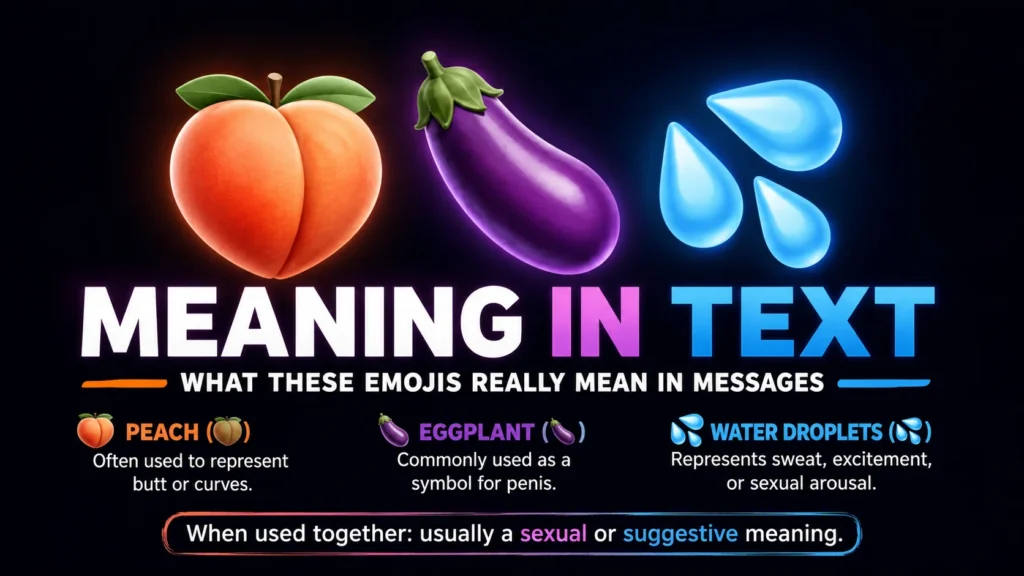
The combination 🍑 🍆 💦 can have a suggestive or sexual meaning in texting, especially when the emojis appear together in a private conversation, dating chat, or flirtatious message.
Individually, these are ordinary emojis with innocent meanings. 🍑 officially represents a peach, 🍆 represents an eggplant, and 💦 represents droplets of water. Internet culture, however, has given them additional meanings through visual association and repeated online use.
In suggestive conversations, 🍑 can refer to someone’s buttocks, 🍆 can be used as a sexual reference to a penis, and 💦 can imply sexual excitement or bodily fluids.
The exact meaning depends on the relationship between the people communicating and the surrounding words.
For example:
“That outfit looks amazing 🍑”
may simply be playful or complimentary.
Meanwhile:
“🍑🍆💦”
used during an intimate conversation is much more likely to carry a sexual meaning.
🍑 🍆 💦 Meaning: Quick Answer
When these three emojis appear together, they often create a sexually suggestive message.
Here is the basic interpretation:
- 🍑 Peach: Often represents buttocks in internet slang.
- 🍆 Eggplant: Frequently used as a sexual reference to a penis.
- 💦 Sweat/droplets: Can suggest sexual excitement or fluids in suggestive conversations.
The combination is therefore usually more suggestive than any one emoji by itself.
Still, context matters. Someone posting 🍑 in a food-related conversation may literally mean peaches, while 💦 can genuinely mean water, sweat, rain, or being overheated.
Where Did These Emoji Meanings Come From?
Emoji meanings often develop beyond their official Unicode descriptions.
The peach became associated with buttocks largely because of its rounded shape. The eggplant developed a sexual association because of its appearance, while the droplets emoji gained additional suggestive meanings through online conversations.
Social media accelerated this process.
Platforms such as Instagram, Snapchat, TikTok, messaging apps, and dating services allowed users to communicate flirtation without directly writing certain words.
How Internet Culture Changed Emoji Language
Emoji communication is highly visual.
A person can communicate an idea with three symbols without writing a complete sentence. This can make a message feel more playful, indirect, or teasing.
That flexibility is one reason the combination 🍑 🍆 💦 became recognizable in certain online contexts.
Official Meaning vs Internet Meaning
This distinction is important.
The official meanings of the characters are ordinary:
🍑 = peach
🍆 = eggplant
💦 = droplets
The suggestive interpretation comes from internet usage and context, not from the literal dictionary definition of the emojis.
Read More : Whoa Meaning in Text: What Does Whoa Mean?
Real-Life Texting Conversations
The same emojis can mean very different things depending on the conversation.
WhatsApp Conversation
Person A:
“I’m making a fruit salad 🍑🍓🍌”
Person B:
“Save me some 🍑”
Here, the peach is being used literally.
Instagram DM
Person A:
“You looked really good in that outfit 👀🍑”
Person B:
“Lol I know what you mean 😂”
Here, the peach is likely being used as a body-related compliment.
Flirty Text Message
Person A:
“You’re making this conversation dangerous 😏”
Person B:
“🍑🍆💦”
Here, the combination is clearly suggestive because of the surrounding context.
TikTok Comment
Person A:
“This recipe uses roasted eggplant 🍆”
Person B:
“Looks delicious!”
Here, 🍆 has its literal food meaning.
This example shows why interpreting emojis without context can easily lead to mistakes.
The Emotional and Psychological Meaning
Emoji combinations often allow people to communicate feelings indirectly.
Using suggestive emojis can create a sense of:
- Flirtation
- Attraction
- Playfulness
- Teasing
- Intimacy
- Curiosity
- Sexual suggestion
People may choose emojis instead of explicit words because emojis feel less direct.
A person might feel more comfortable sending 🍑🍆💦 than writing a sexually suggestive sentence.
Why People Use Emoji Instead of Words
Emojis provide a layer of ambiguity.
The sender can make a suggestive joke while still leaving room to say, “I was only joking.”
This makes emoji communication especially useful in flirting.
For example, sending:
“You 😏🍑”
can feel less direct than spelling out the intended message.
That indirectness is part of modern digital communication.
Meaning in Different Contexts
Social Media
On social media, these emojis may appear in comments, captions, memes, or private messages.
A single emoji may have a harmless meaning, while a combination can create a different implication.
Dating and Relationships
In romantic conversations, the emojis can be used to express attraction or flirtation.
The combination may be intentionally suggestive without being written out in words.
Friend Groups
Friends sometimes use sexualized emoji meanings as jokes.
However, the recipient’s comfort level matters. What one person considers funny may feel inappropriate or uncomfortable to someone else.
Professional Settings
These emojis should generally be avoided in workplace messages when they are being used with their suggestive meanings.
A professional conversation requires clarity and appropriate boundaries.
Casual vs Serious Conversations
The same combination can be playful in one conversation and strongly suggestive in another.
The surrounding words, relationship, and platform all influence interpretation.
When Not to Use 🍑 🍆 💦
There are situations where these emojis can easily create misunderstanding.
Professional Communication
Avoid suggestive emoji combinations in work emails, school communications, or professional group chats.
With People You Barely Know
Sending a sexualized emoji combination to someone you have little relationship with can be uncomfortable or unwelcome.
Public Comments
A comment that seems funny privately may look inappropriate when posted publicly.
When the Meaning Is Ambiguous
If you are discussing food, fitness, sports, or weather, be aware that some readers may interpret these emojis differently because of their internet associations.
Cultural Differences
Not everyone interprets emojis in exactly the same way. Some people may know the slang meaning immediately, while others may only see the literal emoji.
Common Misunderstandings
Does 🍑 Always Mean Butt?
No.
It can literally mean a peach, particularly in food-related conversations.
Does 🍆 Always Have a Sexual Meaning?
No.
It is still an eggplant emoji and is commonly used when discussing cooking, vegetables, recipes, and food.
Does 💦 Always Mean Sexual Fluids?
No.
It can represent water, sweat, splashing, rain, or droplets.
Its suggestive meaning is strongly dependent on context.
Does the Combination Always Mean Sex?
Not necessarily.
The three emojis together are commonly recognized as suggestive, but context can still change the interpretation.
Are These Official Sexual Emojis?
No.
Their suggestive meanings developed through online culture and visual association rather than being their official emoji definitions.
Comparison Table
| Emoji or combination | Common literal meaning | Common internet interpretation |
|---|---|---|
| 🍑 | Peach | Buttocks |
| 🍆 | Eggplant | Penis |
| 💦 | Droplets | Sweat, fluids, or sexual suggestion |
| 🍑🍑 | Peaches | Buttocks/body emphasis |
| 🍆 | Eggplant | Sexual reference in some contexts |
| 💦💦 | Droplets | Intensity, sweat, or suggestive meaning |
| 🍑🍆 | Peach + eggplant | Stronger suggestive implication |
| 🍑🍆💦 | Peach + eggplant + droplets | Commonly interpreted as sexually suggestive |
Key Insight
The combination is more suggestive than the individual emojis. Always consider the words surrounding the emojis before deciding what the sender intended.
Common Variations and Emoji Combinations
1. 🍑
Usually a peach literally, but often a reference to buttocks online.
2. 🍆
Literally an eggplant; commonly used as a sexual reference in suggestive conversations.
3. 💦
Literally droplets; its meaning can become suggestive in intimate conversations.
4. 🍑🍑
Often emphasizes the peach’s body-related interpretation.
5. 🍆🍆
Can intensify the suggestive meaning of the eggplant.
6. 💦💦
Can emphasize water, sweat, excitement, or suggestiveness depending on context.
7. 🍑🍆
The combination is commonly interpreted as sexual rather than food-related when used in a flirtatious conversation.
8. 🍑💦
Can carry a suggestive meaning when used in an intimate context.
9. 🍆💦
Often interpreted as sexually suggestive when used between adults in a flirtatious conversation.
10. 🍑🍆💦
Together, these emojis are generally understood online as a strongly suggestive combination.
How to Respond When Someone Uses Them
Your response should depend on your relationship with the sender and whether you are comfortable with the conversation.
Casual Response
- “Lol, what are you trying to say? 😂”
- “I see what you’re doing there.”
- “Okayyy, message received.”
Funny Response
- “That’s a very interesting combination 😂”
- “The emojis are doing a lot of talking.”
- “You could’ve just used words 😭”
Mature Response
- “I understand the implication, but let’s keep things respectful.”
- “I get what you’re suggesting.”
- “I’m not comfortable with that kind of message.”
Respectful Response
If you do not want to participate in a suggestive conversation, a direct response works best:
“I’d rather keep the conversation non-sexual.”
There is no need to match the sender’s tone.
Regional and Cultural Usage
Western Internet Culture
The sexual interpretations of 🍑 and 🍆 are particularly widespread across English-language social media.
Users familiar with internet slang are likely to recognize the associations quickly.
Asian Online Communities
The meanings have spread internationally through social media, gaming, messaging platforms, memes, and global entertainment.
Younger users may recognize the suggestive meanings even when English is not their first language.
Middle Eastern Online Communities
The emojis can carry the same internet-based associations in English-language chats and social media.
However, cultural expectations around sexual communication can vary considerably.
Global Internet Usage
Emoji slang is increasingly global.
A person does not necessarily need to know the cultural history behind an emoji to understand its suggestive use.
Gen Z vs Millennials
Younger users are generally more familiar with layered emoji meanings and combinations.
Millennials may recognize the peach and eggplant associations but interpret some combinations more literally.
Neither generation uses every emoji in exactly the same way.
Is This Emoji Combination Safe for Kids?
The emojis themselves are ordinary Unicode characters, but their internet slang meanings can be sexually suggestive.
Children may encounter these meanings on social media, messaging platforms, games, or comment sections without understanding the context.
For younger users, it is useful to explain that emojis can have both literal and slang meanings.
For example:
🍆 can mean eggplant in a recipe but something different in a suggestive message.
Understanding context is more useful than treating the emoji itself as inherently inappropriate.
Frequently Asked Questions
What does 🍑 mean in texting?
🍑 literally represents a peach, but in internet slang it is often used as a reference to buttocks, especially in flirtatious conversations.
What does 🍆 mean in text messages?
🍆 literally represents an eggplant. In many online conversations, however, it is used as a sexual reference to a penis.
What does 💦 mean in texting?
💦 represents droplets and can mean water, sweat, splashing, or other forms of moisture. In intimate conversations, it can have a sexual implication.
What does 🍑🍆💦 mean together?
Together, these emojis are commonly interpreted as sexually suggestive, particularly when used in flirting or private adult conversations.
Do these emojis always have sexual meanings?
No. Their literal meanings remain peach, eggplant, and droplets. The surrounding conversation determines whether the slang interpretation applies.
Why do people use 🍑🍆💦 instead of words?
Emojis can communicate suggestive ideas indirectly. They allow people to flirt, tease, or imply something without writing it explicitly.
Is 🍑🍆💦 appropriate for professional messages?
Generally, no. If the emojis are being used with their suggestive meanings, they can easily be inappropriate or misunderstood in professional communication.
Final Thoughts on 🍑 🍆 💦 Meaning in Text
The 🍑 🍆 💦 meaning in text depends heavily on context, but when these three emojis appear together in a flirtatious or private conversation, they are commonly understood as sexually suggestive.
Individually, each emoji has an ordinary meaning: 🍑 is a peach, 🍆 is an eggplant, and 💦 represents droplets. Internet culture has added additional interpretations based on their shapes and how people use them online.
That is why emoji literacy requires more than memorizing definitions.
A peach in a recipe is simply a peach. An eggplant beside cooking instructions is simply a vegetable. Droplets after a discussion about rain probably mean water.
Place those same symbols together in a flirtatious conversation, however, and the message can communicate something very different.
When interpreting 🍑🍆💦, always consider the surrounding words, relationship, platform, and tone before assuming what someone means.