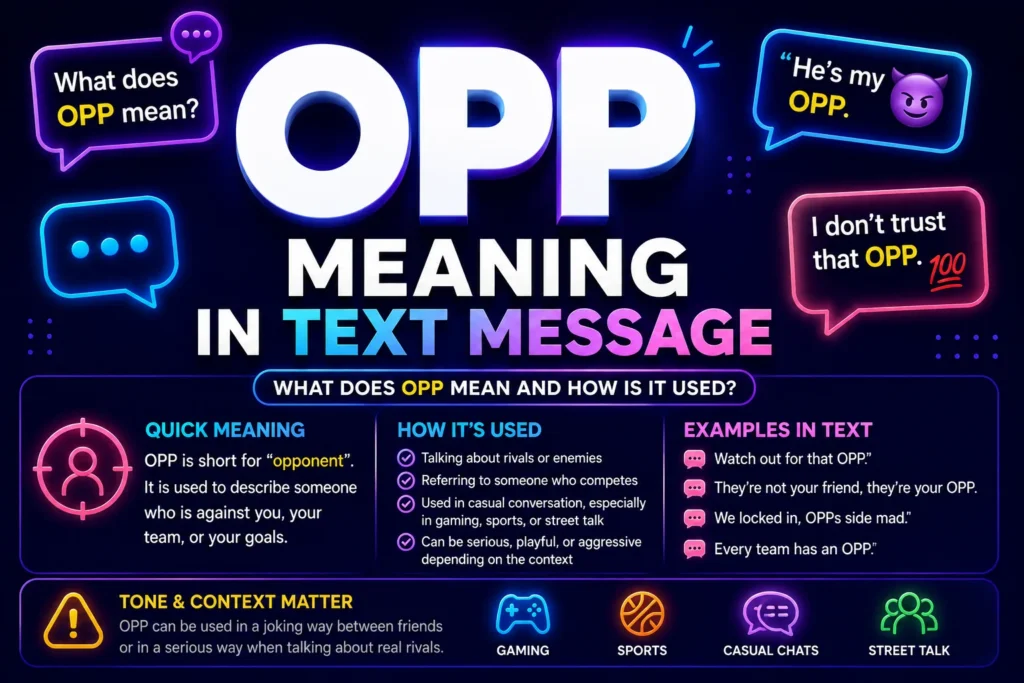
If someone sends you “opp” in a text message, the meaning usually depends on the conversation. In modern slang, OPP most commonly means “opposition,” “opponent,” or “opps” referring to people seen as rivals or enemies.
You may see it in texts, TikTok comments, Instagram captions, gaming chats, rap lyrics, and everyday conversations between friends.
For example:
“Don’t tell him, he’s an opp.”
This means the speaker considers that person an enemy, rival, or someone who is not on their side.
Another common use is:
“They’re my opps.”
Here, opps means rivals or people the speaker has conflict with.
The word can also be used jokingly. A friend might call another friend an “opp” simply because they disagreed about a football team, game, relationship, or silly argument.
OPP Meaning in Text: Quick Answer
OPP usually means “opposition” or “opponent” in slang. It describes a rival, enemy, or person perceived to be against you.
Common interpretations include:
- Opp = opponent
- Opp = opposition
- Opps = rivals or enemies
- An opp = someone considered against you
- My opps = people I have conflict with
The exact tone can range from serious to completely playful.
If someone texts:
“He’s an opp.”
They may be saying:
“He’s against us.”
If they say:
“Bro is my opp 😂”
They may simply be joking about a minor disagreement.
Where Did OPP Come From?
The slang opp is closely associated with African American Vernacular English and urban American speech, particularly language connected with street culture and hip-hop.
The plural form opps became especially recognizable through rap and popular music.
One influential reference is the 1991 song “O.P.P.” by Naughty by Nature, although that song used the abbreviation in a different context from the modern slang meaning of “opps” as rivals.
Over time, opp developed and spread through hip-hop culture, social media, gaming communities, memes, and short-form video platforms.
Today, many young internet users use it much more casually than its original street-related associations might suggest.
How Social Media Changed the Word
TikTok, Instagram, YouTube, and gaming chats helped push opp into mainstream online vocabulary.
A teenager might call a friend an “opp” because they chose a different team in a video game.
Someone else might use the word for an actual rival.
The spelling remains similar, but the seriousness can be completely different.
Why the Plural “Opps” Is Common
You will frequently see opps rather than opp.
For example:
“Watch out for the opps.”
This generally refers to multiple rivals or people considered hostile.
In casual internet speech, the plural form can also be exaggerated for humor.
Read More : 🍑 🍆 💦 Meaning in Text: Emoji Slang Explained
OPP in Real-Life Text Conversations
Understanding the word is easier when you see how people actually use it.
WhatsApp Conversation
Person A:
“Why did you remove Jake from the group?”
Person B:
“He’s an opp now 😂”
Here, the speaker is probably joking about a disagreement rather than describing a serious enemy.
Instagram DM
Person A:
“You still talking to him?”
Person B:
“Nah, he’s an opp.”
This sounds more serious. The person is saying they no longer trust or support him.
TikTok Comments
Person A:
“Bro switched teams 💀”
Person B:
“He’s officially an opp.”
The word is being used humorously to describe someone who changed sides.
Gaming Chat
Player A:
“Which team are you on?”
and,
Player B:
“The red team.”
moreover,
Player A:
“Say less. You’re an opp now 😂”
Here, opp simply means opponent.
The Emotional Meaning Behind OPP
The interesting thing about opp is that its emotional meaning depends heavily on tone.
At its strongest, it can communicate:
- Distrust
- Rivalry
- Anger
- Conflict
- Betrayal
- Competition
- Defiance
But among friends, it can communicate almost the opposite.
Calling your friend an opp can be playful.
For example:
“You picked Arsenal? You’re an opp now 😭.”
Nobody may actually be angry. The word simply dramatizes a harmless disagreement.
That is common in modern internet communication: serious slang is frequently borrowed for exaggerated humor.
Why People Use OPP Instead of “Enemy”
“Enemy” sounds much more formal and dramatic.
Opp feels shorter, more casual, and more culturally connected to internet and youth speech.
Compare:
“He’s my enemy.”
with:
“Bro is my opp.”
The second sounds more conversational and often more playful.
OPP Meaning in Different Contexts
Social Media
On TikTok, Instagram, and X, opp can refer to someone who is against a person, group, creator, or fandom.
It can also be used sarcastically.
Friendships
Friends may call each other “opps” after an argument.
For example:
“You ate my fries. You’re an opp.”
This usually means:
“I’m annoyed with you, but I’m obviously joking.”
Dating and Relationships
Someone might describe an ex-partner as an “opp” after a difficult breakup.
This usage can signal real resentment, so context matters.
Gaming
Gaming is one of the easiest contexts for understanding opp.
An opponent on the other team can literally be an opponent, making “opp” feel almost like a shortened version of the word.
Professional Settings
Avoid using opp in formal emails, workplace reports, academic writing, or professional conversations unless you are discussing the slang itself.
A manager reading:
“He’s an opp.”
may have no idea what you mean.
Use rival, opponent, competitor, or another precise word instead.
When Should You Not Use OPP?
The word can be harmless among friends but inappropriate in other situations.
Avoid It in Formal Writing
Do not replace “opponent” with “opp” in an academic essay or business document.
Be Careful With Serious Conflicts
Calling someone an “opp” can intensify a situation if the person takes the word literally.
Consider Cultural Context
The slang has roots in specific cultural and musical communities. Using it casually is common online, but it is still useful to understand where the expression comes from.
Don’t Assume Everyone Knows It
Older relatives, teachers, coworkers, or people unfamiliar with internet slang may interpret opp differently.
Clear language is better when there is a possibility of confusion.
Common Misunderstandings About OPP
OPP Always Means Enemy
Not necessarily.
It can simply mean opponent, especially in sports and gaming.
Calling Someone an Opp Means You Hate Them
Not always.
Friends frequently use the word as playful exaggeration.
OPP Has Only One Meaning
No.
Context can change whether it means a rival, opponent, opposition, or something else entirely.
OPP Is Always Serious Street Slang
The term has serious cultural roots, but internet users have expanded its usage.
A teenager saying “you’re my opp” over a video game may be joking.
OPP and Opps Are Completely Different
They are generally singular and plural forms of the same slang.
Opp: one rival.
Opps: multiple rivals.
OPP Compared With Similar Slang
| Term | Meaning | Typical Tone |
|---|---|---|
| Opp | Rival or opponent | Casual to serious |
| Opps | Rivals or enemies | Casual to serious |
| Enemy | Someone hostile toward you | Serious |
| Rival | Person or group competing with you | Neutral |
| Hater | Someone who dislikes or criticizes you | Casual |
| Foe | Enemy or adversary | More formal/old-fashioned |
| Opponent | Person competing against you | Neutral |
| Bestie | Close friend | Friendly |
Key Insight
“Opp” is more flexible than “enemy.” A person can be a genuine rival, a gaming opponent, or simply a friend who made the wrong choice in a group chat.
Popular Variations of OPP
1. Opp
The singular form.
Example: “He’s an opp.”
2. Opps
The plural form.
Example: “The opps are here.”
3. My Opp
Used to describe someone personally considered a rival.
Example: “That guy is my opp.”
4. Your Opp
Used to point out someone else’s rival.
Example: “That’s your opp, not mine.”
5. Certified Opp
An exaggerated internet expression for someone who repeatedly acts against you.
Example: “Bro is a certified opp 😂.”
6. Top Opp
A humorous way to describe a major rival.
Example: “He became my top opp after that move.”
7. Real Opp
Can emphasize that the conflict is genuine.
Example: “Nah, that’s a real opp.”
8. Fake Opp
Used when someone pretends to be against you or when the rivalry is not serious.
Example: “He’s a fake opp.”
9. Former Opp
A person who was previously considered a rival.
Example: “We used to be opps, now we’re cool.”
10. Opp Behavior
A phrase describing something that seems disloyal or antagonistic.
Example: “Leaving without me was opp behavior.”
How to Respond When Someone Calls You an Opp
Your response should depend on whether the person is joking or serious.
Casual Replies
- “Bro, what did I even do? 😂”
- “Since when?”
- “We’re opps now?”
- “Relax 😂”
Funny Replies
- “My villain arc starts today.”
- “Put me on the opp list then.”
- “I accept my new position.”
- “You made me an opp over fries? 😭”
Mature Replies
- “Why do you see me that way?”
- “If I upset you, let’s talk about it.”
- “I didn’t realize we had an issue.”
Respectful Replies
If the context feels serious, avoid escalating the language.
A simple:
“If something bothered you, tell me what happened.”
can turn slang-heavy conflict into an actual conversation.
Regional and Cultural Usage of OPP
United States
The slang is strongly connected to American hip-hop and urban speech, where opp and opps can describe rivals or people considered enemies.
United Kingdom
British internet users may understand the slang through American music, TikTok, gaming, and social media. Its use can sound more internet-driven than traditional British slang.
Asian Online Communities
Gaming and social media have helped spread opp internationally. It is often used to mean an opponent, particularly in multiplayer games.
Middle Eastern Online Communities
Young internet users may encounter the term through English-language gaming, rap, TikTok, and Instagram content. The intended meaning is usually understandable from context.
Gen Z vs Millennials
Gen Z users are more likely to use opp casually and humorously online.
Millennials may recognize it primarily through hip-hop or social media rather than everyday vocabulary.
Is OPP Safe for Kids?
The word opp itself is not inherently dangerous or inappropriate.
However, the context can matter.
In some conversations, it may refer to genuine hostility, street conflict, threats, or aggressive behavior. In other conversations, it simply means “opponent” in a game.
Parents and educators should therefore look at the entire message rather than judging the word by itself.
Frequently Asked Questions
What does opp mean in a text message?
Opp usually means opponent, opposition, or rival. It can describe someone who is against you or competing with you.
What does opp mean in slang?
In slang, opp commonly refers to a rival, enemy, or person perceived as being against you. The plural is usually “opps.”
What does “he’s an opp” mean?
It usually means “he’s against me/us” or “he’s a rival.” Depending on the conversation, it may be serious or playful.
What does “my opp” mean?
“My opp” means someone I consider a rival or opponent. Friends may also use it jokingly after a minor disagreement.
What does “opps” mean?
Opps is the plural form of opp and usually means multiple rivals or opponents.
Is opp a bad word?
Not inherently. It can describe rivalry or hostility, but the seriousness depends on the context.
Can opp mean opponent in gaming?
Yes. In gaming conversations, opp can simply be a shortened form of opponent, especially when referring to someone on the opposing team.
Final Thoughts on OPP Meaning in Text Messages
The opp meaning in text message is usually connected to rivalry.
When someone calls another person an opp, they are generally describing that person as an opponent, rival, or someone who is against them. The expression can sound aggressive in one conversation and completely playful in another.
That is why context matters so much.
A gamer saying “you’re an opp now” may simply be teasing a teammate. Someone discussing a serious personal conflict may use the same word with a much heavier meaning.
The safest interpretation is to look at the relationship between the speakers, the subject of the conversation, and the tone surrounding the word.
Once you understand that flexibility, opp becomes a straightforward piece of modern internet slang rather than a confusing abbreviation.