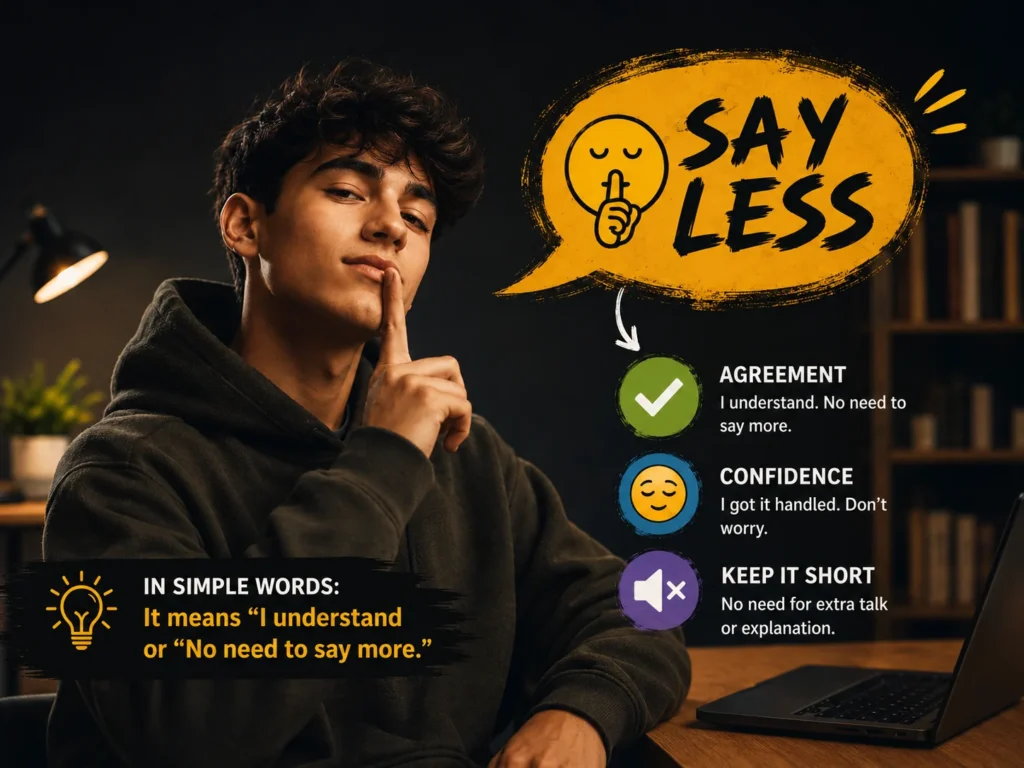
If someone replies “say less” after you suggest a plan, explain a problem, or offer something exciting, they usually are not telling you to be quiet.
In modern slang, say less commonly means “I understand,” “I’m in,” “you don’t need to explain,” or “I already get what you mean.” It often communicates quick agreement, confidence, or enthusiasm. (Later)
That is exactly why people search for say less meaning in text. The literal words sound slightly rude, but the slang meaning is often positive.
A friend might text:
“We’re getting tacos after class.”
And you might answer:
“Say less.”
In that situation, you are basically saying, “I’m already convinced.”
Say Less Meaning in Text – Quick Meaning
Simple definition
Say less is a casual slang expression meaning:
- I understand.
- I’m interested.
- I agree.
- I’m on board.
- No further explanation is needed.
- You already convinced me.
Slang references commonly describe it as a more modern variation of “say no more.” (Slang Dictionary)
The phrase becomes especially natural when someone mentions something you already want.
“I bought extra pizza.”
“Say less.”
Here, “say less” means “You had me at pizza.”
Another example:
“I need someone to come to the concert tonight.”
“Say less, I’m coming.”
In this context, the speaker sounds enthusiastic and ready.
Origin and Background of “Say Less”
Cultural roots
The modern slang use of say less is commonly associated with African American Vernacular English (AAVE) and hip-hop culture. It developed as a concise way to express understanding without requiring additional explanation. (Later)
The phrase is closely related to the older expression “say no more.”
If someone says “say no more,” they mean:
“I already understand your point.”
“Say less” pushes the idea even further:
“You have already said enough for me to understand.”
When did “say less” become popular?
The slang expression appeared online by at least 2011, although spoken slang often exists long before it leaves a searchable written record. (Dictionary.com)
Music helped spread the expression to broader audiences.
Toronto artist Roy Woods released an album titled Say Less in 2017, and the phrase continued moving through hip-hop, social media, and youth culture. (Slang Dictionary)
By the early 2020s, it had become widely recognizable in TikTok comments, memes, group chats, Instagram messages, and casual conversation.
Social media changed its reach
Online communication favors expressions that communicate a lot with very few words.
“Say less” works perfectly for that environment.
Instead of typing:
“I completely understand what you are saying and I am definitely interested.”
Someone can simply reply:
“Say less.”
The confidence and brevity are part of the appeal.
Read More : 💗 Meaning in Text: Is It Love or Friendship?
Real-Life Conversations Using “Say Less”
WhatsApp between friends
Person A: My parents are gone this weekend and I ordered enough pizza for five people.
Person B: Say less 😭 what time?
and,
Person A: Eight.
moreover,
Person B: I’ll be there at 7:59.
Here, “say less” means “You already convinced me.”
The response feels excited, friendly, and slightly humorous.
Instagram DM about going out
Person A: There’s a new coffee place downtown and they have those giant croissants.
Person B: Say less.
and,
Person A: Saturday?
Person B: Absolutely.
There is no request to stop talking.
The receiver is essentially saying, “That sounds good enough. I’m interested.”
TikTok comments
Creator: This restaurant gives students 40% off every Tuesday.
Commenter: Say less, I know where I’m eating next week 😭
Again, the phrase signals enthusiasm and quick acceptance.
Text message between close friends
Person A: I need help moving tomorrow, but there will be pizza.
Person B: Say less. Send me the address.
Person A: You’re the best.
Here, the meaning is closer to “I got you.”
It communicates both understanding and willingness to help.
Emotional and Psychological Meaning of “Say Less”
“Say less” often communicates confidence.
The person is signaling that they have already understood enough to make a decision.
That gives the phrase a slightly stronger emotional feeling than simply saying:
“Okay.”
Compare:
“Want free concert tickets?”
“Okay.”
versus:
“Want free concert tickets?”
“Say less.”
The second response feels far more enthusiastic.
Why people like using it
Modern digital conversations are fast.
People often want language that expresses personality without requiring a paragraph.
“Say less” communicates:
“I understand you.”
“I trust what you’re saying.”
“I’m already convinced.”
“Count me in.”
Sometimes it even communicates loyalty.
Imagine a friend texts:
“My car broke down and I need someone to pick me up.”
You reply:
“Say less. Send your location.”
The emotional message becomes bigger than the literal words.
You are saying:
“You do not need to explain why you need help. I’m coming.”
That can make the phrase feel supportive rather than simply trendy.
Usage in Different Contexts
Social media
On TikTok, Instagram, X, Snapchat, and other platforms, say less often appears when someone recommends something attractive.
For example:
Post: “This website has free textbooks.”
Comment: “Say less 👀”
The comment means:
“I am checking this immediately.”
It can also appear under food recommendations, travel deals, music releases, outfit ideas, or entertainment news.
Friends and relationships
Between friends, “say less” usually sounds relaxed and confident.
A partner might say:
“Come over. I made your favorite dinner.”
The reply:
“Say less ❤️”
means:
“I do not need convincing.”
The romantic context gives the slang a warmer emotional tone.
Work and professional communication
“Say less” is usually too casual for formal professional communication.
If your manager writes:
“Please send the report before noon.”
Replying:
“Say less.”
could sound overly informal or even disrespectful, depending on your workplace.
Better professional alternatives include:
- “Understood.”
- “Absolutely.”
- “Will do.”
- “Got it.”
- “I’ll take care of it.”
Among coworkers who already communicate casually, the phrase may be acceptable.
Context matters more than the slang itself.
Casual versus serious tone
“Say less 😂” can sound excited.
and,
“Say less bro” may sound confident and friendly.
moreover,
“Say less.” with a period can sometimes feel colder or more serious.
Text communication removes facial expression and voice tone, so punctuation can influence interpretation.
When NOT to Use “Say Less”
When someone is sharing something emotional
If someone is explaining grief, anxiety, relationship pain, or another sensitive issue, “say less” may sound dismissive.
For example:
Friend: “I’ve been struggling lately and I don’t really know who to talk to.”
Replying only:
“Say less.”
could make it seem like you want them to stop talking.
A better response would show care:
“I’m here. Tell me what’s going on.”
Formal conversations
Avoid it in:
- Job interviews
- Business emails
- Academic essays
- Customer complaints
- Formal meetings
- Conversations with unfamiliar authority figures
The slang relies on casual familiarity.
When someone may interpret it literally
Not everyone knows contemporary English slang.
A language learner, older relative, or someone unfamiliar with internet culture could hear “say less” as:
“Stop talking so much.”
That can sound rude.
When clarity matters, “I understand” is safer.
During disagreements
Be careful using it during an argument.
Imagine:
Person A: “I’m trying to explain why what you said hurt me.”
Person B: “Say less.”
Even if Person B means “I understand,” it may sound like:
“I don’t want to hear anymore.”
Serious emotional conversations usually benefit from clearer language.
Common Misunderstandings About “Say Less”
It does not normally mean “be quiet”
This is the biggest misunderstanding.
Literally, yes, the words suggest speaking less.
In slang, however, the phrase usually means “You’ve already said enough for me to understand.” (Dictionary.com)
Those are very different messages.
It does not always mean agreement
Sometimes it simply means:
“I understand.”
You can understand someone’s message without necessarily agreeing with every part of it.
It can sometimes be sarcastic
Imagine someone says:
“Apparently our two-hour meeting now starts at 7 a.m.”
You reply:
“Say less 💀.”
You are obviously not enthusiastic about waking up early.
Instead, the response might jokingly mean:
“I’ve heard enough. This already sounds terrible.”
It can occasionally mean “stop talking”
The literal meaning has not disappeared completely.
If someone is overexplaining something, “say less” might genuinely mean:
“You don’t need to keep explaining.”
Slang.net notes that the phrase can sometimes carry this more literal “stop talking” sense as well. (Slang Dictionary)
Tone determines which meaning applies.
Say Less Compared With Similar Slang
| Expression | Meaning | Typical Tone |
|---|---|---|
| Say less | I understand / I’m in | Confident, enthusiastic |
| Bet | Okay / agreed | Casual, confident |
| Say no more | I understand | Slightly older, conversational |
| Got you | I understand / I’ll help | Supportive |
| I’m down | I’m interested | Casual |
| For sure | Definitely | Friendly agreement |
| Facts | I strongly agree | Emphatic |
| Word | I understand / agreed | Casual |
| Copy that | Message understood | Direct or humorous |
| No thanks | I’m not interested | Opposite response |
Key Insight
“Say less” is especially useful when understanding and enthusiasm happen at the same time. It does not simply mean “yes.” It often communicates, “I already know enough—count me in.”
Variations and Related Expressions
Say less
Meaning: I understand; no more explanation needed.
This is the standard modern form.
Say less, bro
Meaning: I understand you, friend.
“Bro” adds familiarity and warmth.
Say less, fam
Meaning: I got you / understood.
“Fam” creates a close, friendly tone.
Say no more
Meaning: I understand completely.
This older phrase communicates almost the same idea and is closely related to “say less.”
Bet
Meaning: Okay, agreed.
It often works naturally in the same conversations.
Friend: “Meet me there at eight.”
You: “Bet.”
I got you
Meaning: I understand or I’ll handle it.
It sounds especially supportive when someone needs help.
I’m down
Meaning: I’m interested.
This variation works mainly for invitations and suggestions.
Heard
Meaning: Understood.
Common in casual conversation and some workplace environments, particularly kitchens and hospitality.
Copy
Meaning: Message received.
It comes from communication language but is often used humorously in texts.
Enough said
Meaning: No further explanation is necessary.
This phrase captures the core idea behind “say less.”
How to Respond When Someone Says “Say Less”
Casual replies
When someone responds positively:
- “Bet.”
- “See you there.”
- “I knew you’d understand.”
- “That’s what I wanted to hear.”
Funny replies
If the conversation is playful:
- “I barely said anything 😭”
- “You didn’t even let me finish.”
- “Already convinced? Respect.”
- “Message received at record speed.”
Mature replies
If they are confirming something important:
- “Perfect, I appreciate it.”
- “Thanks for understanding.”
- “Great, I’ll send you the details.”
- “Sounds good. Let me know if you need anything.”
Respectful replies
If you are uncertain about their meaning:
- “Got you.”
- “Perfect.”
- “Thanks.”
- “I’ll send the rest of the details anyway.”
Usually, “say less” does not require a complicated response.
It is often already closing the explanation.
Regional and Cultural Usage
African American cultural influence
Modern use of “say less” is strongly associated with AAVE and hip-hop-influenced speech. Several slang references trace its contemporary use to those communities. (Later)
As with many expressions that become mainstream, people may encounter it today without knowing its cultural background.
Understanding that history helps prevent slang from being treated as though social media suddenly invented it.
Western culture
Across the United States, Canada, and other English-speaking spaces, “say less” has become widely understood among younger internet users.
Toronto’s music scene also played a notable role in its wider popularization, particularly during the 2010s. (Slang Dictionary)
Asian culture
Young English speakers across Asia may encounter “say less” through TikTok, American music, movies, gaming communities, and international social media.
Because the literal translation can be misleading, learners sometimes initially think it means “talk less.”
Context usually reveals its slang meaning.
Middle Eastern culture
The expression also appears among English-speaking and bilingual users in Middle Eastern online communities.
As elsewhere, usage tends to be strongest among people consuming global English-language entertainment and social content.
Global internet culture
Once slang becomes part of memes, videos, music, gaming, and comment sections, geographical boundaries become weaker.
Someone in London, Karachi, Toronto, Dubai, or Singapore may understand exactly what “say less” means even if the phrase did not originate locally.
Gen Z versus Millennials
“Say less” is strongly associated with modern youth slang, but it is not exclusively Gen Z terminology.
The phrase was circulating online well before TikTok became dominant and appeared online by at least 2011. (Dictionary.com)
Millennials may therefore recognize it from hip-hop, Twitter-era slang, or music, while younger users may associate it more strongly with TikTok, memes, and short-form video culture.
Is “Say Less” Safe for Kids?
Yes. “Say less” is generally clean slang and contains no profanity or inherently sexual meaning.
The main concern is tone rather than content.
A teenager telling a friend “say less” after receiving a party invitation is usually harmless.
A child saying “say less” to a teacher who is giving instructions could sound disrespectful because the teacher may interpret the phrase literally.
Teaching both the slang meaning and the importance of context is more useful than simply banning the phrase.
FAQs About Say Less Meaning in Text
What does “say less” mean in texting?
In texting, say less usually means “I understand,” “I agree,” or “you don’t need to explain further.” It can also communicate enthusiasm, especially when responding to an invitation or attractive offer. (Later)
What does “say less” mean from a guy?
When a guy texts “say less,” he is usually saying he understands or agrees with what you suggested.
For example, if you say, “Come over, I ordered pizza,” and he replies “say less,” he probably means “I’m definitely coming.”
What does “say less” mean from a girl?
The meaning does not depend on gender.
A girl using “say less” may be expressing agreement, understanding, excitement, or readiness to participate.
Context tells you more than who sent it.
Is “say less” rude?
Usually not among friends.
However, it can sound rude if used during a sensitive conversation or with someone who interprets it literally as “stop talking.”
What does “say less” mean on TikTok?
On TikTok, “say less” commonly communicates enthusiastic agreement or immediate interest.
If a creator says, “This place has unlimited dessert for $10,” someone commenting “say less” means they are already convinced.
Does “say less” mean “yes”?
Sometimes, but its meaning is slightly richer.
It often means “Yes, and you don’t need to convince me any further.”
What is the difference between “say less” and “bet”?
Both can express agreement.
Bet usually means “okay” or “deal,” while say less emphasizes that the speaker already understands or has heard enough to agree.
Conclusion: “Say Less” Is Really About Understanding
The say less meaning in text is almost the opposite of what the phrase initially appears to say.
Instead of rudely telling someone to stop talking, it usually communicates:
“I understand. You’ve already convinced me.”
That is why the phrase works so well when friends make plans, recommend something exciting, offer help, or explain an idea.
Tone still matters.
“Say less 😭” between friends can feel funny and enthusiastic, while “say less” during an emotional argument might sound dismissive.
Once you understand the relationship between context and tone, the phrase becomes easy to use naturally—and sometimes two words really are enough.