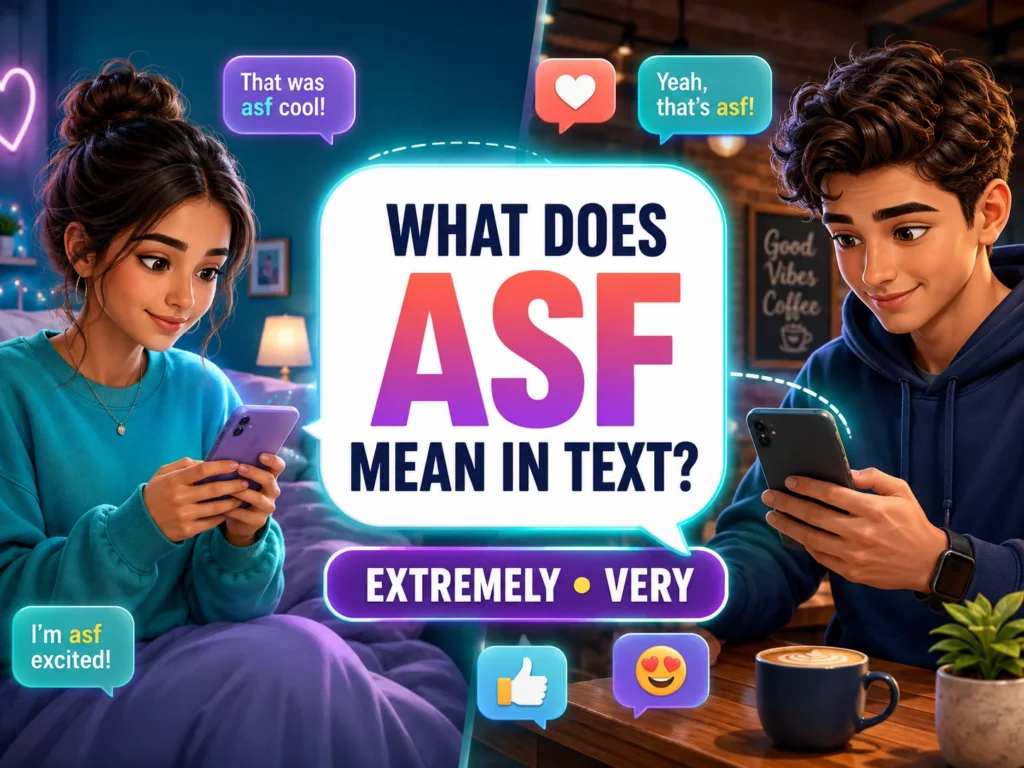
The most common meaning of ASF in text is “as f*.”** People add it after an adjective to make that adjective stronger. For example, “tired ASF” means “extremely tired,” while “funny ASF” means “very funny.”
You will often see ASF in WhatsApp messages, Instagram captions, TikTok comments, gaming chats, and casual conversations between friends. It usually makes a message sound more emotional, dramatic, humorous, or intense.
The abbreviation can be confusing because its meaning depends on where it appears. In some conversations, ASF may mean “age, sex, from,” while in formal subjects it can represent an organization or medical term.
Understanding the surrounding sentence is therefore important. The sender’s relationship with you, emotional tone, and choice of words can reveal whether ASF is playful slang, a question, or a serious abbreviation.
ASF in Text – Quick Meaning
In most informal messages, ASF means “as f*.”** The expression works as an intensifier, meaning it increases the strength of the word placed before it.
Simple Definition
ASF is commonly used to mean:
- Extremely
- Very
- Seriously
- Intensely
- To a noticeable degree
It does not always express anger. People frequently use it for excitement, admiration, frustration, attraction, embarrassment, or humor.
Short Examples
“That movie was scary ASF.”
This means the movie was extremely scary.
“You look pretty ASF today.”
The sender is giving a strong, casual compliment.
“I’m hungry ASF right now.”
The person is saying they are extremely hungry.
ASF can also mean “age, sex, from” when someone is requesting basic personal details in an online chat. That meaning is less common today and usually appears as a direct question, such as “ASF?” rather than after an adjective.
Origin and Background of ASF
ASF developed from the longer slang phrase “as f***,” which has been used in casual English to emphasize descriptions for many years. Online communities shortened it because abbreviations were faster to type.
Early internet users frequently compressed common phrases into expressions such as LOL, BRB, WTF, and AF. Both AF and ASF eventually became popular ways to intensify an adjective.
From AF to ASF
AF is the more widely recognized version, but many people add the letter S because it reflects the word “as.” For example:
- Cold AF
- Cold ASF
- Funny AF
- Funny ASF
Both versions normally communicate the same idea. ASF may feel slightly more dramatic because it visually resembles the full expression more closely.
Social Media Influence
TikTok, Instagram, X, Snapchat, Discord, and online gaming helped ASF spread across different communities. Short comments such as “cute ASF” or “clean ASF” allow users to express a strong reaction without writing a complete sentence.
Memes also changed its tone. Although the original phrase contains profanity, ASF can now appear in playful messages where the sender is not trying to sound aggressive.
Read More : ALL Meaning in Text: Uses, Examples and Best Replies
Real-Life Conversations Using ASF
The exact feeling behind ASF becomes clearer when it appears in a realistic conversation. These examples show how tone, context, and relationships affect its meaning.
WhatsApp Conversation
Person A: Are you still coming to dinner?
and,
Person B: Yes, but I’m tired ASF after work.
moreover,
Person A: No problem. Come whenever you feel ready.
Here, ASF emphasizes exhaustion. The sender is not angry; they are simply describing how tired they feel.
Instagram DM
Person A: I finally posted the pictures from my birthday.
Person B: I just saw them. You look gorgeous ASF!
Person A: Stop, you’re making me blush.
In this conversation, ASF strengthens a friendly compliment. It communicates excitement and admiration.
TikTok Comments
Person A: This ending was sad ASF.
Person B: For real. I wasn’t expecting to cry today.
The commenters use ASF to describe a powerful emotional reaction to the video.
Text Message Between Friends
Person A: Did you finish the assignment?
and,
Person B: No, it’s confusing ASF.
moreover,
Person A: Send it to me. I’ll explain the last question.
ASF communicates frustration, but the message is still casual. It tells the friend that the assignment feels extremely confusing.
Emotional and Psychological Meaning of ASF
ASF gives ordinary descriptions more emotional force. “I’m nervous” communicates a feeling, but “I’m nervous ASF” makes that feeling sound immediate and intense.
People use abbreviations like ASF because digital messages do not include facial expressions or vocal tone. Strong slang helps replace some of those missing emotional signals.
What Emotion Does It Express?
Depending on the sentence, ASF may communicate:
- Strong excitement
- Attraction or admiration
- Frustration
- Surprise
- Exhaustion
- Humor
- Embarrassment
- Anger
- Disappointment
- Enthusiasm
The adjective before ASF usually identifies the emotion. “Happy ASF” is positive, while “annoyed ASF” is negative.
Why People Use It
Using ASF can make a message feel more spontaneous and honest. It often suggests that the sender is speaking without carefully filtering their reaction.
Imagine receiving two replies to a new outfit: “That looks nice” and “That looks good ASF.” The second reply feels louder, more energetic, and more emotionally invested.
If I received ASF after a positive adjective, I would normally read it as enthusiastic approval. After a negative adjective, I would treat it as a sign that the person’s discomfort or frustration deserves attention.
Usage of ASF in Different Contexts
ASF is flexible, but it does not belong naturally in every type of communication. Its meaning and acceptability depend on the platform, relationship, and subject.
On Social Media
ASF commonly appears in captions, reactions, memes, and comment sections. Users may write “accurate ASF” under a relatable post or “beautiful ASF” beneath a photograph.
It creates a bold, youthful tone. Some people spell it in lowercase as “asf” to make the message feel relaxed.
Between Friends
Close friends may use ASF without thinking about its literal profanity. In a trusted group chat, it can function as everyday emphasis.
Examples include:
- “That match was intense ASF.”
- “I’m bored ASF.”
- “Your new haircut is fresh ASF.”
In Relationships and Flirting
ASF can make a compliment sound strongly attracted or flirtatious. Messages such as “You’re cute ASF” or “You looked good ASF tonight” often express more than neutral praise.
Context still matters. A close partner may find it playful, while someone you barely know could consider it too forward or disrespectful.
At Work or School
ASF is generally unsuitable for professional emails, academic writing, customer communication, and formal workplace chats. The abbreviation represents profanity even when the full word is hidden.
Use alternatives such as “extremely,” “particularly,” “highly,” “remarkably,” or “very” in serious settings.
Casual Versus Serious Tone
In casual conversations, ASF often sounds funny or expressive. In an argument, the same abbreviation may increase tension.
“I’m confused ASF” sounds informal and frustrated. “I’m angry ASF about what happened” feels more confrontational and should be taken seriously.
When Not to Use ASF
Avoid ASF when the audience may be uncomfortable with profanity or when your message needs to sound respectful and controlled.
It is usually inappropriate in:
- Job applications
- Workplace emails
- School assignments
- Messages to teachers
- Customer support conversations
- Religious discussions
- Legal or official communication
- Conversations with unfamiliar adults
- Public brand announcements
- Messages intended for young children
Cultural Sensitivity
Not every culture treats casual profanity in the same way. Some people see ASF as harmless internet slang, while others consider it rude regardless of the context.
When communicating with someone from a different background, use ordinary emphasis until you understand their comfort level.
Risk of Misunderstanding
A compliment such as “You’re amazing ASF” might be affectionate between friends, but another person may interpret it as an insult.
ASF magnifies whatever comes before it. If the adjective is ambiguous, the abbreviation can make the misunderstanding stronger.
Common Misunderstandings and ASF Comparison Table
The biggest mistake is assuming ASF always shows anger. It only strengthens a description; the emotion comes from the surrounding words.
Another misunderstanding involves reading ASF as a separate statement. In “beautiful ASF,” it does not describe an organization or disease. It simply means “extremely beautiful.”
Literal Versus Figurative Meaning
ASF is rarely meant literally in slang conversations. The profanity functions as emphasis rather than referring to anything physical.
Capital letters do not automatically change its meaning. “ASF,” “asf,” and “Asf” can all mean the same thing in casual text.
| Expression | Common Meaning | Tone | Example |
|---|---|---|---|
| ASF | As f*** | Strong, casual | “I’m tired ASF.” |
| AF | As f*** | Casual, widely used | “That was funny AF.” |
| Very | To a high degree | Neutral | “That was very funny.” |
| Extremely | To an exceptional degree | Formal or neutral | “The road was extremely busy.” |
| Fr | For real | Agreement or sincerity | “That was difficult, fr.” |
| So | Strong emphasis | Casual but clean | “That was so good.” |
| Kinda | Somewhat | Softer, opposite intensity | “I’m kinda tired.” |
| Not at all | Complete disagreement or absence | Opposite meaning | “It wasn’t scary at all.” |
Key Insight
ASF is stronger and more informal than “very.” It adds emotional energy, but it may also introduce profanity and a sharper tone.
Variations and Types of ASF
The emotional meaning of ASF changes according to the adjective placed before it. These common variations appear frequently in online conversations.
1. Funny ASF
This means something is extremely funny. It usually expresses amusement or strong approval of a joke.
2. Cute ASF
This describes a person, animal, outfit, or object as exceptionally cute. It often sounds affectionate or flirtatious.
3. Tired ASF
This means the sender feels completely exhausted. It may be a light complaint or a genuine request for rest.
4. Mad ASF
This indicates intense anger. Unlike playful examples, this version may signal a serious emotional conflict.
5. Hungry ASF
The sender is extremely hungry. Friends often use it humorously before deciding where to eat.
6. Bored ASF
This means someone has nothing interesting to do and strongly wants entertainment or conversation.
7. Cold ASF
The phrase describes extremely cold weather, a cold room, or a person feeling physically cold.
8. Fine ASF
This is usually a strong comment about physical attractiveness. It can be flattering, flirtatious, or inappropriate depending on the relationship.
9. Hard ASF
In music, gaming, fashion, or sports, “hard ASF” often means impressive, powerful, or stylish rather than difficult.
10. Weird ASF
This describes something as extremely strange. Its tone may be humorous, judgmental, or uncomfortable.
Other Meanings of ASF
Outside modern slang, ASF may represent “age, sex, from” in online introductions. It can also refer to organizations, technical concepts, or African swine fever in medical and agricultural discussions.
The surrounding topic should make these formal meanings clear.
How to Respond When Someone Uses ASF
Your reply should match the emotional purpose of the original message. You do not need to use profanity if it feels unnatural.
Casual Replies
If someone says, “I’m hungry ASF,” you could reply:
- “Same. Let’s order something.”
- “What are you craving?”
- “I know that feeling.”
Funny Replies
For a lighthearted message, try:
- “Emergency snacks are on the way.”
- “That sounds like a serious situation.”
- “ASF levels officially detected.”
- “You’re dramatic ASF today.”
Mature Replies
When ASF communicates frustration or anger, respond calmly:
- “I understand why you’re upset.”
- “Tell me what happened.”
- “Let’s work through it.”
- “Take your time—I’m listening.”
Respectful Replies
You can acknowledge the meaning without copying the slang:
- “Yes, that was extremely difficult.”
- “I completely agree.”
- “You looked wonderful.”
- “That sounds exhausting.”
A good response follows the emotion, not merely the abbreviation.
Regional and Cultural Usage of ASF
ASF is recognized internationally, but its popularity and acceptability vary across cultures and age groups.
Western Culture
In the United States, Canada, the United Kingdom, and other English-speaking regions, ASF commonly appears in informal online language. AF is often more familiar, but ASF carries the same basic meaning.
Asian Culture
Young English-speaking internet users across Asian countries may use ASF in gaming, fan communities, private messages, and social media comments.
However, mixed-age families and formal social environments may view the expression as unnecessarily rude.
Middle Eastern Culture
ASF may appear among younger users who follow global internet trends. Cultural expectations around politeness and profanity can make it less acceptable in public or family-facing conversations.
Using “very,” “so,” or “extremely” is safer when you are uncertain about the audience.
Global Internet Usage
Online communities have made ASF understandable beyond native English-speaking countries. Its emotional tone often travels through memes, music, gaming, and influencer content.
This global spread does not guarantee that everyone knows its hidden profanity. Some users repeat it without understanding the full phrase.
Gen Z Versus Millennials
Gen Z commonly uses ASF in short reactions and humorous comments. Lowercase “asf” is especially common because it feels casual and visually softer.
Millennials may be more familiar with AF or the older interpretation “age, sex, from.” Older generations might recognize ASF only as a formal abbreviation.
Is ASF Safe for Kids?
ASF is not ideal for children because its most common slang meaning contains a strong swear word. Even though the abbreviation hides the complete word, its intention remains profane.
Parents and teachers can explain its meaning calmly without repeating it as acceptable everyday language. Children should understand that online abbreviations can carry meanings that are not obvious.
Clean alternatives include:
- Very
- Really
- Extremely
- Super
- So
- Incredibly
A child who sees “funny ASF” can understand it as “extremely funny,” but should be encouraged to use a more age-appropriate expression.
FAQs About the Meaning of ASF in Text
What does ASF mean in texting?
ASF usually means “as f***” in texting. It is placed after an adjective to mean extremely, very, or intensely.
Is ASF a bad word?
ASF is an abbreviation rather than a complete swear word, but it represents a profane phrase. Some people consider it offensive or inappropriate.
What does “cute ASF” mean?
“Cute ASF” means extremely cute. It may express affection, admiration, or flirtation depending on who sends it.
What does ASF mean from a girl?
When a girl uses ASF, it normally strengthens the adjective before it. “You’re funny ASF” is an enthusiastic compliment, while “I’m annoyed ASF” communicates strong frustration.
What does ASF mean from a guy?
Its basic meaning remains the same regardless of gender. A message such as “You look good ASF” may indicate strong attraction or playful admiration.
Can ASF mean “age, sex, from”?
Yes. ASF can mean “age, sex, from” when someone asks “ASF?” during an online introduction. This meaning is older and less common than “as f***.”
Are ASF and AF the same?
In most casual messages, ASF and AF mean the same thing. Both intensify an adjective, although AF is often more widely recognized.
Conclusion
The usual meaning of ASF in text is “as f*,”** a slang intensifier used to mean extremely or very. It can strengthen compliments, complaints, jokes, and emotional reactions.
Its tone depends on the word before it. “Beautiful ASF” communicates strong admiration, while “angry ASF” signals serious frustration.
ASF works naturally in relaxed conversations between people who are comfortable with slang. It should be avoided in professional, academic, family-sensitive, and unfamiliar social situations because its hidden meaning contains profanity.
Once you understand the context, ASF is easy to interpret. Pay attention to the adjective, the relationship, and the mood of the conversation, and you can respond confidently without misreading the sender’s intention.