
If you spend time texting, scrolling through social media, or chatting online, you’ve probably seen someone type “ISTG” and wondered what it means.
Internet slang evolves quickly, and many abbreviations can be confusing when you first encounter them. Some seem obvious, while others carry emotional meanings that aren’t immediately clear.
The phrase “ISTG” is one of those expressions that appears in casual conversations, emotional messages, funny posts, and even serious discussions. Understanding it helps you better interpret the tone behind a message and avoid misunderstandings.
In this guide, you’ll learn the complete ISTG meaning in chat, where it came from, how people use it today, and what it reveals about modern digital communication.
ISTG Meaning in Chat – Quick Meaning
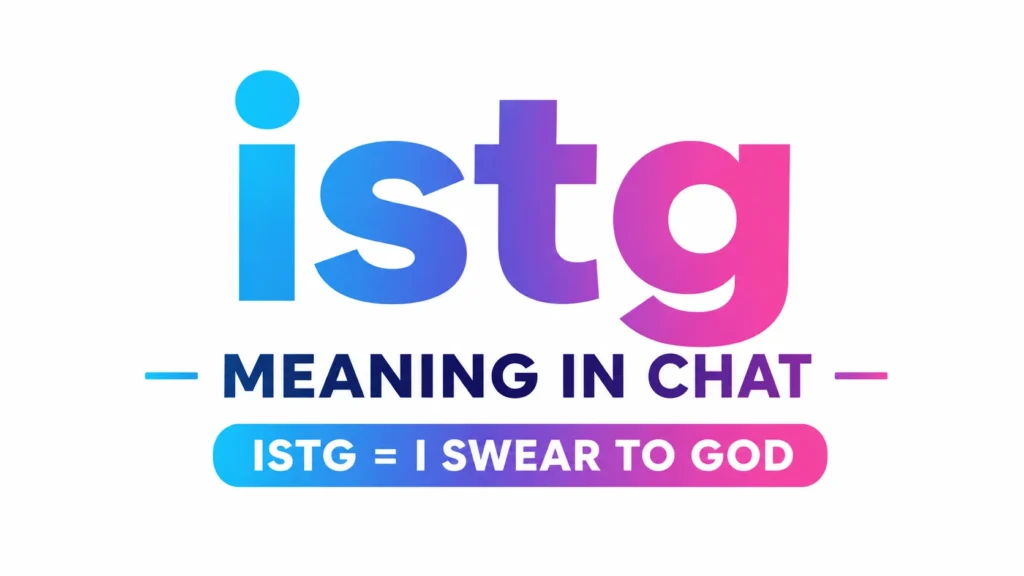
What Does ISTG Mean?
ISTG stands for:
“I Swear To God.”
People use it to emphasize that they are being truthful, serious, surprised, frustrated, or emotionally invested in what they are saying.
In most conversations, ISTG functions as a way to add emotional weight to a statement.
Quick Definition:
- ISTG = I Swear To God
- Used for emphasis
- Common in texting and social media
- Usually informal
- Can express honesty, frustration, excitement, or disbelief
Common Examples
“ISTG I didn’t touch your phone.”
and,
“ISTG that was the funniest video I’ve ever seen.”
moreover,
“ISTG if this happens again, I’m leaving.”
Although the phrase contains the word “God,” many users employ it casually rather than as a religious statement.
Origin & Background
Where Did ISTG Come From?
The full phrase “I swear to God” existed long before the internet.
For generations, English speakers used it in spoken conversation to strengthen a statement or convince others of their sincerity.
As texting became popular, people naturally shortened common phrases into abbreviations. Similar examples include:
- OMG
- BRB
- TBH
- IDK
ISTG emerged from this trend because it allowed people to communicate strong emotions quickly.
Social Media Influence
Platforms like Twitter, Instagram, Snapchat, and TikTok helped popularize ISTG among younger users.
Character limits, fast-paced conversations, and informal communication encouraged shorter expressions.
Over time, ISTG became part of everyday online language.
How Its Meaning Evolved
Originally, the phrase mainly signaled honesty.
Today, ISTG serves several purposes:
- Showing frustration
- Expressing excitement
- Emphasizing truthfulness
- Reacting dramatically
- Adding humor
As a result, context now determines the exact meaning.
Read More : What Is the Meaning of WYA? The Real Texting Meaning Explained
Real-Life Conversations
WhatsApp Conversation
Person A:
Did you really finish the entire project overnight?
Person B:
ISTG I stayed awake until 4 AM.
Person A:
That’s actually impressive.
Instagram DM Conversation
Person A:
Did you meet your favorite creator?
Person B:
ISTG I almost cried when I saw them.
Person A:
I would’ve done the same.
TikTok Comment Section
Person A:
This recipe changed my life.
Person B:
ISTG I make it every week now.
Person A:
Glad I’m not the only one.
Text Message Conversation
Person A:
Are you serious about moving abroad?
Person B:
ISTG I’ve been planning it for months.
Person A:
Wow, I didn’t realize that.
Emotional & Psychological Meaning
What Emotion Does ISTG Express?
One reason ISTG remains popular is its emotional flexibility.
Depending on the situation, it can communicate:
- Sincerity
- Excitement
- Anger
- Frustration
- Shock
- Determination
Why People Use It
Digital conversations lack facial expressions and vocal tone.
Because of that, people often use abbreviations to convey emotion more clearly.
ISTG helps readers understand that a statement carries extra emotional weight.
What It Reveals About Modern Communication
Modern communication prioritizes speed.
People want to express strong feelings without typing lengthy explanations.
ISTG acts as a shortcut that instantly signals intensity.
Personal-Style Scenario
Imagine telling your friends that you unexpectedly met a celebrity at a café.
If they doubt your story, replying with “ISTG it actually happened” immediately adds sincerity and excitement to your message.
Usage in Different Contexts
Social Media
On social media, ISTG often appears in:
- Captions
- Comments
- Reactions
- Memes
Example:
“ISTG this song gets better every time I hear it.”
Friends and Relationships
Among friends, the phrase commonly reinforces honesty.
Example:
“ISTG I’m not ignoring you. I’ve just been busy.”
In relationships, it can express reassurance or emotional intensity.
Work and Professional Settings
Using ISTG in professional communication is generally not recommended.
Emails, reports, and workplace messages usually require more formal language.
Instead of ISTG, consider:
- “I assure you”
- “I can confirm”
- “To clarify”
Casual vs Serious Tone
The same abbreviation can sound different depending on context.
Casual:
“ISTG that movie was hilarious.”
Serious:
“ISTG I’m telling the truth.”
Understanding the surrounding conversation is essential.
When NOT to Use It
Professional Communication
Avoid ISTG in:
- Job applications
- Business emails
- Formal presentations
- Client communication
Religious Sensitivity
Some people view phrases involving God as significant religious expressions.
Using ISTG casually around individuals with strong religious beliefs may be inappropriate.
Situations That May Cause Confusion
Not everyone knows internet slang.
Older relatives, international contacts, or professional colleagues may misunderstand the abbreviation.
In those cases, writing the full message is often better.
Common Misunderstandings
People Think It Always Means Anger
Many users assume ISTG signals frustration.
While it can, it also expresses excitement, honesty, and surprise.
Tone Can Be Misread
Without context, the phrase may seem aggressive.
Example:
“ISTG stop doing that.”
This could be playful or genuinely annoyed.
Literal vs Figurative Meaning
Most users do not intend a literal oath.
Instead, they use ISTG figuratively to emphasize a statement.
Understanding this distinction helps prevent misinterpretation.
Comparison Table
| Expression | Meaning | Tone | Similarity to ISTG |
| ISTG | I Swear To God | Emotional | Base expression |
| TBH | To Be Honest | Honest | Less intense |
| NGL | Not Gonna Lie | Casual honesty | Similar |
| FR | For Real | Agreement | Moderate similarity |
| ONG | On God | Strong sincerity | Very similar |
| IDC | I Don’t Care | Indifference | Opposite tone |
| JK | Just Kidding | Humor | Different purpose |
| SMH | Shaking My Head | Disappointment | Related emotion |
Key Insight
ISTG stands out because it combines honesty and emotion. Unlike many abbreviations that simply shorten words, ISTG adds emphasis and emotional intensity to digital conversations.
Variations / Types
ISTG
Standard form meaning “I Swear To God.”
ONG
“On God.”
Used to emphasize sincerity.
FR
“For Real.”
Used to confirm honesty.
NGL
“Not Gonna Lie.”
Introduces truthful opinions.
TBH
“To Be Honest.”
Signals openness.
Deadass
Means completely serious.
Popular among younger users.
No Cap
Means not lying or exaggerating.
Swear Down
Common in British slang.
Used to stress honesty.
Legit
Means genuine or authentic.
Often used casually.
I Promise
The non-slang alternative.
More suitable in serious situations.
How to Respond When Someone Uses It
Casual Replies
- “I believe you.”
- “That makes sense.”
- “Fair enough.”
Funny Replies
- “Okay, okay, I’m convinced.”
- “No need to bring ISTG into this.”
- “That’s some serious commitment.”
Mature Replies
- “Thanks for being honest.”
- “I appreciate the clarification.”
- “I understand your point.”
Respectful Replies
- “Got it.”
- “Thank you for explaining.”
- “I trust what you’re saying.”
Regional & Cultural Usage
Western Culture
In North America and Europe, ISTG is widely recognized among younger internet users.
Most people interpret it as an informal expression of emphasis.
Asian Culture
Many Asian users understand ISTG through exposure to global social media.
However, local slang often remains more common in everyday conversations.
Middle Eastern Culture
Usage varies depending on language, culture, and religious perspectives.
Some users may avoid the phrase because of its religious wording.
Global Internet Usage
Thanks to TikTok, Instagram, gaming communities, and messaging apps, ISTG has become internationally recognizable.
Generational Differences
Gen Z
Uses ISTG frequently in everyday conversations.
Millennials
Generally understand it but may use it less often.
Older generations may be less familiar with the abbreviation.
Is It Safe for Kids?
Understanding the Context
In most cases, ISTG is relatively harmless internet slang.
It does not contain offensive language or explicit content.
However, parents should ensure children understand:
- Appropriate communication settings
- Audience awareness
- Respectful online behavior
The phrase is generally safe, but context always matters.
FAQs
What does ISTG mean in texting?
ISTG means “I Swear To God.” It is used to emphasize honesty, emotion, or seriousness in a message.
Is ISTG rude?
Not usually. However, tone and context can make it sound aggressive if used during arguments.
Is ISTG religious?
The phrase contains a religious reference, but many people use it casually rather than as a literal religious statement.
Can ISTG be used on Instagram?
Yes. It frequently appears in comments, captions, stories, and direct messages.
Is ISTG the same as ONG?
They are very similar. Both emphasize sincerity, although ONG means “On God.”
Should I use ISTG at work?
Generally no. Professional environments usually require more formal language.
Why is ISTG so popular?
It communicates strong emotion quickly, making it ideal for fast-paced online conversations.
Conclusion
Understanding the ISTG meaning in chat goes beyond knowing its definition. While it literally stands for “I Swear To God,” its real power lies in the emotion it adds to digital conversations.
Whether someone is expressing excitement, frustration, honesty, or disbelief, ISTG helps communicate feelings that plain text sometimes struggles to convey.
As online language continues to evolve, abbreviations like ISTG remain valuable because they combine speed, personality, and emotional expression. When used appropriately and with awareness of context, it can make conversations feel more authentic and engaging.
The next time you see ISTG in a message, you’ll understand not only what it means but also the feeling behind it.




1 thought on “ISTG Meaning in Chat: Means and Why People Use It”