Three letters can completely change the mood of a conversation.
Imagine asking a friend, “Are you still coming tonight?” and receiving nothing but “IFG.” Is that an enthusiastic yes, a reluctant maybe, or something entirely different?
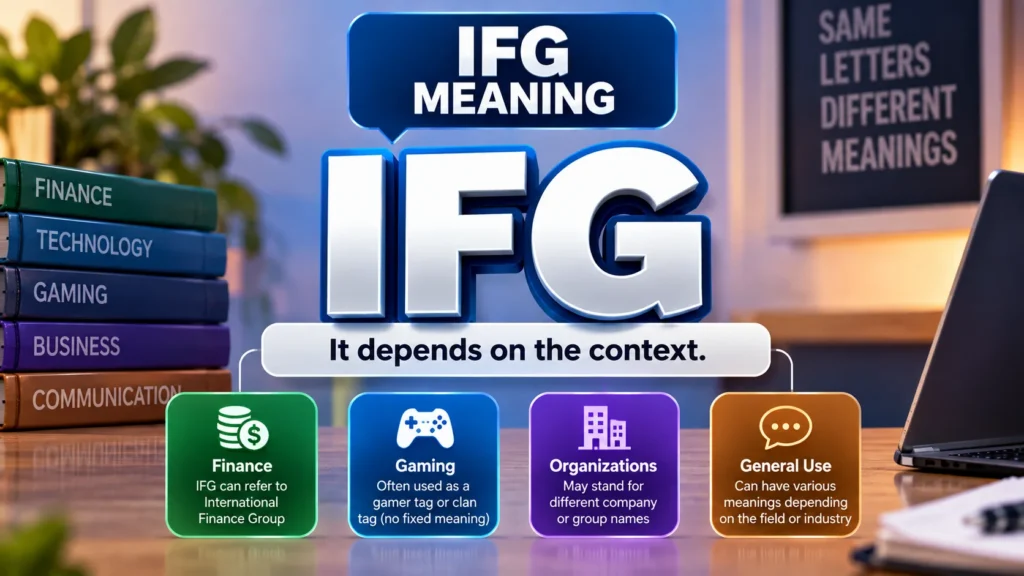
In current online slang, IFG is commonly used for “I F*ing Guess,”** a stronger and more sarcastic version of “I guess.” It often communicates reluctance, uncertainty, mild annoyance, or the feeling of agreeing without much enthusiasm. Dexerto documents this as the primary Snapchat interpretation while also noting “I Feel Good” as another use.
Other recent slang references reverse the priority and identify “I Feel Good” as the more common reading, especially when someone is describing a positive mood.
That disagreement tells us something useful: IFG is not as standardized as LOL, BRB, or IDK.
The surrounding sentence matters more than the letters alone.
IFG – Quick Meaning
Two interpretations deserve the most attention.
I F***ing Guess
This version is basically an intensified form of:
“I guess.”
It often sounds:
- reluctant;
- sarcastic;
- uncertain;
- mildly irritated;
- indifferent;
- resigned.
Example:
“You coming with us?”
“IFG 🙄”
The emotional translation is closer to:
“Fine, I guess.”
Dexerto reports this use across Snapchat and other social platforms, especially when someone reluctantly agrees to a suggestion.
I Feel Good
The second important interpretation is:
“I Feel Good.”
This works as a quick mood update.
Example:
“Finally finished my exams. IFG 😭❤️”
Here, reluctant agreement makes no sense. The person is clearly expressing happiness or relief.
Several current 2026 slang guides identify this positive interpretation as a common or even primary use.
A simple rule helps:
Reply to a question + annoyed tone → probably “I F*ing Guess.”**
Positive statement + happy tone → probably “I Feel Good.”
Origin & Background
Unlike older abbreviations such as LOL or ASAP, IFG does not have a single well-documented origin.
It appears to have developed through informal internet communication where users compress emotional phrases into initials.
From “I Guess” to a Stronger Reaction
“I guess” already communicates uncertainty.
Someone saying:
“I guess I’ll go.”
is technically agreeing, but not enthusiastically.
Adding an intensifier makes that emotional hesitation stronger.
The abbreviated form allows users to communicate the same attitude without typing the whole phrase.
Urban Dictionary entries for the expression date back to at least 2019, showing that the sarcastic version was circulating online several years before its more recent visibility on Snapchat and TikTok.
The Positive Interpretation
“I Feel Good” follows an equally simple abbreviation pattern:
I = I
F = Feel
G = Good
It works naturally as a mood statement.
Someone may post after exercising:
“Morning run done. IFG.”
Or after receiving good news:
“Passed the interview. IFG rn 😭”
Several 2026 slang sites currently document this reading, showing how the same acronym can evolve differently across separate online communities.
Social Media Made the Ambiguity Bigger
TikTok, Snapchat, Instagram, Discord, and group chats mix users from different communities.
One group may understand IFG instantly as sarcastic agreement.
Another may use it primarily as a mood update.
That is why modern slang cannot always be decoded like a mathematical formula.
Sometimes you need the conversation before the acronym.
Real-Life Conversations
Person A: Are you actually coming to dinner tonight?
Person B: IFG 😭
and,
Person A: That’s the least excited yes I’ve ever received.
Person B: I’m tired but I’ll come.
Here, the response means something like “I f*ing guess.”** The person agrees without enthusiasm.
Instagram DMs
Person A: How are you feeling after finally submitting everything?
Person B: IFG honestly 😭❤️
and,
Person A: You survived!
Person B: Barely, but yes 😂
The positive context makes “I Feel Good” much more natural.
TikTok Comments
Person A: So we’re all pretending that ending made sense?
and,
Person B: IFG 💀
moreover,
Person A: Exactly because what even was that?
Here, the phrase carries uncertainty mixed with sarcasm.
Snapchat
Person A: Wanna go out later?
Person B: ifg
and,
Person A: You sound thrilled 😂
Person B: I’m coming, aren’t I?
This matches the reluctant-agreement use commonly associated with Snapchat.
Emotional & Psychological Meaning
The interesting part of IFG is not the letters.
It is the attitude hiding behind them.
When someone means “I F***ing Guess,” they are rarely communicating a confident yes.
They may be saying:
“I don’t really care.”
“I suppose so.”
“Fine.”
“Probably.”
“I don’t have a better answer.”
That ambiguity can make the expression feel funny between close friends but cold in a more sensitive conversation.
Reluctant Agreement
Imagine your friends spend twenty minutes arguing about where to eat.
Finally someone asks:
“Pizza then?”
You answer:
“IFG.”
You have technically agreed.
Emotionally, though, your message says:
“I am done debating this.”
That is why the expression often feels more expressive than simply typing “yes.”
Positive Mood
When it means “I Feel Good,” the psychology changes completely.
Now the abbreviation becomes an emotional status update.
Someone who has:
finished an exam;
completed a workout;
received good news;
resolved a stressful problem;
or simply woken up in a great mood
may use it as a compact way of sharing positive energy.
Context Creates the Emotion
Compare:
“Should we just order pizza?”
“IFG 🙄”
with:
“Workout complete. IFG 😌”
The letters are identical.
The emotional message is almost opposite.
This is a perfect example of why internet language is often interpreted through tone markers such as emojis, sentence position, and previous messages.
Usage in Different Contexts
Snapchat
Snapchat is strongly associated with the sarcastic interpretation.
A 2024 Dexerto slang explainer identifies “I F*ing Guess”** as the most common Snapchat use and describes it as conveying reluctance, annoyance, or indifference.
Example:
“Are you coming?”
“IFG.”
TikTok
TikTok usage is less stable.
Under a positive glow-up, workout, or achievement video, “I Feel Good” may make perfect sense.
Under a debate, complaint, or dramatic comment thread, the sarcastic version may fit better.
Always read the comment above it.
In DMs, it may work exactly like ordinary texting.
In captions, “I Feel Good” becomes more plausible because captions often describe someone’s mood.
For example:
“Fresh haircut. Great weather. IFG.”
Friends and Relationships
Among close friends, the stronger sarcastic version can feel playful.
In a relationship conversation, it can feel dismissive.
Imagine:
Person A: Do you even want to see me tonight?
Person B: IFG.
Even if the sender means only “I guess,” the intensifier makes the answer sound unenthusiastic.
Tone matters.
Gaming and Discord
Gaming groups often create their own shorthand.
IFG may appear as sarcastic agreement, but community-specific meanings are possible.
If the acronym suddenly appears in a game-specific discussion where neither common interpretation fits, ask rather than guessing.
When NOT to Use It
Avoid the expression when your message needs to sound respectful, enthusiastic, or completely clear.
Professional Messages
Do not answer your manager:
“Can you finish this today?”
with:
“IFG.”
Even if you intend “I Feel Good,” the reader may understand the profane interpretation.
That could create an awkward situation very quickly.
Formal Writing
Avoid it in:
- emails to clients;
- academic assignments;
- job applications;
- reports;
- professional presentations;
- customer-support communication.
Use full language instead.
Serious Relationship Conversations
A sarcastic abbreviation can easily make emotional conversations worse.
If your partner asks:
“Do you still want this relationship?”
“IFG”
is probably one of the least helpful possible replies.
Write clearly.
With People Who May Not Know the Slang
Unlike OMG or LOL, IFG is not universally understood.
Several current slang sources disagree about its dominant definition.
That alone is a strong reason to avoid it when clarity matters.
Common Misunderstandings
It Does Not Have One Universal Definition
This is the biggest mistake.
Some 2026 sources call “I Feel Good” the primary interpretation. Others identify “I F*ing Guess.”**
The safest explanation is that both circulate online.
It Is Not the Same as IG
IG commonly means:
“I guess”
or:
“Instagram.”
IFG can function as a stronger version of “I guess,” but the extra letter significantly changes the tone.
It Does Not Automatically Mean “I Feel Guilty”
Some niche online pages list “I Feel Guilty.”
That interpretation may appear in specific conversations, but evidence for it is much weaker than the two major meanings discussed above. One current slang site documents it, demonstrating why highly context-specific acronyms should not be treated as universal vocabulary.
Capitalization Does Not Solve the Problem
Users may write:
IFG
ifg
Ifg
and intend exactly the same thing.
Social messaging does not consistently follow capitalization rules.
It Can Sound Harsher Than Intended
The profane interpretation adds emotional intensity.
If someone is unfamiliar with your humor, they may read frustration where you intended playful uncertainty.
IFG Compared With Similar Slang
| Term | Common Meaning | Typical Emotion |
|---|---|---|
| IFG | I F***ing Guess | Reluctant/sarcastic |
| IFG | I Feel Good | Positive/upbeat |
| IG | I Guess | Uncertain/casual |
| IDK | I Don’t Know | Uncertain |
| IDC | I Don’t Care | Indifferent |
| IMO | In My Opinion | Opinion |
| NGL | Not Gonna Lie | Honest/direct |
| FR | For Real | Agreement/emphasis |
| FML | F*** My Life | Frustration |
| IKR | I Know, Right? | Agreement |
Key Insight
The closest comparison is IG = “I guess.” IFG can intensify that same uncertainty with frustration or attitude. When used as “I Feel Good,” however, it moves into an entirely different emotional category.
Variations and Types
1. IFG
Short meaning: I F***ing Guess.
Often used as a reluctant answer.
Example: “Are we leaving now?” — “IFG.”
2. ifg
Short meaning: Same slang in lowercase.
Lowercase formatting may make the message feel more casual but does not guarantee a different definition.
3. IFG 🙄
Tone: Reluctant or annoyed.
The eye-roll emoji strongly supports the sarcastic interpretation.
4. IFG 😭
Tone: Depends on context.
It may mean reluctant agreement delivered humorously or emotional relief after something positive.
5. IFG 😂
Tone: Playful uncertainty.
The sender may be agreeing while treating the situation as a joke.
6. IFG Today
Possible meaning: I Feel Good.
Mood-oriented wording makes the positive interpretation more likely.
Example:
“Finally slept eight hours. IFG today.”
7. IFG After a Workout
Possible meaning: I Feel Good.
Fitness and wellness captions often make a mood-based reading logical.
8. IFGS
Reported meaning: I F***ing Guess So.
This longer variation occasionally appears as an even more explicit form of reluctant agreement. Urban Dictionary records this expansion.
9. IFG as a Caption
Likely meaning: Often mood-related.
Without a question immediately before it, “I Feel Good” may be more plausible.
10. IFG as a Reply
Likely meaning: Often reluctant agreement.
If someone asks a yes-or-no question and receives only “IFG,” the “I F***ing Guess” interpretation usually fits much better.
How to Respond When Someone Uses It
Your reply depends entirely on tone.
Casual Replies
If they reluctantly agree:
“😂 I’ll take that as a yes.”
“Good enough.”
“So enthusiastic 😭”
“Okay, you’re coming then.”
Funny Replies
“That sounded incredibly convincing.”
“Your excitement is overwhelming 😂”
“Say less enthusiastic next time 😭”
“I’ve never heard a stronger yes.”
Mature Replies
If they seem genuinely annoyed:
“You don’t have to if you don’t want to.”
“It’s okay to say no.”
“Are you actually comfortable with that?”
These replies avoid turning uncertain agreement into pressure.
Positive Replies
If they mean “I Feel Good”:
“Love that for you.”
“Glad you’re feeling better!”
“As you should 😌”
“Good vibes today.”
Respectful Replies
When you genuinely cannot tell:
“What do you mean by IFG here?”
“Do you mean ‘I feel good’ or ‘I guess’?”
A quick question is better than building a whole conversation around the wrong definition.
Regional & Cultural Usage
Western Internet Culture
The sarcastic interpretation fits especially naturally into American-style internet slang where profanity is often abbreviated to create emphasis without spelling out the entire word.
Its tone resembles expressions such as:
“idc”
“fml”
and:
“wtf.”
Asian Online Communities
English slang frequently crosses into multilingual conversations across Asia through TikTok, Snapchat, Discord, gaming, and Instagram.
However, IFG is far less universally recognized than expressions such as LOL or OMG.
Spelling out your meaning is wiser when speaking with people from different linguistic backgrounds.
Middle Eastern Online Culture
The same pattern applies in Middle Eastern multilingual chats.
Young users may understand global English abbreviations, particularly through gaming and social media, but there is no reason to assume everyone recognizes this one.
Global Internet Usage
The most important cultural feature is not geography but community.
A specific Snapchat friend group may consistently use it one way.
A fitness community may interpret it differently.
A meme page may use the sarcastic version almost exclusively.
Digital communities create their own mini-dialects.
Gen Z vs. Millennials
The abbreviation feels more closely aligned with short-form, reaction-heavy communication commonly associated with younger users.
Gen Z users may combine it with emojis:
“ifg 😭”
and,
“IFG 🙄”
moreover,
“ifg ig 💀”
Millennials may be more likely to use the clearer “I guess,” “IDK,” or older shorthand.
These are tendencies rather than strict age rules.
Is IFG Safe for Kids?
It depends on which expansion is intended.
“I Feel Good” is completely harmless.
The other common version contains the F-word, even when only the initial is visible.
That makes the abbreviation itself visually mild but its expanded meaning potentially inappropriate for younger children or formal school settings.
A child-friendly explanation could be:
“IFG can mean ‘I Feel Good.’ Some older teens and adults also use it as a stronger, rude version of ‘I guess.’”
Parents and educators do not necessarily need to spell out the profanity when explaining it to young children.
For school assignments, full standard English is preferable anyway.
FAQs
What does IFG mean in text?
It can mean “I F*ing Guess,”** expressing reluctant or sarcastic agreement, or “I Feel Good,” expressing a positive mood. Context determines which interpretation fits.
What does IFG mean on Snapchat?
On Snapchat, it is commonly interpreted as “I F*ing Guess.”** It often appears as an uncertain, annoyed, or reluctant response to a suggestion or question.
What does IFG mean on TikTok?
TikTok usage varies. In replies to arguments or questions, it may mean “I F***ing Guess.” In upbeat captions or mood-related posts, it may mean “I Feel Good.”
Does IFG mean I Feel Good?
Yes. Several current slang references document “I Feel Good” as a common interpretation, particularly in positive posts, captions, and conversations about mood.
Does IFG mean I F***ing Guess?
Yes. This is an established slang interpretation, particularly as a sarcastic or reluctant response. Dexerto identifies it as the common Snapchat use.
What does IFG mean from a girl?
Gender does not change the definition. Look at the sentence. If she replies reluctantly to a question, it probably means “I F***ing Guess.” If she is talking positively about her mood, “I Feel Good” is more likely.
What does IFG mean from a guy?
The same context rule applies. The abbreviation itself does not have a gender-specific or automatically romantic meaning.
Conclusion
IFG is a perfect example of why modern internet slang cannot always be understood by memorizing one expansion.
In many Snapchat, TikTok, Discord, and texting conversations, it means “I F*ing Guess.”**
That version carries attitude.
It can communicate reluctance, mild irritation, uncertainty, resignation, or playful indifference.
Someone asks:
“Are you coming?”
and receives:
“IFG 🙄”
The emotional message is basically:
“Fine, I guess.”
Yet another established online use is “I Feel Good.”
If someone posts:
“Finished my workout. IFG 😌”
the positive interpretation fits far better.
The easiest decoding method is therefore simple.
Look at what came immediately before the acronym.
Was it answering a question?
Check for reluctant agreement.
Was the person describing their mood, achievement, workout, or good news?
Think positive emotion.
Are neither of those interpretations logical?
Ask.
Because unlike highly standardized abbreviations such as LOL or BRB, these three letters still carry noticeable variation across online communities.
Understanding the context will always give you a better answer than relying on the acronym alone.
For high CTR (click-through rate), titles and descriptions should create curiosity, a clear benefit, and a reason to click without giving everything away.