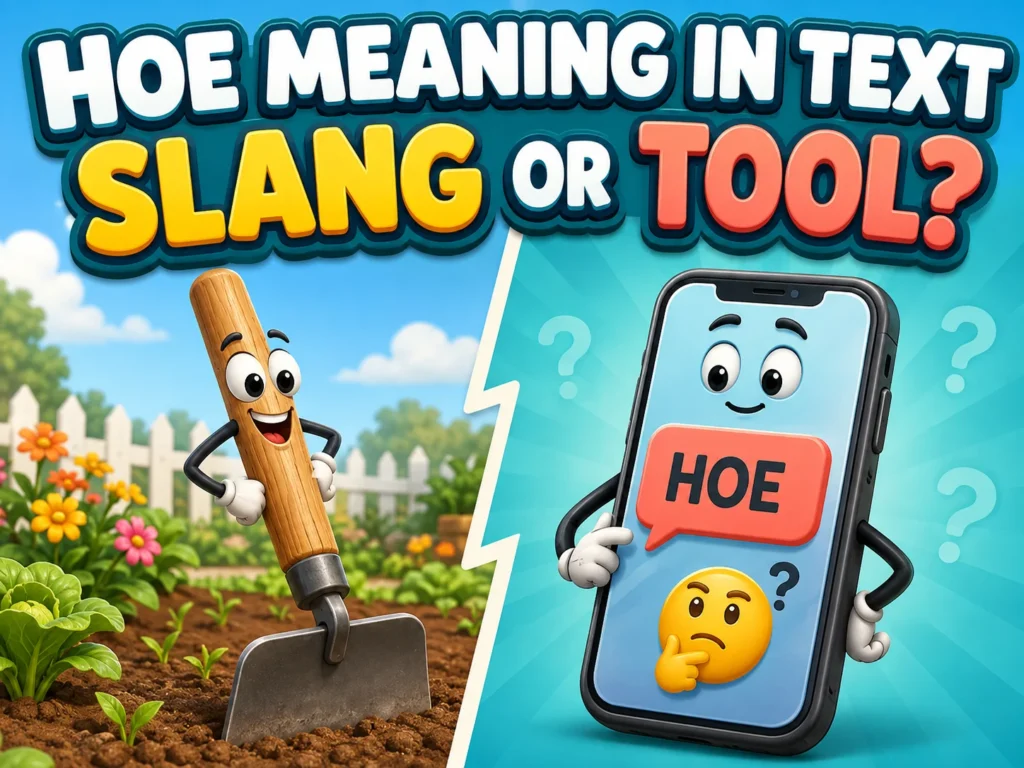
The usual hoe meaning in text is a disrespectful slang label for someone perceived as sexually promiscuous, highly flirtatious, or involved with several romantic partners.
It is most frequently directed at women, although modern users sometimes apply it to people of any gender. Depending on the relationship and tone, it may appear as an aggressive insult, playful teasing, self-description, or exaggerated internet humor.
For example, “He called her a hoe” almost certainly describes an insult. In contrast, two close friends joking privately may use the same word without intending genuine harm.
The word can also appear in phrases such as “plant hoe,” “coffee hoe,” or “fashion hoe.” In those expressions, it humorously describes someone who is extremely enthusiastic about a hobby or interest.
There is also a completely unrelated literal meaning. A hoe is a gardening tool used to loosen soil and remove weeds. Context normally makes it easy to distinguish the tool from the slang term.
Because the slang meaning carries a history of sexual judgment and gendered disrespect, it should never be used casually without understanding its emotional weight.
Hoe Meaning in Text – Quick Explanation
In texting slang, “hoe” can communicate several related ideas:
- An insulting label for a supposedly promiscuous person
- Someone who flirts with several people
- A person accused of being unfaithful
- A teasing nickname between close friends
- A self-referential joke about dating
- Someone intensely interested in a hobby
- An exaggerated meme expression
- A garden tool in its ordinary dictionary meaning
Consider these examples:
“He called me a hoe because I rejected him.”
The word is being used as a hostile and controlling insult.
“You flirted with the waiter for free dessert, you little hoe 😂”
The laughing emoji suggests teasing, but the relationship between the people still determines whether it is acceptable.
“I’m becoming such a plant hoe. I bought four more pots.”
Here, the speaker is joking about being obsessed with plants. The phrase does not carry its usual sexual meaning.
A message containing only “hoe” is rarely positive. It may be a joking greeting in a very close friendship, but it can easily feel demeaning when sent without friendly context.
Origin and Background of the Word
The literal gardening word and the insulting slang word have different histories.
The ordinary noun “hoe” is centuries old. It refers to a tool with a flat blade used for cultivating soil, removing weeds, and working around plants. Merriam-Webster traces this gardening term through Middle English and Anglo-French. Its dictionary entry records uses of the tool dating back to the 14th century.
The slang meaning developed from “ho,” an altered form of “whore.” Merriam-Webster labels that slang noun disparaging and offensive, especially when it refers to a woman or another person judged for having multiple sexual partners. The dictionary’s “ho” entry makes that offensive status explicit.
“Hoe” eventually became a common alternative spelling of “ho” in informal writing. Music, television, comedy, memes, and social media made the spelling increasingly visible.
Its meaning has broadened in some online communities. Friends may use it ironically, and individuals sometimes reclaim it as a humorous self-description rather than accepting it as a source of shame.
Phrases such as “book hoe” or “travel hoe” weaken the sexual meaning even further. In those constructions, the word functions as exaggerated shorthand for an enthusiast.
This evolution does not erase the original insult. A term can be playful in one community and deeply hurtful in another. Understanding both meanings is essential to using—or avoiding—it responsibly.
Read More : FS Meaning in Text Message/social media/from a girl/slang/chat
Real-Life Conversations Using “Hoe”
The surrounding relationship, punctuation, and emotional situation reveal whether the word is playful or harmful.
WhatsApp: Friendly Teasing
Amina: I said I was taking a break from dating.
Sara: And now you have dinner plans with that new guy?
Amina: It is only dinner!
Sara: Okay, hoe era 😂 Just be safe and have fun.
The laughing emoji and supportive final sentence make the exchange feel playful. This tone would not automatically be acceptable between strangers.
Instagram DMs: A Hobby-Based Joke
Lina: Did you really order another ten books?
Maya: They were discounted. I had no choice.
Lina: You are officially a book hoe.
Maya: That title belongs in my bio.
The phrase means “someone obsessed with books.” Neither speaker is commenting on dating or sexuality.
TikTok Comments: Public Insult
Creator: Being single does not mean I want everyone’s attention.
Commenter: Sure, hoe.
Creator: You do not know me. Keep the comments respectful.
The commenter is using the word to shame the creator. Without friendship or consent, it reads as direct harassment.
Text Message: Relationship Conflict
Noah: Why were you talking to him at the party?
Emma: He asked me a question about work.
Noah: Whatever, hoe.
Emma: Calling me names is not acceptable. We can talk when you are ready to be respectful.
Here, the word is not playful. It is being used to punish and humiliate someone during conflict. Emma responds by setting a clear boundary.
Emotional and Psychological Meaning
The word often carries more emotion than its short spelling suggests. It can communicate jealousy, sexual judgment, anger, insecurity, familiarity, rebellion, or playful confidence.
As an insult, “hoe” attempts to reduce someone’s identity to their perceived dating or sexual behavior. It can be particularly painful because it connects personal relationships with shame.
Gender also shapes its emotional impact. Women have historically faced harsher social judgment for behavior that may be ignored or praised in men. Calling a woman a hoe can reinforce that double standard.
In controlling relationships, the term may be used to create guilt. A jealous partner might apply it to ordinary behavior such as wearing certain clothes, having friends, posting photographs, or speaking to another person.
That usage reveals more about the accuser’s desire for control than the target’s character.
Inside trusted friendships, the psychological meaning may be different. Some friends reclaim the word to remove its power, using it as exaggerated humor rather than moral criticism.
A familiar scenario explains the difference. Imagine someone sharing three harmless celebrity crushes in a private group chat. A close friend replies, “Your fictional hoe era is getting serious 😂.”
Everyone understands the joke, and nobody is being attacked. If an unfamiliar person posted the same word beneath that individual’s photograph, it could feel threatening or humiliating.
Intent matters, but impact matters too. “I was joking” does not automatically repair hurt caused by language someone never agreed to receive.
Usage in Different Contexts—and When Not to Use It
Social Media
On TikTok, Instagram, X, and other platforms, “hoe” may appear in memes, captions, arguments, song references, or hobby-based phrases.
Self-referential captions such as “entering my gardening hoe era” use the literal tool and slang meaning as a pun. Other phrases, including “attention hoe,” can still sound insulting because they criticize someone for seeking validation.
Public comments require more caution than private jokes. Tone is harder to read, and people from different cultural backgrounds may interpret the word literally or aggressively.
Friends and Group Chats
Some close friends use the word as playful teasing. This only works when everyone understands the relationship and is comfortable with that language.
Do not assume closeness gives permanent permission. A word that feels funny during a relaxed conversation may become hurtful during an emotional disagreement.
Dating and Relationships
The term is risky in romantic relationships because it can express jealousy, mistrust, or possessiveness.
Calling a partner a hoe is not a healthy substitute for asking honest questions. If trust is damaged, discuss the specific action instead of attacking the person’s identity.
Say, “I felt uncomfortable when that happened,” rather than using a sexualized insult.
Work and Professional Communication
The word is inappropriate in professional messages, meetings, emails, classrooms, customer conversations, and workplace group chats.
Even hobby-based phrases may cause misunderstandings. A message such as “I’m a marketing hoe” may sound humorous to the sender but unprofessional or offensive to colleagues.
When Not to Use It
Avoid using “hoe”:
- During an argument
- Toward a stranger
- In professional settings
- To shame someone’s clothing
- To criticize dating choices
- Around children
- In formal writing
- When someone has asked you to stop
- When gender or sexual harassment is already an issue
- When cultural differences make the tone uncertain
A useful rule is simple: if you would need to explain that the word was harmless, choose a clearer expression instead.
Common Misunderstandings
One common mistake is believing that “hoe” and “ho” have completely different slang meanings. They are usually spelling variations of the same offensive label.
Another misunderstanding is assuming that the word always refers to sexual behavior. In phrases such as “coffee hoe,” it may simply mean a dedicated or excessive enthusiast.
That playful construction does not make every use harmless. Calling someone “a hoe” is much more personal and damaging than jokingly describing yourself as “a coffee hoe.”
People also confuse teasing with permission. Hearing friends use the word with each other does not mean an outsider can join in.
Literal and slang meanings create occasional confusion:
- “I need a hoe for the garden” refers to the tool.
- “She is a hoe” uses the insult.
- “I spent all day hoeing the garden” describes working the soil.
- “I’m a plant hoe” is an internet joke about loving plants.
Tone indicators can help, but emojis are not magical shields. Adding “😂” after an insult does not guarantee that the recipient will find it funny.
Another mistake is assuming the word targets only women. Although its history is strongly gendered, people now use it toward men and nonbinary people as well. Its offensive potential remains.
Hoe Compared With Similar Slang
| Term | Common meaning | Typical tone | Risk level |
|---|---|---|---|
| Hoe/ho | A supposedly promiscuous person | Playful or insulting | High |
| Flirt | Someone who enjoys romantic attention | Light or descriptive | Low |
| Player | Someone involved with several people | Critical or admiring | Moderate |
| Promiscuous | Having multiple sexual partners | Clinical or judgmental | Moderate |
| Thirsty | Desperate for romantic or sexual attention | Mocking | Moderate |
| Attention seeker | Someone strongly seeking notice | Critical | Moderate |
| Pick-me | Someone seeking approval by performing for others | Dismissive | Moderate |
| Heartbreaker | Someone who causes romantic disappointment | Playful or critical | Low to moderate |
| Cheater | Someone who breaks relationship agreements | Direct accusation | High |
| Social butterfly | A highly sociable person | Positive | Low |
| Loyal | Faithful or committed | Positive | Opposite meaning |
| Enthusiast | Someone deeply interested in something | Neutral and respectful | Low |
Key Insight
“Flirt” describes behavior, while “hoe” often attacks identity and character. When clarity matters, name the specific behavior rather than using a loaded label.
Variations and Types of “Hoe” Slang
1. “Hoe”
Meaning: An insulting or joking label for a person.
Without extra context, this is the riskiest form because it may imply sexual promiscuity.
2. “Ho”
Meaning: A shorter spelling with essentially the same slang meaning.
Dictionaries generally classify this form as disparaging and offensive.
3. “Hoe Behavior”
Meaning: Conduct jokingly or critically described as flirtatious.
Friends may use it lightly, but it can still communicate judgment.
4. “Attention Hoe”
Meaning: Someone believed to seek constant attention.
This phrase is usually dismissive rather than affectionate.
5. “Plant Hoe”
Meaning: A person who enthusiastically collects plants.
The phrase is often self-referential and humorous, with little connection to sexuality.
6. “Book Hoe”
Meaning: Someone obsessed with reading or buying books.
It commonly appears in online reading communities as exaggerated self-description.
7. “Coffee Hoe”
Meaning: A person who is intensely enthusiastic about coffee.
The tone is usually casual, playful, and hobby-focused.
8. “Travel Hoe”
Meaning: Someone constantly planning or taking trips.
It can express pride in an adventurous lifestyle.
9. “Reformed Hoe”
Meaning: A joking description of someone who says their dating habits have changed.
Despite the humor, it may reinforce judgment about a person’s past.
10. “Garden Hoe”
Meaning: The ordinary tool used for cultivating soil.
This is the literal meaning and is not insulting unless someone deliberately creates a pun.
How to Respond When Someone Says “Hoe”
Your response should depend on the sender’s intention and your level of comfort. You are never required to accept an insulting nickname to appear relaxed.
Casual Replies Between Friends
- “You know me too well.”
- “That is a dramatic interpretation.”
- “Only on weekends.”
- “Please respect my mysterious lifestyle.”
- “I prefer social butterfly.”
Funny Replies
- “I’m actually a certified gardening professional.”
- “Wrong—I am a rake.”
- “My plants requested legal representation.”
- “Put some respect on my garden.”
- “That title requires a membership fee.”
Mature Replies
- “I know you are joking, but I dislike that word.”
- “Please do not describe me that way.”
- “Let’s talk about the behavior instead of using insults.”
- “That comment felt disrespectful.”
- “I’m happy to discuss this calmly.”
Respectful Replies
- “What exactly do you mean by that?”
- “I would prefer different wording.”
- “Please keep the conversation respectful.”
- “That term is not appropriate here.”
- “I’m ending this conversation if the insults continue.”
If the message becomes repeated harassment, disengage, save relevant evidence, block the account, or report the behavior through the platform’s safety features.
Regional and Cultural Usage
Western Culture
In the United States, the slang term is strongly connected with informal speech, music, entertainment, dating culture, and internet humor.
Some younger speakers use it casually among friends, while many people continue to view it as a serious gendered insult.
In Britain, Europe, Australia, and other English-speaking regions, the meaning is usually understood through American entertainment and social media. Acceptance varies between communities.
Asian Culture
English slang spreads quickly through music, gaming, streaming, and short-form videos. Users may understand the word without recognizing how offensive it can sound to native speakers.
In socially conservative communities, public references to sexual behavior may create stronger discomfort or reputational harm.
Middle Eastern Culture
The term can be particularly sensitive in environments where discussions of sexuality are private and social reputation carries significant importance.
Using it publicly may be interpreted as a serious accusation rather than casual American slang. Direct translation into local languages may also sound much harsher.
Global Internet Culture
Online users sometimes reclaim the word or attach it to hobbies. “Fashion hoe” and “music hoe” may function as playful badges of enthusiasm.
Global circulation creates uneven understanding. One person may intend a meme, while another hears misogyny or personal humiliation.
Generational Differences
Gen Z users may recognize ironic, hobby-based, and reclaimed uses more easily. Millennials often understand both the insulting and playful meanings through popular culture.
Older adults and young children are more likely to understand only the gardening tool—or to interpret the slang use as clearly offensive.
Is “Hoe” Safe for Kids?
The literal gardening meaning is completely appropriate for children. A child may learn that a hoe is a tool used to remove weeds and prepare soil.
The slang meaning is not child-friendly because it involves sexual judgment and insulting language. Children may repeat it after hearing music, videos, or older students without understanding its impact.
Parents and teachers can explain the difference calmly:
“A garden hoe is a tool. Online, the same spelling can be used as a hurtful name for a person, so we do not call people that.”
This explanation gives children useful context without providing unnecessary sexual detail. It also teaches a broader communication lesson: words can change meaning depending on where and how they are used.
Frequently Asked Questions
What does hoe mean from a girl?
A girl may use it as friendly teasing, self-description, criticism, or an insult. Her gender does not fix the meaning; the relationship and tone provide the answer.
What does hoe mean from a guy?
From a guy, it may be a joke, a sexualized insult, or an expression of jealousy. If it targets someone during conflict, it should be treated as disrespectful.
Is hoe a bad word?
The gardening term is harmless. The slang term is widely considered offensive when used to label or shame another person.
Can hoe be used as a compliment?
Sometimes friends reclaim it playfully, but it is not traditionally complimentary. Never assume someone will welcome it.
What does “hoe behavior” mean?
It usually describes actions the speaker considers flirtatious, disloyal, attention-seeking, or romantically reckless. The phrase can be humorous or judgmental.
What does “plant hoe” mean?
It humorously describes someone who loves collecting, growing, or discussing plants. The phrase usually has no sexual implication.
What is the difference between hoe and whore?
The slang “ho” or “hoe” developed as an altered, informal form of “whore.” All can be highly offensive when directed at a person, although “hoe” also has an unrelated gardening definition.
Conclusion
The hoe meaning in text depends heavily on context. Literally, a hoe is an ordinary gardening tool. In slang, it usually labels someone as sexually promiscuous, highly flirtatious, disloyal, or desperate for attention.
Close friends sometimes reclaim the word as playful teasing. Internet users also attach it to hobbies in expressions such as “plant hoe,” “book hoe,” and “coffee hoe.”
Those lighter uses do not remove the term’s history as a gendered insult. Relationship, tone, consent, and setting determine whether it feels humorous or humiliating.
When uncertain, avoid using it to describe another person. Clear words such as “flirtatious,” “unfaithful,” “sociable,” or “enthusiastic” communicate the intended idea without turning someone’s identity into an insult.
Understanding slang is not only about knowing definitions. It is about recognizing emotional impact—and choosing language that preserves both honesty and respect.