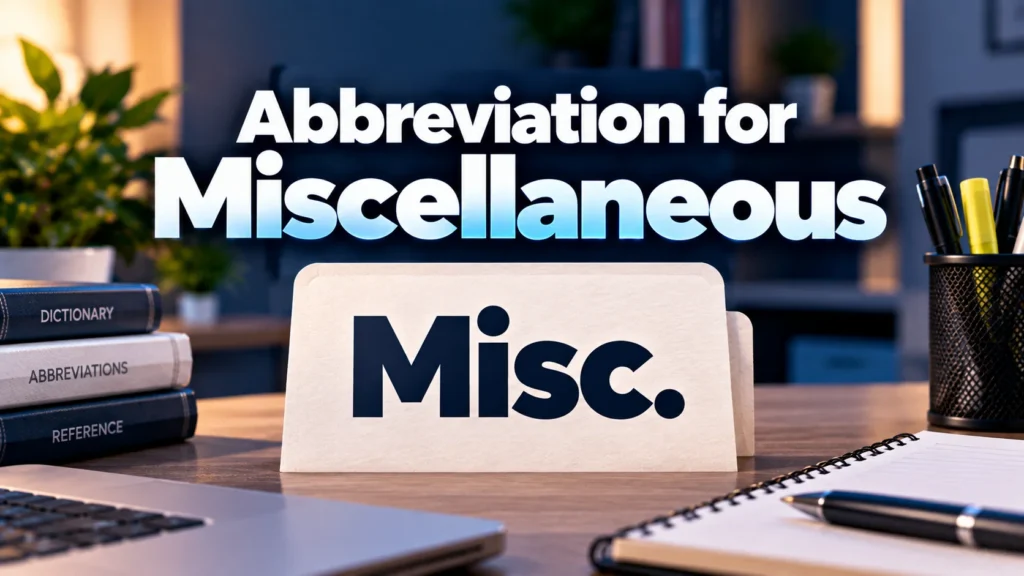
If you need to shorten the word miscellaneous, the most widely recognized abbreviation is:
misc.
Cambridge Dictionary defines misc. as the written abbreviation for miscellaneous, and Collins gives the same abbreviation in both British and American English. Merriam-Webster also lists misc as an abbreviation meaning miscellaneous.
You may encounter examples such as:
“Misc. expenses”
“Misc. documents”
“Misc. supplies”
The meaning is simply various, mixed, or not belonging to one specific category.
However, modern writing creates one small complication: you will also see misc without a period.
That version is especially common in folder names, spreadsheets, database fields, navigation menus, file labels, and other digital environments where punctuation is often removed for simplicity.
Both forms can therefore appear naturally. The best choice depends on your style guide, audience, and where the abbreviation is being used.
Abbreviation for Miscellaneous – Quick Meaning
The standard dictionary abbreviation for miscellaneous is:
Misc. = Miscellaneous
Lowercase is equally possible:
misc. = miscellaneous
Cambridge gives misc. as the written abbreviation, while Merriam-Webster lists misc without requiring the period.
In practical use:
- misc. expenses = miscellaneous expenses
- misc. items = miscellaneous items
- misc. files = miscellaneous files
- misc. charges = miscellaneous charges
- misc. notes = miscellaneous notes
- misc. supplies = miscellaneous supplies
The full word miscellaneous describes a mixture of things that are different or not necessarily related to one another. Cambridge gives examples involving miscellaneous items and expenses, while Merriam-Webster defines the word in terms of diverse or varied things.
Should Misc. Be Capitalized?
Usually, capitalization follows normal sentence rules.
Write:
Misc. Expenses
if it is a heading or category title.
Write:
misc. expenses
inside an ordinary sentence when capitalization is unnecessary.
A style guide from the Australian Government specifically advises using the same capitalization as the full word and gives misc for miscellaneous as its example.
Origin and Background of Misc. as an Abbreviation
The abbreviation is easy to understand once you look at the full word.
Miscellaneous is relatively long, so writers naturally shorten it to its opening letters:
miscellaneous → misc.
This follows a familiar abbreviation pattern.
For example:
department → dept.
approximately → approx.
telephone → tel.
miscellaneous → misc.
Merriam-Webster traces the English word miscellaneous to usage dating from the seventeenth century and defines it as involving diverse or mixed things.
The abbreviation became useful anywhere people needed compact labels.
Think of:
- Accounting ledgers
- Inventories
- Office filing systems
- Classified advertisements
- Business forms
- Catalogues
- Notes
- Tables
If an expense did not belong under rent, transport, wages, or equipment, it could simply appear under:
Misc.
How Digital Culture Changed the Spelling
Computer interfaces made misc without punctuation increasingly natural.
A folder called:
Misc
looks cleaner than:
Misc.
Likewise, programmers, database administrators, spreadsheet users, and website designers often avoid punctuation in labels.
This does not necessarily mean one version is “wrong.”
It reflects the difference between traditional abbreviation punctuation and modern interface style.
Interestingly, the Australian Government Style Manual explicitly recommends abbreviations such as misc without a full stop, showing that even formal style systems do not universally require the period.
Real-Life Conversations About “Misc.”
Although misc. is not internet slang, people regularly encounter it in work files, school documents, bills, shopping lists, and digital folders.
WhatsApp Conversation
Person A: I’m organizing the event budget. Where should I put decorations and random small purchases?
Person B: Just make a “Misc. Expenses” section.
Person A: Misc. means miscellaneous, right?
Person B: Exactly. Anything that doesn’t fit the main categories.
Here, the abbreviation saves space in a budget.
Instagram DM
Person A: Why is your story highlight called “misc” 😭
Person B: Because none of those photos belong together.
and,
Person A: So basically random stuff?
Person B: Exactly 😂
Here, misc means miscellaneous or assorted content.
TikTok Comments
Creator: Cleaning my “MISC” drawer today.
Commenter A: What does misc mean?
Commenter B: Miscellaneous. Basically the drawer where everything without a category goes 💀
Creator: Literally accurate.
This illustrates how the abbreviation has moved naturally into everyday digital labels.
Text Message
Person A: The invoice has a $35 “misc. charge.” Do you know what that is?
Person B: It means miscellaneous charge, but I’d ask what specifically they included.
Person A: Yeah, I want a breakdown before paying.
That final example highlights an important point: miscellaneous can be useful for organizing information, but sometimes it is too vague.
Emotional and Psychological Meaning of “Miscellaneous”
An abbreviation such as misc. does not have an emotional meaning in the way internet slang does.
Still, the concept of miscellaneous reveals something interesting about how people organize information.
Humans naturally create categories.
Receipts become:
Food
Transport
Housing
Entertainment
But real life does not always fit neatly into four boxes.
Eventually, we create:
Miscellaneous
Psychologically, it functions as a kind of catch-all category.
It means:
“This belongs here, but nowhere more specific.”
Consider a desk drawer containing spare batteries, an old key, tape, a cable, three coins, and a screwdriver.
Calling it a “misc. drawer” feels natural because creating six separate categories would be unnecessary.
The same logic works digitally.
Someone organizing hundreds of computer files may have carefully labeled folders for work, family, finances, and photographs—and then one folder simply called:
“Misc.”
That folder often becomes the home of everything that does not fit elsewhere.
The abbreviation therefore represents something familiar in human behavior: our desire for organization meeting the unavoidable messiness of real life.
Usage in Different Contexts
Business and Accounting
One of the most familiar uses is:
misc. expenses
Cambridge’s Business English entry specifically gives misc. as the abbreviation for miscellaneous and discusses uses such as miscellaneous expenses, charges, and costs.
Examples include:
“Misc. office expenses”
and,
“Misc. travel costs”
moreover,
“Misc. administrative charges”
However, businesses should avoid hiding substantial expenses inside vague miscellaneous categories.
Files and Folders
You may see:
Misc
as a folder containing files that do not belong anywhere else.
In digital environments, the version without a period often looks more natural:
Documents
Photos
Invoices
Misc
Spreadsheets
A spreadsheet might contain:
| Category | Amount |
|---|---|
| Rent | $800 |
| Transport | $120 |
| Supplies | $75 |
| Misc. | $40 |
Here, Misc. provides a compact category name.
School and University
Students may create:
“Misc. Notes”
for material that does not belong to one particular chapter.
Teachers might also label additional handouts:
“Misc. Resources.”
Social Media
Although less common, creators sometimes label mixed content:
“misc pics”
and,
“misc thoughts”
moreover,
“misc dump”
In these cases, misc essentially means “assorted” or “random.”
Professional Writing
The abbreviation can save space in:
- Tables
- Charts
- Forms
- Ledgers
- Column headings
- Lists
In ordinary formal prose, however, writing miscellaneous in full usually looks more polished.
When NOT to Use Misc. or Misc
Abbreviations work best when they improve clarity.
Do not shorten miscellaneous merely because you can.
Avoid It in Formal Prose When Space Is Not Limited
Instead of:
“The report identified misc. administrative problems.”
write:
“The report identified miscellaneous administrative problems.”
The complete word reads more naturally.
Avoid Vague Accounting Categories
Imagine a business report showing:
Misc. expenses: $75,000
That raises obvious questions.
What exactly were those expenses?
A miscellaneous category may be acceptable for small, genuinely unrelated costs, but important financial information deserves specific labels.
Avoid Misc. When a Better Category Exists
If a folder contains only employee contracts, do not call it:
“Misc.”
Call it:
“Employee Contracts.”
Good organization depends on descriptive categories.
Avoid Assuming Every “MISC” Is the Same
Uppercase MISC may occasionally be an acronym or organization-specific code rather than simply the abbreviation for miscellaneous.
Context still matters.
Common Misunderstandings About Misc.
“Misc.” and “misc” mean different things
Usually, no.
Both can abbreviate miscellaneous.
The difference is mainly punctuation and style.
“Misc. is the only correct spelling”
Not universally.
Cambridge and Collins prominently show misc. with a period, while Merriam-Webster lists misc, and the Australian Government Style Manual specifically uses misc without a full stop.
Your required style guide should decide the final form.
“Miscellaneous means unimportant”
Not necessarily.
Miscellaneous means varied or consisting of different kinds of things.
Something can be important and still be classified as miscellaneous.
“Misc. means random”
Sometimes that is a useful casual interpretation, but it is not exact.
“Random” suggests lack of a particular pattern or selection method.
“Miscellaneous” primarily suggests different types grouped together.
“Misc. expenses means unnecessary expenses”
No.
They are simply expenses that do not fit the main named categories.
Whether they are necessary is a separate question.
Misc. Compared With Similar Abbreviations and Terms
| Term | Meaning | Best Use |
|---|---|---|
| misc. | Miscellaneous | Traditional abbreviation |
| misc | Miscellaneous | Digital/modern style |
| var. | Various | Certain shortened contexts |
| assorted | Mixed types | General description |
| other | Remaining category | Forms and menus |
| general | Broad/non-specific | Folder or department labels |
| mixed | Containing different types | Everyday description |
| various | Several different kinds | Formal prose |
| etc. | And other similar things | End of a list |
| N/A | Not applicable/available | Forms and tables |
Key Insight
Misc. does not mean “etc.” Miscellaneous describes a group containing different types of items, while etc. means “and other similar things” at the end of a list. They perform different jobs in a sentence.
10 Variations and Common Forms of Miscellaneous
1. Misc.
Meaning: Miscellaneous.
This is the conventional dictionary-style abbreviation.
2. misc.
Meaning: Miscellaneous in lowercase.
Useful inside sentences and lowercase labels.
3. Misc
Meaning: Miscellaneous.
Common in modern headings, folders, categories, and style systems that omit abbreviation periods.
4. misc
Meaning: Lowercase abbreviation without punctuation.
Often seen in filenames, coding contexts, or informal digital labels.
5. MISC
Meaning: Often miscellaneous when used as a category label.
Capitalization may simply reflect interface design.
6. Misc. Expenses
Meaning: Expenses that do not fit established categories.
Frequently used in accounting and budgeting.
7. Misc. Items
Meaning: Various different items grouped together.
Common in inventories and storage lists.
8. Misc. Files
Meaning: Files without a more specific folder category.
Useful for temporary organization.
9. Misc. Notes
Meaning: Notes covering different or uncategorized subjects.
Common among students and researchers.
10. Misc. Charges
Meaning: Various charges grouped under one heading.
When money is involved, requesting details may be sensible if the amount is unclear.
How to Respond When Someone Uses “Misc.”
Because misc. is a practical abbreviation rather than slang, responses are usually straightforward.
Casual Replies
Them: “Put it in misc.”
You could answer:
- “Got it.”
- “Okay.”
- “Will do.”
- “Makes sense.”
Funny Replies
If someone has a chaotic miscellaneous folder:
- “Ah yes, the folder where organization goes to die 😭”
- “Misc: home of everything we refuse to categorize.”
- “The legendary junk drawer of the computer.”
Mature Replies
When clarity matters:
- “Could we create a more specific category for these items?”
- “What costs are included under miscellaneous expenses?”
- “I’ll place it under Misc. unless you prefer another category.”
Respectful Professional Replies
If an invoice includes “misc. charges,” you might write:
“Could you please provide a breakdown of the items included under miscellaneous charges?”
That is clearer and more professional than assuming what the category contains.
Regional, Cultural and Generational Usage
American English
American dictionaries recognize misc and misc. as abbreviations for miscellaneous.
Merriam-Webster lists misc, while Collins’ American English entry shows both misc and misc. in its treatment of the abbreviation.
British English
Cambridge and Collins show misc. as a standard written abbreviation.
In practice, punctuation conventions depend heavily on house style.
Australian English
The Australian Government Style Manual takes a notably modern approach and gives:
misc
without a full stop.
Its broader guidance recommends avoiding full stops in many shortened forms.
Asian and Middle Eastern English
Because English is widely used in business, accounting, education, software, and administration, misc. and misc are easily understood internationally.
Users may encounter the term on invoices, spreadsheets, university notes, ecommerce systems, or computer folders even when English is not their first language.
Gen Z vs Millennials
There is no meaningful generational difference in the definition.
The main difference is where the abbreviation appears.
Older office systems may favor:
“Misc.”
Modern apps and folders often favor:
“misc”
Younger digital users may therefore see the punctuation-free form more often, but both generations understand essentially the same word.
Is Misc. Safe for Kids? Plus FAQs
Yes. Misc. is completely safe and neutral.
It contains no profanity, adult meaning, or hidden slang implication when used as the abbreviation for miscellaneous.
For students, the useful lesson is understanding both the meaning and appropriate punctuation.
What is the abbreviation for miscellaneous?
The standard abbreviation is misc. Cambridge and Collins both list misc. as an abbreviation for miscellaneous. Merriam-Webster also recognizes misc without the period.
Is it misc or misc.?
Both forms are used.
Misc. is a conventional dictionary form, while misc is also recognized and is especially common in digital labels and style systems that omit periods in abbreviations.
What does misc. mean?
Misc. means miscellaneous, describing different, assorted, or mixed things grouped together.
For example, “misc. supplies” means various supplies that may not belong to one specific category.
Should misc have a period?
It depends on the style guide.
Cambridge writes misc., but the Australian Government Style Manual specifically recommends misc without a full stop.
What does misc. mean on a bill?
It usually means miscellaneous charges or expenses—costs grouped together because they do not fit another listed category.
If the amount is significant, you can request an itemized explanation.
What does misc mean in a folder?
A folder named Misc normally contains miscellaneous files: different items that do not fit the other available folders.
Is “miscellaneous” the same as “various”?
They are similar.
Both can describe different kinds of things, but miscellaneous often carries the additional idea that those different items have been collected or grouped together.
Conclusion: The Best Abbreviation for Miscellaneous
The most familiar abbreviation for miscellaneous is “misc.”
Cambridge Dictionary and Collins both present misc. as the written abbreviation, making it a safe choice for general English writing.
However, misc without a period is also valid in many contexts.
Merriam-Webster recognizes misc as an abbreviation, and modern style guidance such as the Australian Government Style Manual specifically uses the punctuation-free form.
The practical rule is simple:
Use misc. when you want a conventional written abbreviation.
Use misc when your style guide prefers no periods or when you are creating a clean digital label such as a folder, spreadsheet category, menu item, or filename.
In ordinary formal prose, spelling out miscellaneous is often the clearest option.
And remember what the word actually communicates: miscellaneous does not mean worthless, unnecessary, or completely random. It describes different kinds of things grouped together because they do not fit neatly into one more specific category.
That is why “Misc.” appears everywhere from office budgets and receipts to computer folders and classroom notes.
Sometimes life simply refuses to fit into perfect categories—and that is exactly what the miscellaneous category is for.