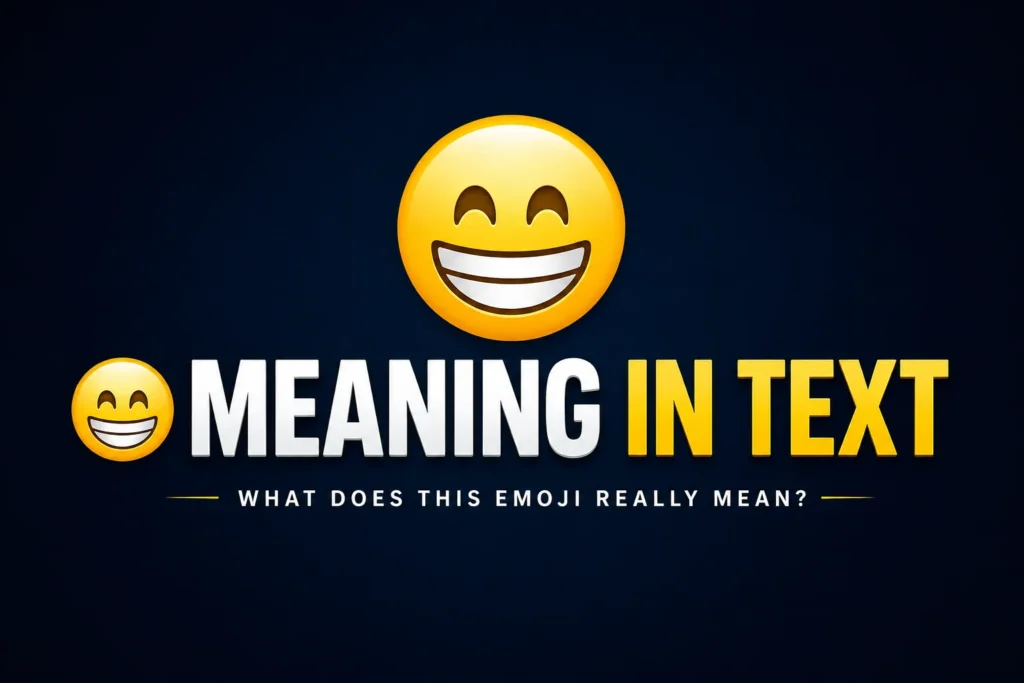
The 😁 emoji is called the Grinning Face With Smiling Eyes. In texting, it usually expresses happiness, excitement, friendliness, amusement, or enthusiastic positivity.
The emoji shows a wide toothy grin with smiling eyes, which makes it feel more energetic than a simple 🙂.
For example:
“I finally passed my exam 😁”
Here, 😁 shows genuine happiness and excitement.
Someone might also send:
“You actually did it 😁”
In this case, the emoji adds warmth and encouragement.
The exact meaning depends on the message, relationship, and conversation. In some situations, 😁 can also communicate awkwardness, nervous happiness, embarrassment, or playful excitement.
😁 Meaning in Text: Quick Answer
😁 usually means happiness, excitement, a big smile, or enthusiastic friendliness.
Common interpretations include:
- “I’m happy!”
- “That’s great!”
- “I’m excited!”
- “I’m really pleased.”
- “I’m joking around.”
- “I’m smiling about this.”
For example:
“We won! 😁” = excited happiness.
“Thanks for helping me 😁” = warm appreciation.
“Yeah… I totally forgot 😁” = potentially awkward or playful.
The surrounding words determine the emotional shade.
What Is the 😁 Emoji Called?
The official name of 😁 is Grinning Face With Smiling Eyes.
It belongs to the smiley and emotion category of emojis.
The emoji combines two obvious visual signals:
- A broad, toothy grin
- Smiling, narrowed eyes
That combination usually makes it feel energetic and openly positive.
😁 vs 😀 vs 😃
These emojis are similar, but their emotional flavor can differ.
😀 often feels like straightforward happiness.
😃 can feel cheerful and enthusiastic.
😁 usually feels more energetic, excited, or intensely happy.
Compare:
“Good morning 😀”
with:
“I got the tickets 😁”
The second message feels more excited.
The Emotional Meaning of 😁
Emojis work partly because they add emotional information that plain text cannot easily provide.
A message such as:
“I got it.”
is neutral.
Add 😁:
“I got it 😁”
and the message becomes warmer and more cheerful.
The sender appears pleased rather than simply acknowledging the information.
Happiness
“We finally finished the project 😁”
The emoji communicates genuine satisfaction.
Excitement
“Guess who’s coming tomorrow 😁”
The emoji suggests anticipation.
Friendly Appreciation
“Thanks a lot 😁”
It makes the gratitude feel warm and casual.
Playfulness
“I may have eaten the last slice 😁”
The emoji can signal that the sender is joking or being mischievous.
Awkwardness
“Yeah, I forgot to send it 😁”
Here, the smile can soften an embarrassing admission.
Why People Use 😁 in Text Messages
The emoji can make a message feel more emotionally expressive without requiring additional words.
Digital communication lacks many face-to-face signals.
When people talk in person, others can see their smile and hear their tone.
Texting removes those signals.
😁 helps replace some of that emotional information.
It can communicate:
“I’m saying this with a big smile.”
That makes it useful in casual conversations.
Read more : Wey Meaning in Text: What Does Wey Mean?
Real-Life Texting Conversations
WhatsApp Conversation
Person A:
“I passed my driving test!”
Person B:
“Let’s gooo 😁 Congratulations!”
Here, 😁 reinforces excitement and celebration.
Instagram DM
Person A:
“I finally bought those shoes.”
Person B:
“I knew you would 😁”
The emoji gives the response a friendly, teasing quality.
Text Message
Person A:
“Can you help me move this weekend?”
Person B:
“Sure 😁”
The emoji makes the acceptance feel enthusiastic and friendly.
TikTok Comment
Person A:
“This puppy knows exactly what he’s doing 😂”
Person B:
“Look at that face 😁”
Here, the emoji expresses cheerful amusement.
😁 Can Be Sarcastic?
Yes.
Although 😁 is primarily positive, emojis do not have one fixed emotional meaning.
Someone can use a big smile to make a message sound deliberately awkward, mischievous, or sarcastic.
For example:
“I definitely didn’t eat your fries 😁”
The sender may obviously be joking.
Another example:
“Sure, I’ll clean the whole house myself 😁”
Depending on the conversation, this could be playful sarcasm rather than genuine enthusiasm.
How Context Changes 😁
Compare:
“I got the job 😁”
with:
“You forgot again 😁”
The first is clearly happy.
The second could be teasing, passive-aggressive, or simply playful.
The emoji itself does not determine the complete meaning.
😁 in Different Contexts
Social Media
😁 is common in comments, captions, replies, and direct messages when someone wants to express cheerful energy.
Friendships
Friends may use it to show excitement, agreement, teasing, or appreciation.
“You coming tonight? 😁”
This can make a simple question feel more enthusiastic.
Dating and Relationships
😁 can communicate warmth without being as romantic as ❤️ or 😘.
For example:
“Had a really good time with you 😁”
sounds affectionate and happy without being overly intense.
Gaming
Gamers may use 😁 after a successful move or victory.
“Easy win 😁”
The emoji can make the message feel playful or confident.
Professional Communication
😁 can work in relaxed workplace chats, especially among familiar colleagues.
It is usually less suitable for formal emails, serious announcements, or sensitive workplace situations.
When 😁 Can Feel Awkward
The meaning of an emoji depends heavily on the message around it.
A cheerful grin may feel strange after bad news.
For example:
“I’m sorry about your loss 😁”
would usually be inappropriate because the emoji conflicts with the emotional situation.
Similarly:
“Your application was rejected 😁”
could sound insensitive or sarcastic.
Emoji Tone Mismatch
This happens when the emoji communicates an emotion that conflicts with the words.
The result can be confusing.
A smile can soften a casual mistake, but it should not automatically be used to soften serious or painful information.
Common Misunderstandings About 😁
Does 😁 Mean Laughing?
Not exactly.
😁 usually represents a big grin or enthusiastic happiness.
For laughter, people often use 😂 or 🤣.
Is 😁 a Flirty Emoji?
It can be, but it is not inherently romantic.
Context matters.
“You look great 😁”
may be friendly or slightly flirty depending on the relationship.
Does 😁 Mean Sarcasm?
Not by itself.
It can be used sarcastically, but the surrounding message needs to provide that interpretation.
Is 😁 the Same as 😀?
They are close, but 😁 generally has a stronger, wider-grin feeling.
Can 😁 Mean Nervousness?
Sometimes.
A person may use a smiling emoji to soften an awkward or uncomfortable statement.
For example:
“I completely forgot about the meeting 😁”
The sender may be trying to make the mistake feel less serious.
😁 vs Similar Smile Emojis
| Emoji | Common meaning | Typical feeling |
|---|---|---|
| 😁 | Big grin, excitement | Energetic happiness |
| 😀 | Happy smile | Simple positivity |
| 😃 | Cheerful happiness | Friendly enthusiasm |
| 😄 | Joy and amusement | Warm happiness |
| 😆 | Laughing hard | Strong amusement |
| 😂 | Laughing intensely | Humor |
| 🙂 | Gentle smile | Calm or neutral |
| 😊 | Warm, pleased smile | Sweetness or affection |
| 😅 | Nervous or relieved smile | Awkwardness/relief |
Key Insight
😁 is generally a stronger and more energetic smile than 🙂 or 😀. It often tells the reader that the sender is genuinely pleased, excited, or playfully enthusiastic.
Common Variations of 😁
1. 😁 Alone
A simple expression of happiness or excitement.
2. 😁😁
Repeating it increases the enthusiasm.
3. “Thanks 😁”
Usually friendly appreciation.
4. “Okay 😁”
Can sound cheerful, playful, or occasionally sarcastic.
5. “Really? 😁”
May show excitement or playful curiosity.
6. “I knew it 😁”
Often expresses satisfaction or teasing confidence.
7. “Let’s go 😁”
Strong excitement or encouragement.
8. “Oops 😁”
Can make a small mistake sound playful.
9. “My bad 😁”
Usually softens an informal apology.
10. “You already know 😁”
Can suggest friendly confidence or shared understanding.
How to Respond When Someone Sends 😁
You usually do not need to explain the emoji. Simply respond naturally to the message.
Casual Replies
- “Haha 😁”
- “Exactly!”
- “Same 😂”
- “Let’s go!”
Funny Replies
- “Why are you smiling like that? 😂”
- “I know that grin 😭.”
- “What are you planning? 😁”
Friendly Replies
- “Glad you’re happy!”
- “That makes me smile too 😁.”
- “Awesome!”
Respectful Replies
If the emoji appears in a serious conversation, focus on the words rather than assuming the smile represents the whole tone.
If you’re unsure, you can simply ask:
“You mean that in a good way?”
Regional and Cultural Usage
Western Culture
😁 is widely understood as a cheerful, energetic smile in American, British, Canadian, and Australian online communication.
Asian Online Communities
The emoji is frequently used in messaging, gaming, social media, and casual English conversations.
Middle Eastern Online Communities
😁 is commonly understood as a positive and friendly expression in English-language digital communication.
Global Internet Culture
Because emojis are visual symbols, 😁 has become broadly recognizable across language barriers.
However, individual users may attach slightly different emotional meanings to it.
Gen Z vs Millennials
Both generations use 😁, although younger users may combine it with other emojis, memes, abbreviations, and exaggerated punctuation.
For example:
“WE DID IT 😁😭🔥”
The combination creates a more dramatic emotional reaction than 😁 alone.
Is 😁 Safe for Kids?
Yes. 😁 is a normal, non-explicit emoji that generally represents happiness or a big smile.
Children may use it in family chats, school-related conversations, games, and social media.
As with all emojis, context matters. A child may use 😁 playfully or sarcastically, so the surrounding message should be considered.
Frequently Asked Questions
What does 😁 mean in text?
😁 usually means a big smile, happiness, excitement, friendliness, or enthusiastic positivity.
What is the 😁 emoji called?
Its official name is Grinning Face With Smiling Eyes.
Is 😁 a happy emoji?
Yes. 😁 is primarily a happy and enthusiastic emoji, although it can sometimes be used playfully or sarcastically.
What does 😁 mean from a girl?
There is no universal meaning based on gender. A girl using 😁 may simply be expressing happiness, friendliness, excitement, amusement, or playful energy.
What does 😁 mean from a guy?
Likewise, a guy using 😁 usually means he is happy, excited, amused, or being friendly. The conversation determines the exact tone.
Is 😁 flirty?
It can be used in a flirty conversation, but 😁 is not inherently a flirting emoji. Emojis such as 😉 or 😘 are more commonly associated with flirting.
What is the difference between 😁 and 😂?
😁 usually represents a big grin or enthusiastic happiness, while 😂 represents laughing very hard or finding something extremely funny.
Final Thoughts on 😁 Meaning in Text
The 😁 meaning in text is usually positive.
It communicates a big grin, happiness, excitement, friendliness, or playful enthusiasm.
The emoji can make an ordinary sentence feel warmer:
“Thanks 😁”
It can make good news feel more energetic:
“I got the job 😁.”
It can even soften a small mistake:
“Oops, my bad 😁.”
Still, context matters.
A smiling emoji does not automatically make every message friendly. In some conversations, 😁 can be teasing, awkward, or sarcastic.
The safest approach is to read the emoji together with the words around it. Most of the time, though, when someone sends 😁, they are simply showing you a big, cheerful smile.