A friend sends “You looked good today 🌚,” and suddenly the message feels more suggestive than an ordinary compliment. The words seem innocent, but that dark moon face adds a hidden layer.
The 🌚 emoji commonly expresses mischief, flirtation, sarcasm, awkward humor, side-eye, or an unspoken double meaning. It can make a normal sentence feel suspiciously playful.
Its meaning is rarely fixed. The relationship between the people, the words before it, and the emotional mood of the conversation all influence how it should be understood.
Someone may use 🌚 after telling a cheeky joke. Another person may send it to suggest that they know a secret. In a romantic chat, it can turn a friendly comment into a subtle invitation to flirt.
This guide explains the most common meanings of 🌚, realistic conversation examples, cultural differences, situations where it may cause confusion, and natural ways to respond.
🌚 Emoji Meaning in Text – Quick Explanation
The 🌚 emoji usually communicates a mischievous, ironic, suspicious, or flirtatious mood. Its sideways-looking face can make the sender appear as if they are hiding a thought or waiting for you to understand an unspoken message.
Common interpretations include:
- “You know what I mean.”
- “I have a mischievous idea.”
- “That sounded more suggestive than intended.”
- “I noticed something suspicious.”
- “I am joking—but not completely.”
- “There is another meaning behind this.”
- “I am giving you side-eye.”
- “This situation is awkwardly funny.”
- “Let us pretend I did not say that.”
- “I may be flirting with you.”
Examples include:
“So, are you going to invite me over or what? 🌚”
“You said you were going to sleep three hours ago 🌚”
“I know why you liked that picture 🌚”
The same emoji can also represent the moon, nighttime, astronomy, or a dark aesthetic. Literal use is more likely when it appears with stars, space, sleep, or evening-related words.
Context decides whether 🌚 is a moon, a joke, a flirtatious hint, or a quiet accusation.
Origin and Background of the 🌚 Emoji
The official name of 🌚 is New Moon Face. Unicode lists it as code point U+1F31A, placing it among the moon and space emojis. Unicode Emoji List
It was approved in Unicode 6.0 in 2010 under the original name “New Moon with Face” and later included in Emoji 1.0 in 2015. Emojipedia
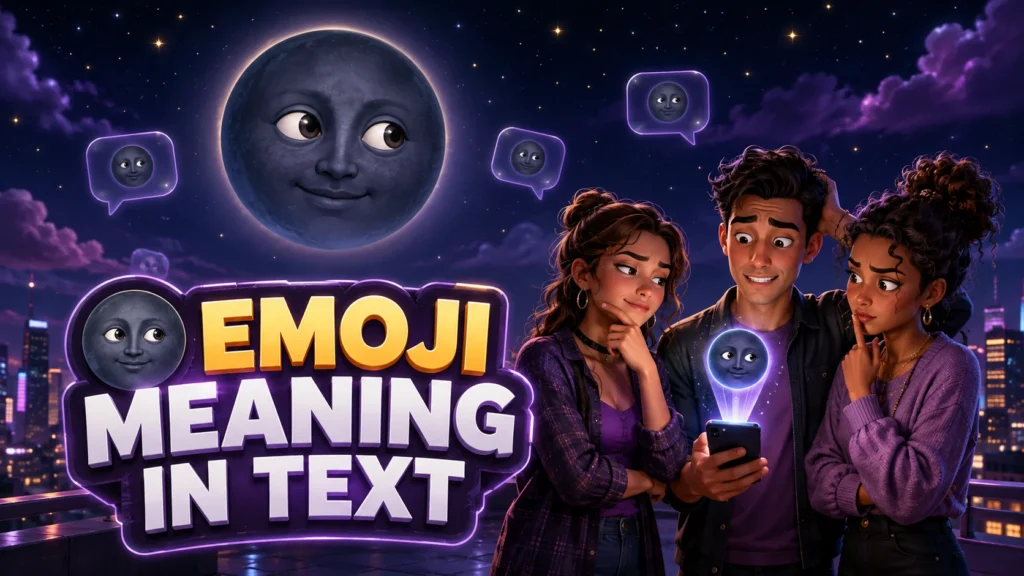
Its basic design shows a dark moon with human facial features and a slight smile. The expression looks unusual enough to feel mysterious, amused, or mildly unsettling.
Different platforms have displayed its face differently. Some versions appear to look sideways, while others face forward. These visual changes can affect whether people interpret it as suspicious, flirtatious, creepy, or simply playful.
Internet users gradually gave the emoji meanings beyond astronomy. Its shadowy face became useful for moments when a message contained an implication that felt too awkward or bold to express directly.
Memes, reaction posts, TikTok comments, and private messages helped strengthen its ironic personality. It now functions almost like a quiet facial reaction added after a sentence.
The meaning evolved because people recognized the same emotional expression in the design: a person who knows something, says very little, and waits for everyone else to notice.
Real-Life Conversations Using 🌚
WhatsApp Conversation
Amina: You replied to his message very quickly.
Sara: I was already using my phone.
Amina: Of course you were 🌚
Sara: Stop. It is not like that.
Amina uses 🌚 to show that she does not completely believe Sara’s explanation. The tone is teasing rather than seriously accusatory.
Instagram DMs
Adam: That new profile picture looks amazing.
Mia: Thank you!
Adam: I might have looked at it more than once 🌚
Mia: More than once?
Adam: Maybe a few times.
Here, the emoji turns an ordinary compliment into a flirtatious confession. Adam is testing whether Mia welcomes the attention.
TikTok Comments
Commenter A: He said they are “just friends.”
and,
Commenter B: Just friends who post each other every day 🌚
moreover,
Commenter C: We all know where this is going.
The emoji suggests doubt and invites readers to notice a possible romantic connection.
Text Messages
Daniel: I heard what you said at the party.
Leo: Which part?
Daniel: The part about wanting to call your ex 🌚
Leo: That was supposed to stay private.
In this exchange, 🌚 communicates “I know your secret.” The tone could feel playful or uncomfortable depending on the friendship.
These examples show why the emoji cannot be translated into one sentence. It adds attitude rather than a complete standalone meaning.
Emotional and Psychological Meaning
The 🌚 emoji allows people to communicate indirectly. Instead of openly stating a suspicion, romantic interest, or inappropriate joke, the sender leaves space for the receiver to interpret it.
This indirectness offers emotional protection. If the other person responds positively, the sender can continue. If the reaction is uncomfortable, the sender may pretend the emoji was only a joke.
That uncertainty makes 🌚 useful for flirting. It creates tension without requiring someone to say exactly what they want.
The emoji can also express social awareness. When a friend tells an obviously incomplete story, 🌚 signals, “I noticed what you left out.”
Its dark, smiling face produces a strange combination of friendliness and suspicion. The smile prevents it from feeling completely hostile, while the shadow creates an atmosphere of secrecy.
I once saw someone text, “You and Ali seemed very comfortable together 🌚” after a group dinner. The recipient laughed because the message identified a romantic connection she had not admitted yet.
The emoji worked because both people understood the tone. Sent by a stranger, the same message could have felt intrusive.
Read More : Blud Meaning in Text:Friendly Slang or insult? & how to use it
Using 🌚 in Different Contexts
Social Media
On TikTok, Instagram, Snapchat, and X, 🌚 often appears after a suspicious observation, suggestive joke, or sarcastic comment.
Example: “He watched every story but still says he is not interested 🌚”
The emoji invites other users to notice the contradiction without explaining it directly.
Friends and Group Chats
Friends use 🌚 to tease one another about crushes, secrets, embarrassing mistakes, or suspicious excuses.
Example: “You only joined because she was playing 🌚”
Close relationships usually make the tone easier to interpret. Teasing can still become uncomfortable if it exposes private information.
Dating and Relationships
In romantic conversations, 🌚 frequently signals flirtation, attraction, curiosity, or a double meaning.
Example: “Maybe you should come and tell me in person 🌚”
It can be a low-pressure way to test romantic interest. The sender should respect the other person’s response instead of treating the emoji as automatic consent to continue.
Work and Professional Settings
The emoji is risky in professional communication because its meaning can appear suggestive, sarcastic, or passive-aggressive.
A message such as “Nice presentation 🌚” may look as if the sender is secretly criticizing the work. Use a clear smile or complete sentence instead.
Casual Versus Serious Tone
🌚 works best in relaxed conversations where both people understand one another’s humor.
Avoid it in medical, legal, financial, disciplinary, or emotionally sensitive messages. Ambiguity can create unnecessary stress when clarity is needed.
When Not to Use 🌚 and Common Misunderstandings
Do not use 🌚 when the recipient may interpret teasing as criticism, flirting, or disrespect. This is especially important with new acquaintances and professional contacts.
Avoid sending it after someone shares grief, anxiety, rejection, illness, or another vulnerable experience. Its smirking appearance can make a sincere response feel insensitive.
Do not use the emoji to pressure someone romantically. If a person ignores the flirtatious tone or changes the subject, respect that boundary.
Cultural sensitivity matters as well. Not every community interprets 🌚 as playful. Some people see only a strange moon, while others consider the face creepy or suspicious.
A common misunderstanding is that 🌚 always means something sexual. It can be suggestive, but it also expresses sarcasm, secrets, side-eye, irony, or ordinary nighttime imagery.
It does not automatically mean the sender is angry. The face usually communicates quiet amusement more than open hostility.
People also confuse 🌚 with 🌑. The 🌑 emoji is a plain new moon without a face and is more likely to represent darkness, astronomy, space, or night. 🌚 adds a human expression, which creates emotional subtext.
Another mistake is reading 🌚 alone without considering the words around it. “Goodnight 🌚” may simply create a nighttime mood, while “Come say goodnight properly 🌚” sounds much more flirtatious.
The sender’s personality matters. Someone who uses playful emojis constantly may intend less than a person who rarely sends them.
🌚 Compared With Similar Emojis
| Emoji | Common Meaning | Typical Tone | Example |
|---|---|---|---|
| 🌚 | Mischief, shade, or hidden meaning | Ironic and suggestive | “I saw you two together 🌚” |
| 😏 | Smirking confidence or flirtation | More openly suggestive | “You missed me 😏” |
| 👀 | Curiosity, attention, or suspicion | Observant and interested | “What happened here? 👀” |
| 🙃 | Awkwardness or quiet frustration | Ironic and uncomfortable | “Another meeting at 7 a.m. 🙃” |
| 🤨 | Doubt or disbelief | Questioning and skeptical | “That is your excuse? 🤨” |
| 😳 | Embarrassment or surprise | Shy and exposed | “You noticed? 😳” |
| 🌑 | New moon or darkness | Literal and atmospheric | “No moonlight tonight 🌑” |
| 🌝 | Bright moon face or goofy happiness | Cheerful and odd | “Everything is fine 🌝” |
| 🙂 | Polite smile or restrained emotion | Friendly or tense | “Okay, understood 🙂” |
| 😂 | Obvious laughter | Openly humorous | “You really said that 😂” |
Key Insight
🌚 is less direct than 😏 and more emotionally loaded than 🌑. It works best when the sender wants to suggest mischief, suspicion, or flirtation without explaining the hidden thought.
Variations and Types of 🌚 Usage
Flirty 🌚
Meaning: “I am interested, and I want you to notice.”
The emoji adds romantic tension to a compliment or invitation.
Example: “You could always sit next to me 🌚”
Mischievous 🌚
Meaning: “I have a cheeky idea.”
It suggests playful trouble without openly describing the plan.
Example: “We could leave the party early 🌚”
Sarcastic 🌚
Meaning: “I do not fully believe that.”
The face quietly questions someone’s statement or excuse.
Example: “You accidentally liked all her pictures 🌚”
Side-Eye 🌚
Meaning: “I noticed something suspicious.”
It acts like a silent glance between people who understand the situation.
Example: “He suddenly changed the subject 🌚”
Secret-Knowing 🌚
Meaning: “I know what you are hiding.”
Friends use it when referencing information the other person has not admitted.
Example: “Should I mention who called you last night? 🌚”
Suggestive 🌚
Meaning: “This sentence has a second meaning.”
The emoji turns an innocent-looking comment into a possible innuendo.
Example: “Maybe I can keep you company 🌚”
Awkward-Humor 🌚
Meaning: “That was uncomfortable, but also funny.”
It softens a socially awkward moment through irony.
Example: “We both arrived wearing the same outfit 🌚”
Shady 🌚
Meaning: “That behavior deserves quiet criticism.”
The sender expresses disapproval without making a direct accusation.
Example: “She forgot to mention that part 🌚”
Dark-Humor 🌚
Meaning: “The joke is slightly uncomfortable or morally questionable.”
It signals awareness that the humor has an unusual edge.
Example: “Well, that plan ended perfectly 🌚”
Dark humor should never target someone’s genuine pain.
Literal Moon 🌚
Meaning: Nighttime, the moon, darkness, or space.
The emoji carries little hidden meaning when used with clear astronomical or bedtime context.
Example: “The sky looks beautiful tonight 🌚✨”
How to Respond When Someone Sends 🌚
Casual Replies
- “What are you suggesting?”
- “I know that look.”
- “Why the suspicious moon?”
- “Go ahead—say what you mean.”
Funny Replies
- “That moon knows too much.”
- “Do not bring 🌚 into this.”
- “The evidence is purely circumstantial.”
- “I refuse to answer without my lawyer.”
Flirty Replies
- “Maybe you understood correctly 😏”
- “Is that your way of flirting?”
- “You could ask me directly.”
- “Interesting suggestion 🌚”
Use a flirty response only when you feel comfortable with the conversation.
Mature Replies
- “I am not sure what you mean.”
- “Could you say that more clearly?”
- “I would rather not joke about that.”
- “Let us keep the conversation respectful.”
A direct question is appropriate when the emoji creates uncertainty. You do not have to follow a flirtatious or suggestive tone that makes you uncomfortable.
Regional and Cultural Usage
Western Digital Culture
In English-language social media, 🌚 commonly expresses shade, innuendo, irony, suspicion, or playful flirtation.
Its dark face is often treated like someone quietly watching a situation unfold.
Asian Digital Culture
The emoji appears in multilingual chats, fandom discussions, memes, and romantic teasing. Some users treat it as a general awkward or mischievous reaction.
Interpretations can vary widely between countries, languages, and social circles.
Middle Eastern Culture
In Arabic-English and other mixed-language conversations, 🌚 can add cheeky humor, romantic implication, or friendly suspicion.
Conservative social settings may interpret suggestive usage more seriously, so the relationship and audience deserve careful attention.
South Asian Culture
In Urdu-English, Hindi-English, Bengali-English, and other multilingual chats, 🌚 often appears after teasing comments about crushes, secret plans, or suspicious behavior.
Close friends may understand it immediately, while older relatives may see only a moon with an unusual face.
Global Internet Usage
Memes and short-form videos have made the mischievous meaning recognizable across borders. The emoji still lacks one universal emotional definition.
A private friend group may develop its own meaning that differs from broader internet usage.
Generational Differences
Gen Z users often use 🌚 as an ironic reaction, flirtatious hint, or silent side-eye. Some Millennials may associate it more strongly with older “creepy moon” memes.
Older users are more likely to interpret it literally or feel uncertain about the facial expression. These are general patterns, not fixed rules.
Is the 🌚 Emoji Safe for Kids?
The 🌚 emoji itself is safe for children. Its official identity is simply a new moon with a face, and it contains no inherently offensive content.
Its online meaning can become flirtatious or suggestive, depending on the surrounding message. Children may use it innocently while older users interpret it differently.
Parents can explain that emojis change tone and should not be sent to strangers when the meaning is unclear.
A child-friendly meaning is: “A funny dark moon face used for nighttime, silliness, or playful secrets.”
Read More: Emoji Meaning in Text
Frequently Asked Questions
What does 🌚 mean in a text from a guy?
It may indicate flirting, mischief, sarcasm, or a hidden implication. Read the sentence and consider whether the relationship already includes romantic teasing.
What does 🌚 mean from a girl?
The meaning is not determined by gender. It can express attraction, suspicion, playful shade, awkward humor, or an unspoken thought.
Is 🌚 a flirting emoji?
Yes, it can be. It often adds a subtle double meaning to a compliment, invitation, or personal comment, but flirting is not its only use.
Does 🌚 have a dirty meaning?
It may make a sentence sound suggestive, but it is not automatically sexual. It also represents sarcasm, mischief, side-eye, secrecy, or nighttime.
What is the difference between 🌚 and 😏?
🌚 feels mysterious, ironic, or quietly suspicious. 😏 usually communicates more direct confidence, smugness, or flirtation.
Why does 🌚 look creepy?
The dark face, slight smile, and sideways-looking eyes on some platforms create an unusual expression. This makes the emoji feel watchful or secretive.
What should I reply to 🌚?
Ask, “What do you mean?” if you are uncertain. You can tease back, respond flirtatiously, or set a clear boundary depending on your comfort level.
Conclusion
The 🌚 emoji usually adds mischief, flirtation, sarcasm, shade, awkward humor, or a hidden meaning to a text. It communicates the feeling that the sender knows—or is suggesting—more than they are saying directly.
Context remains essential. “Beautiful night 🌚” may be literal, while “You can come over tonight 🌚” carries a noticeably different emotional tone.
Use it with people who understand your humor, and avoid it when the conversation requires sensitivity or professional clarity.
The mysterious moon works because it leaves something unsaid. When the relationship and timing are right, 🌚 can turn an ordinary sentence into a playful moment that both people instantly understand.